Turing's "Child Machine": Ability Comes from Experience, Not a One-Time Build
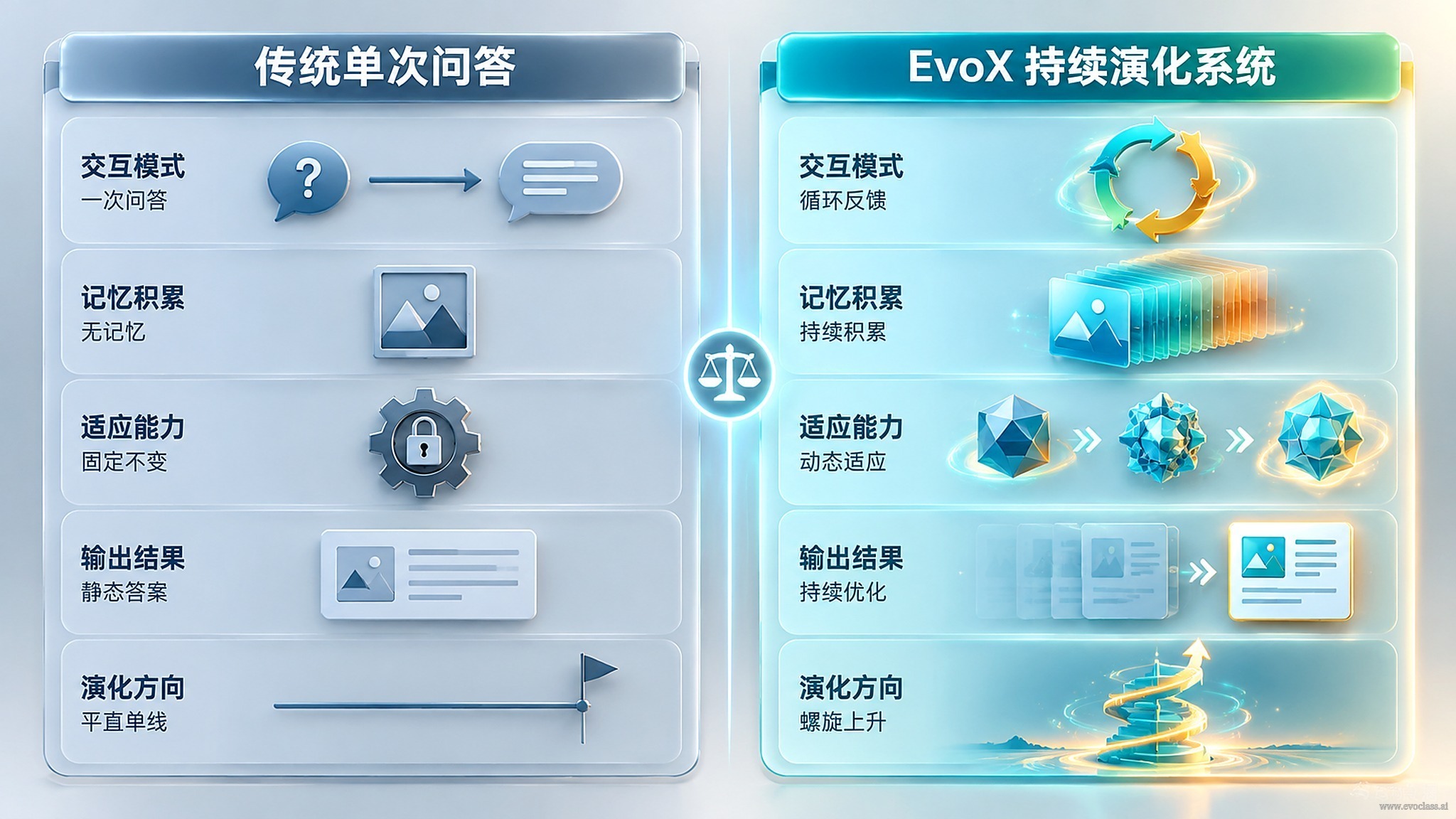
In 1950, Turing proposed the idea of a "Child Machine": rather than training a machine into a finished product all at once, we should educate it like a child—letting it experiment in an environment, receive rewards and punishments, and gradually acquire abilities. Mapping this idea onto today's systems yields two approaches—traditional one-shot Q&Ais an open loop,an EvoX continuous evolution systemis a closed loop. Both can output seemingly reasonable answers, but they differ completely in "what happens after the answer."
Side-by-Side Comparison: Open Loop vs. Evolutionary Closed Loop
| Dimension | traditional one-shot Q&A | an EvoX continuous evolution system |
|---|---|---|
| Interaction Mode | Prompt → Generate → Output; the process ends when the answer ends | Generate candidates → Test in environment → Accumulate feedback → Evolve again; the loop keeps running |
| Feedback Loop | No pathway automatically feeds execution results back into the system | Test results serve as feedback, driving the generation, selection, and retention of the next round of candidates |
| Validation Mechanism | Validation is mostly done outside the system, relying on researchers to manually judge, filter, reproduce, and re-prompt | Task environments, evaluators, or real execution interfaces enter the system boundary; candidates are not only generated but actually executed and tested |
| Accumulation of Improvement | Improvements are scattered across human judgment and ad-hoc conversation logs, hard to consolidate into system capability | Improvements are consolidated through feedback and retention mechanisms, and capability accumulates over iterations |
| Environmental Coupling | Essentially decoupled from the real physical environment; once generated, it stays fixed | Deeply coupled with the environment; environmental changes feed directly into the next round of evolution |
| When to Choose | More direct and efficient when the task can be generated in one shot and validation is cheap | Essential when tasks are complex, real, and require continuous validation and accumulated improvement |
Why the Four Stages of the Closed Loop Drive Growth
Breaking the closed loop down, each stage has a clear responsibility:Generate Candidatesproposes possibilities;Test in Environmentlets candidates be actually executed under real conditions;Accumulate Feedbackrecords the test results;Evolve Againgenerates and retains the next generation of candidates based on accumulated feedback. With the four linked end to end, the system gains a continuity that one-shot Q&A lacks: a failure does not vanish when the output ends but becomes the starting point of the next round.
Note also that the closed loop does not eliminate the human role but changes where humans sit: in one-shot Q&A, people must judge, reproduce, and re-prompt round after round; in a closed-loop system, people are more responsible for designing evaluation criteria, setting selection and retention rules, and reviewing boundary conditions, handing repetitive judgments over to the system. This is the most concrete realization of Turing's "Child Machine" idea today—not built in one shot, but growing through experience.
Open Loop vs. Evolutionary Closed LoopThe comparison diagram summarizes traditional one-shot Q&A as an open loop of prompt, generation, and output, where validation is mostly done manually outside the system and improvements are hard to consolidate; EvoX, by contrast, forms a closed loop of generating candidates, testing in the environment, accumulating feedback, and evolving again, bringing test results into the system to drive the next generation of candidates and shifting the division of labor between humans and the system.