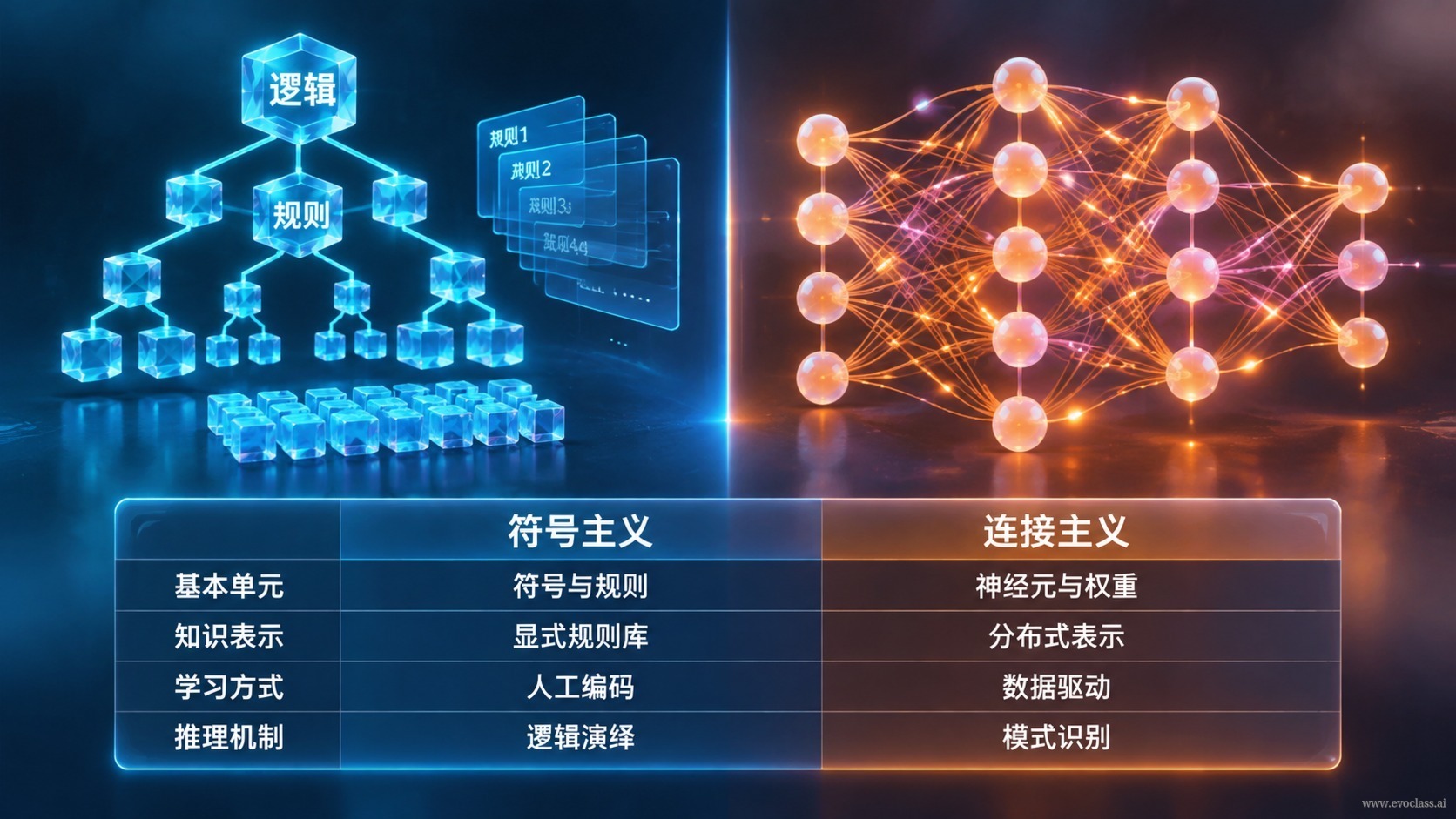
In the early history of artificial intelligence, the understanding of "intelligence" was not confined to a single approach. This page establishes comparative coordinates for three routes:Symbolism,ConnectionismandCybernetics. Each answers the question "how does intelligence arise?" from a distinct angle: knowledge representation and reasoning, distributed parallel networks, and dynamic feedback regulation.
Three Routes at a Glance
- Symbolism: Uses logical symbols as its medium and emphasizes explicit knowledge representation and rule-based reasoning; intelligence is seen as operations on symbolic structures, such as the deductive chain of "if A then B."
- Connectionism: Uses neuronal connection weights as its medium and extracts patterns from data through distributed parallel processing and representation learning; intelligence emerges from the coordination of large numbers of simple units.
- Cybernetics: Centers on feedback loops, focusing on error regulation, stabilizing mechanisms, and goal achievement in dynamic environments; intelligence manifests as closed-loop regulation of perception–decision–execution.
Core Differences and Complementarity
The fundamental differences among the three can be grasped through three dimensions:Knowledge Medium(symbols / weights / state feedback),Computational Mechanism(logical reasoning / parallel representation / feedback regulation),Relationship with the Environment(offline modeling / data-driven / online interaction).
For example, an intelligent system may simultaneously include: using logical rules to constrain decisions (symbolism), using neural networks for perception and representation (connectionism), and using feedback loops to regulate behavior (cybernetics). This combination of "knowledge representation—parallel computation—dynamic regulation" is precisely an important characteristic of modern intelligent systems.
Comparison Table of Core Mechanisms: Symbolism vs. ConnectionismObserve the comparison table of core mechanisms between symbolism and connectionism in the figure, and think about how it relates to "symbolism focuses on logic-based knowledge representation and reasoning."