Learning Objectives:Understand the advantages of evolutionary computation in handling conflicting objectives and complex constraints.
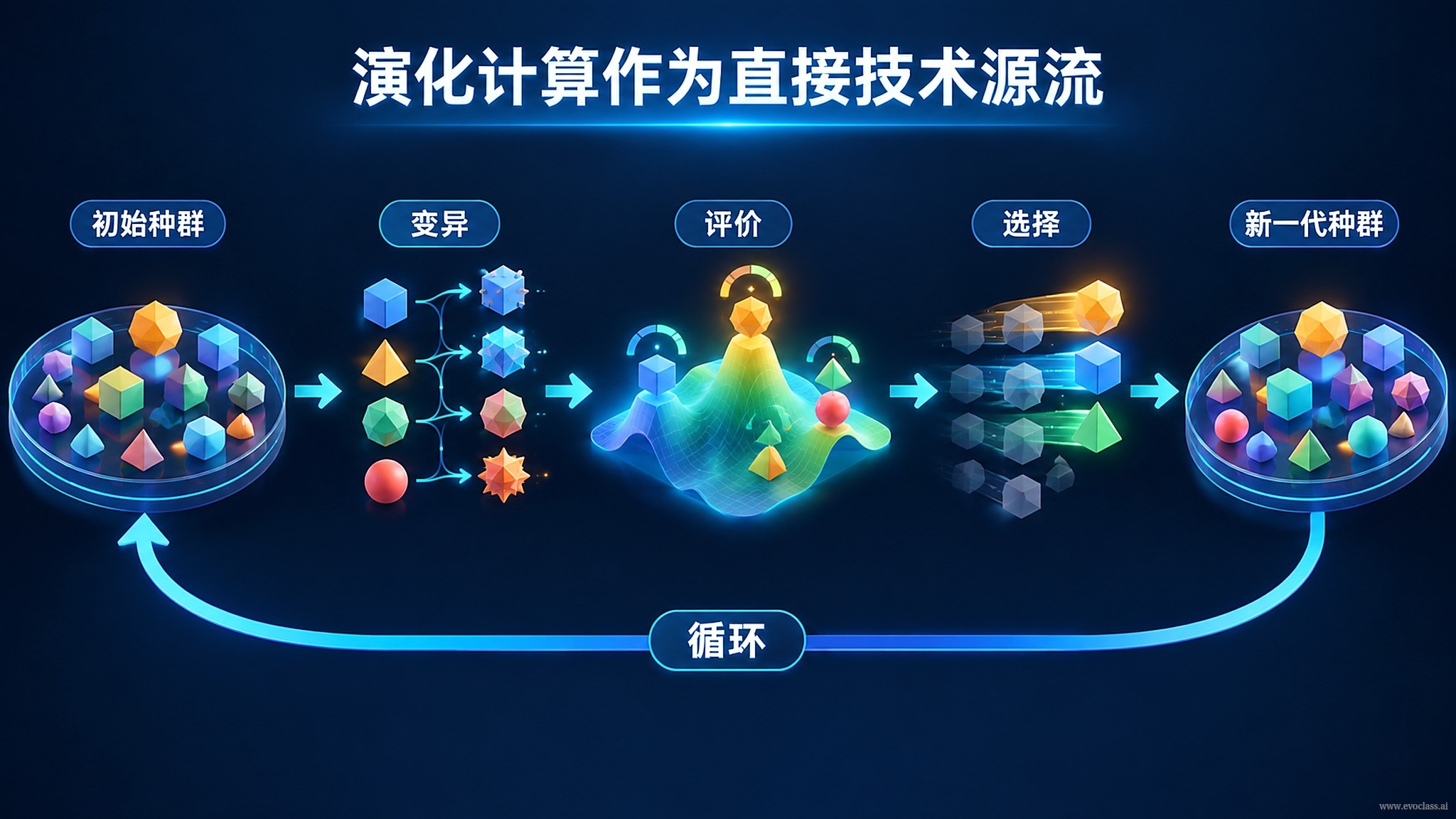
After reviewing the paths of symbolism, connectionism, and cybernetics,evolutionary computationis the most directly implementable technical source for algorithmic systems: it does not treat intelligence as the product of a "pre-specified unique answer," but instead understands problem-solving as "generate variation — environmental evaluation — retain/recombine" — an ongoing process that lets a population seek an acceptable balance amid complex constraints and conflicting objectives.
Viewed from a longer historical perspective, the evolution of intelligence shows a clear trend of acceleration: from genetic accumulation to language and culture, and then to software, computing power, and AI carriers, the evolutionary cycle has been compressed from generations to years, months, and even single iterations. As early as 1950, Turing proposed the idea of a "child machine," advocating that capabilities be gradually acquired in an environment through education, experimentation, and reward and punishment — this was the intellectual precursor to evolutionary computation. Today's large models possess powerful understanding, generation, and reasoning abilities, yet a single generation cannot verify its own correctness, nor remain effective over the long term as environments and models continually change. Evolutionary computation thus becomes the direct technical source that fills this gap, and lays the conceptual foundation for building an evolutionary closed loop with EvoX.
Three Key Characteristics
- No pre-specified unique answer: The algorithm generates diverse candidate individuals, which are filtered by the environment or a fitness function, forming adaptive solutions through iteration.
- Evaluation is continuous feedback: It is not a one-time right-or-wrong judgment, but provides direction for adjustment to the population in every generation.
- Selection is environmental pressure: It is not a single decision, but a mechanism of retention and elimination that gives better-adapted individuals more opportunities to continue.
A Natural Fit for Conflicting Objectives and Complex Constraints
Traditional single-objective optimization often requires first compressing multiple metrics into a single objective (e.g., by assigning weights). Evolutionary computation, by contrast, maintains a candidate population, retains individuals with different trade-off directions after each generation's evaluation, and ultimately delivers a comparable set of solutions rather than a single answer.
For example, in an engineering problem requiring high performance, low cost, and strong robustness simultaneously, a single-objective method must first fix the weights; evolutionary computation lets individuals with different trade-off directions survive simultaneously, producing a comparable set of compromise solutions from which decision-makers can choose after seeing the actual costs.
Why It Is the Conceptual Origin of EvoX
The loop of "variation — evaluation — selection" forms the conceptual origin for understanding EvoX's subsequent systematic, engineering-oriented, and parallel implementations: models generate possibilities, the environment provides feedback, and the system evaluates, selects, and inherits — allowing scattered intelligent components to accumulate continuously.
Diagram of the basic evolutionary computation workflow: variation, evaluation, and selectionObserve the diagram of the basic evolutionary computation workflow — variation, evaluation, and selection — and think about how it relates to "evolutionary computation forms the most direct technical source at the intersection of multiple paths."