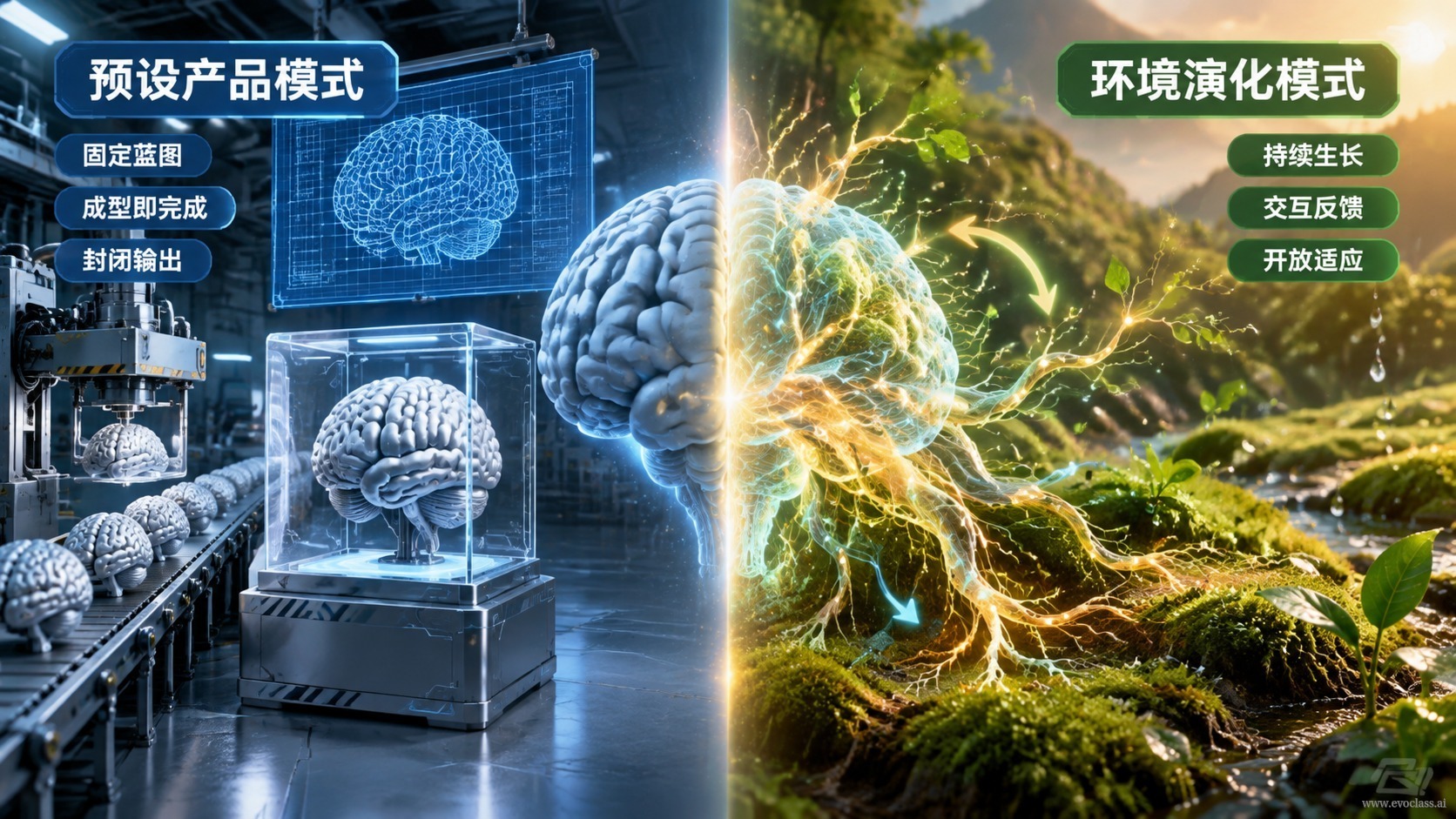
The same system can be understood in two ways: one is to see it asa product that is fully designed in advance and stays fixed after deployment; the other is to see it asa dynamic process continually shaped in an environment through action, feedback, selection, and retention. The judgment this page offers is that intelligence is closer to the latter—it is not an answer that stays static after delivery, but an ongoing process continually shaped by its environment.
The Origins of Both Models: From the "Child Machine" to the Evolution Loop
This judgment does not come out of nowhere. Over a longer view, the evolutionary cycle of human intelligence has been continuously compressing: from the generational scale of genetic accumulation, to the spread of language and culture, to software, computing power, and AI carriers, the evolutionary cycle has compressed from generations all the way down to years, months, and even a single iteration. Facing an ever-changing real physical world, large models already possess powerful understanding, generation, and reasoning capabilities, buta single generation cannot prove its own correctness, and it is also hard for it to remain continuously effective amid changes in environments and models. As early as 1950, Turing proposed the idea of the"Child Machine": rather than writing mature intelligence in one go, it is better to let the machine, like a child, gradually acquire capabilities in an environment through education, experimentation, rewards, and punishments—this is precisely the early form of the "environmental process" approach.
Predefined Product Model: Capabilities Are Determined Before Operation
Treating intelligence as a product means completing a linear, closed process:Requirements → Design → Packaging → Deployment, with capabilities fixed after delivery.Behavioral boundaries are essentially determined before operation begins, and no structural changes occur during the operational phase. This model is predictable, reproducible, and easy to validate; the cost is: when the real environment changes, the system can only retreat to the starting point of the process, re-labeling, re-designing, and re-deploying, and each re-deployment freezes the boundaries once again, so the problem repeats periodically.
Environmental Process Model: Capabilities Are Generated During Operation
Treating intelligence as a process turns the system's core action into a loop:Action → Environmental Feedback → Multi-Candidate Evaluation → Retain the Better → Update Strategy → Act Again. It does not require producing correct behavior in one shot, but rather requires the system to continually act, continually receive feedback, and turn that feedback into the basis for the next action. Therefore, the key question in building an intelligent system is not "what to output," buthow actions are generated, andhow action results are transformed into usable feedback.
Selection and Retention: Why Evolution Can Accumulate
The reason the process model can continually adapt is not blind trial and error, butevaluating, selecting, and retaining the more effective results from among multiple possible outcomes. Each round of iteration produces multiple sets of candidates, the environment provides success/failure and quality signals, and the system uses these to evaluate, eliminate, and retain, depositing the retained better paths as the starting point for the next round. It is precisely the step of "retention" that keeps experience from being wasted, allows capabilities to accumulate, and makes continuous adaptation possible for the system.
Implications for EvoX and AI Native Research
If intelligence is a process, the focus of research shifts from "choosing or deploying a fixed answer" to "building a process that can be explored, fed back, and evolved." Models generate possibilities, environments provide feedback, and systems handle evaluation, selection, and inheritance—this is precisely where EvoX builds an evolution loopbetween model capabilities and system capabilities, enabling dispersed intelligent components to accumulate continuously. To judge whether a solution is truly AI Native, look at whether it has this loop, rather than at how powerful a model it calls.
Comparison of the Predefined Product Model and the Environmental Evolution ModelObserve the comparison of the Predefined Product Model and the Environmental Evolution Model in the image, and share the key points you notice.