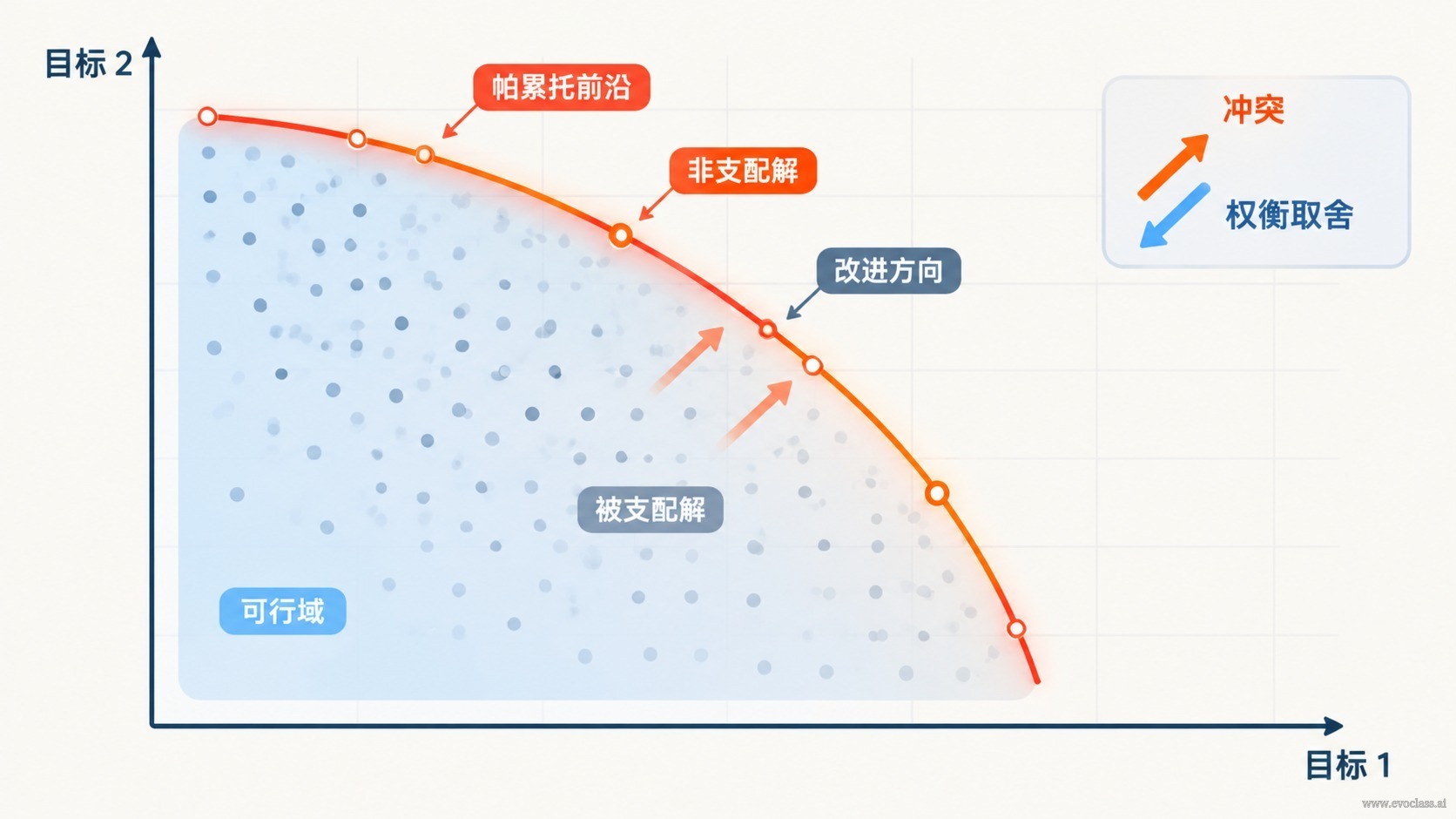
In real-world AI systems engineering, we almost never encounter problems with only a single objective. Improving model accuracy often increases inference latency and compute cost; enhancing robustness may sacrifice peak performance; reducing energy consumption may in turn limit model capacity. These objectives pull against one another and are not fully commensurable, so there isno single optimal solution, only a set ofnon-dominated trade-off solutions—that is, an approximation to the Pareto front.
Key Concepts
- Multi-objective tension: improving one objective often degrades another; objectives are not fully commensurable.
- Complex constraints: hard and soft constraints coexist, and together with uncertainty and dynamic environments they shrink the feasible region, invalidating the single-point optimum assumption.
- A unique optimum usually does not exist: single-objective scalarization or single-point search struggles to represent the true decision space.
- The output should be a set of solutions: diverse candidates must be retained, offering a comparable trade-off boundary and room for preference-based selection.
- Advantages of evolutionary computation: through parallel population exploration and diversity preservation, it simultaneously approximates multiple trade-off solutions, well suited to conflicting objectives and complex constraints.
Why Evolutionary Computation Fits
Evolutionary computation does not rely on gradients or differentiability of the objective function; instead, it searches the objective space in parallel via a population. Each individual in the population represents a candidate solution, and mechanisms such as non-dominated sorting and crowding distance maintain solution diversity while converging toward the Pareto front. This way, decision-makers can select different trade-off solutions from the front based on scenario preferences at the final stage, rather than locking in an a priori weight before optimization.
Illustration of the Pareto Front in Multi-Objective OptimizationObserve the illustration of the Pareto front for multi-objective optimization, and share the key points you notice.