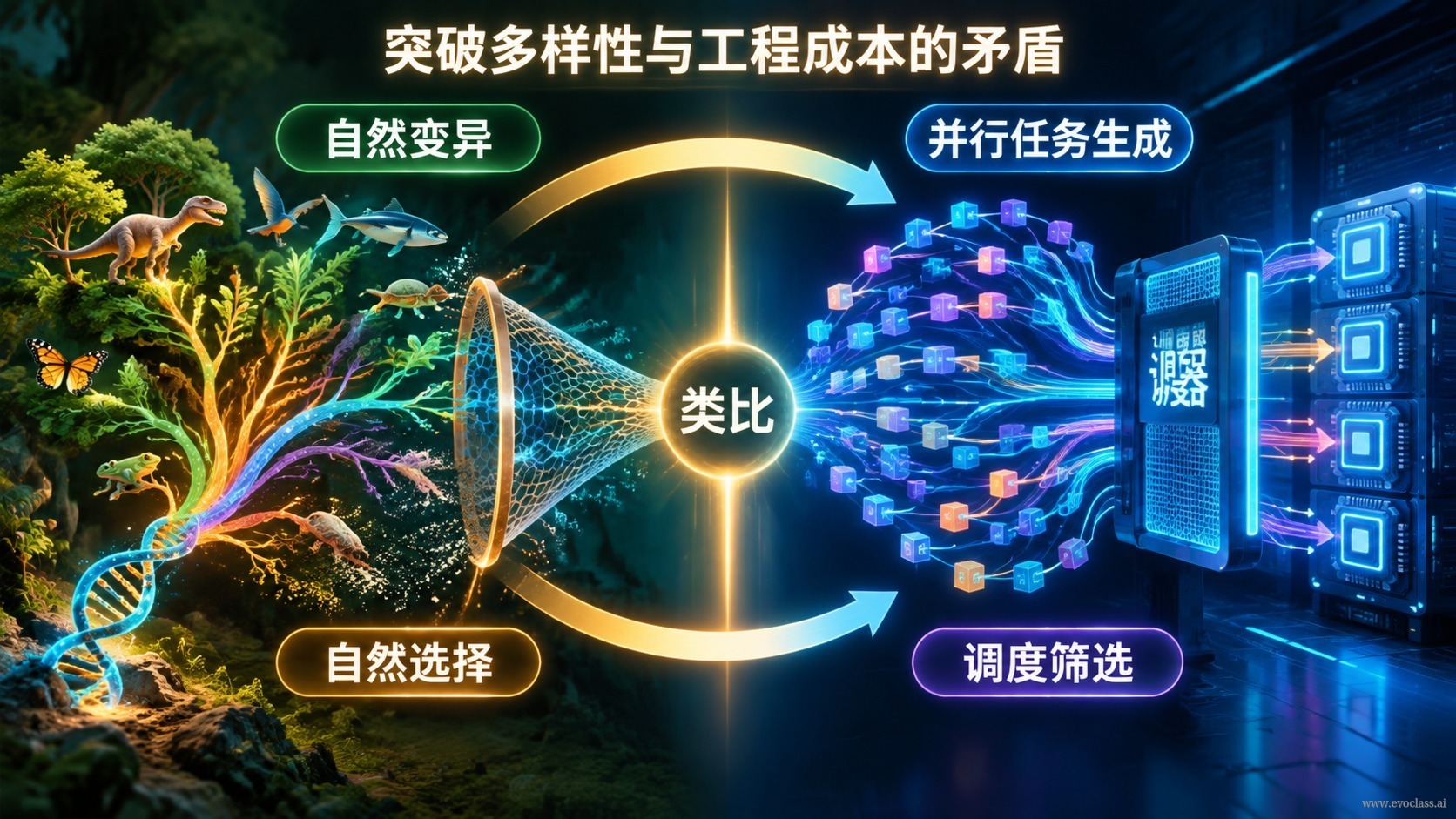
Complex structures in nature rarely come from a single, fully specified blueprint; they are more like an ongoing process:mutationcontinuously generates new candidate branches,while selectionretains effective paths and eliminates inefficient ones based on environmental feedback. Diversity is therefore not an extra burden outside the process, but anintrinsic productof this mechanism. This same mechanism is also the source ofintelligent evolution: from genetic accumulation to language and culture, and on to software, computing power, and AI substrates, the evolutionary cycle has been compressed from generations to years, months, or even a single iteration. Turing's 1950 "child machine" idea further suggested that capabilities can be acquired gradually in an environment through education, trial and error, and reward and punishment, rather than being fully specified from the start.
Nature's Inspiration: Mutation Generates Candidates, Selection Retains Paths
- mutation: Generate new candidate branches from existing forms, letting them reach into possibility spaces not yet explored.
- while selection: Retain effective paths and eliminate inefficient branches based on environmental feedback, allowing exploration to gradually converge.
- Candidate generation and screening occur continuously, without first enumerating "all possible solutions" and then verifying them one by one.
The Pain Point of Traditional Engineering: Why Diversity Is Expensive
If traditional engineering needs 100 feasible solutions, that typically means about 100 serial cycles of "design—simulate—evaluate—prototype." Each attempt consumes manpower, computing power, and time,so diversity manifests as a high marginal cost: in a serial workflow, total cost grows roughly linearly with the number of solutions (C \propto n), and since design, simulation, and evaluation depend on one another, scheduling and coordination themselves expand rapidly with scale. In other words, diversity is treated as an extra cost item in the workflow rather than a reusable exploration resource.
Where Evolutionary Computation Fits: The Population Is the Natural Parallel Unit
Evolutionary computation engineers "mutation—selection" into parallelizable population exploration: candidates form a population that can begenerated and evaluated simultaneously, with selection pressure applied uniformly across the entire batch. Parallelism is not a technique optimized in later; it is an inherent property of this mechanism—and this is precisely what most fundamentally distinguishes it from traditional serial engineering workflows.
How the Trade-off Is Transformed
- Diversity: from an "extra cost item" to a "search resource"—more candidates mean wider coverage and stronger robustness, not a longer schedule.
- Bottleneck: from serial manual scheduling to parallel computational throughput—scalability is determined by compute capacity, and as scale grows, unit cost is amortized.
The conclusion of this page can be compressed into one sentence: evolutionary computation turns the traditional trade-off of "diversity necessarily costly, serial scheduling cumbersome" into a scalableparallel computing problem. EvoX builds a bridge precisely at the gap betweenmodel capabilityandsystem capability, organizing the "mutation—selection" mechanism into anevolutionary loopin which models generate possibilities, environments provide feedback, and systems evaluate, select, and inherit—enabling evaluation, selection, and inheritance beyond a large model's single generation to continuously accumulate.
Analogy: Natural Evolution and Engineering Parallel SchedulingObserve the analogy diagram between natural evolution and engineering parallel scheduling, and consider how it relates to "Breaking the Trade-off Between Diversity and Engineering Cost."