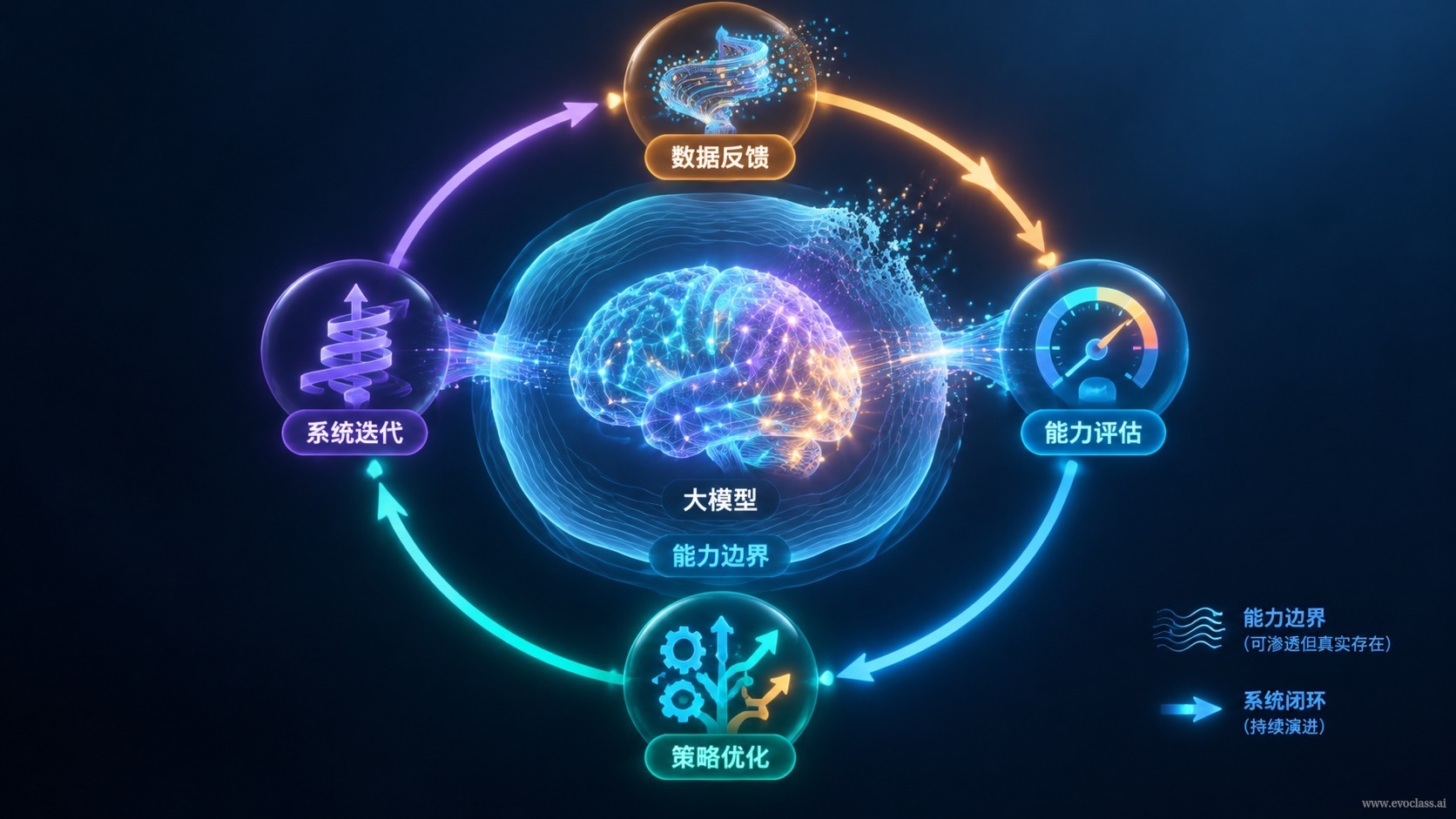
Large models have turned themselves into a reliablecapability foundation: semantic understanding, code and solution generation, multi-step reasoning, tool and function calling—it is more than enough to support an interaction pattern of "pose a question, get candidates." But the stronger the foundation, the more easily it masks an engineering truth:The model generates possibilities; the closed loop must be borne by the system. This page sets out to argue precisely thiscapability boundary, and why continuous evolution is a system-level responsibility rather than a natural extension of model capability.
I. What the Model Already Handles Well
- Semantic Understanding: parse vague requirements into executable problem statements and identify the implicit constraints and goals within them.
- Generation capability: produce code, configurations, solutions, and explanations within minutes, and self-revise within the same conversation turn.
- Multi-step Reasoning: complete task decomposition, chained derivation, and trade-off explanations, naturally exhibiting an output form of "propose candidates and explain the rationale."
- Tool Calling: trigger retrieval, computation, and external APIs through function calling, connecting language output to real actions.
Together, these four points mean that "candidate generation" is now nearly free. The truly scarce resource is not the number of candidates, butthe mechanism for applying selection pressure to candidates.
II. Structural Gaps: A Single Session Cannot Close the Loop
- In-session state is volatile: once the context is exhausted, cross-task memory breaks down, and lessons learned in the previous round cannot automatically carry over into the next.
- Missing ground truth: the model cannot autonomously define "what counts as correct," nor can it provide evaluation criteria independent of its own output.
- Missing experiment orchestration: batch benchmarking, statistical significance testing, constraint-compliance validation, and execution in costly real-world environments all fall outside the model's control.
The conclusion is clear: the model cannot independently complete, within a single session or a single task, the closed loop ofcandidate generation—environment validation—result consolidation. This is not a matter of insufficient capability, but rather thatthis responsibility was never the model's to begin with.
III. Four Types of Work the System Must Step In For
- Candidate generation and mutation: organize model outputs and proactively expand and structure the search space.
- Environment construction and invocation: build reproducible experiment environments and handle orchestration, execution, and validation.
- Evaluation and selection: define ground truth and evaluators, and complete ranking, selection, and significance assessment.
- Consolidation and reuse: write successful results and failure experiences into long-term memory, making them the starting point for the next task.
The division of labor comes down to one sentence:The model generates possibilities; the system applies selection pressure and preserves history. Neither can replace the other—without the model, the system has no diversity to select from; without the system, the model can only reset to zero time and again.
IV. Shifting the Criterion: From "How Good Is a Single Output" to "Can Improvements Accumulate"
To measure whether a system is truly evolving, the criterion should not be "how good a single output is," but rather "whether improvements can accumulate across tasks and Agent cycles." A stunning output that cannot be inherited is, in essence, still a one-time consumption. When each task's output is consolidated into reusable engineering assets—code, configurations, evaluators, failure case sets—the starting point of subsequent tasks is higher than the previous one. This isProject-level Continuous Evolution. The practices of EvoX offer a stable and reliable paradigm for engineering consolidation: spanning Agents and task cycles, solidifying experience into assets rather than leaving it behind in conversation logs.
Finally, let us draw a line against adjacent topics: this page only argues "why system-level continuous evolution is needed”,不展开算法自身的双层演化机制(见后续 MetaDE 相关内容)。
AI Model Capabilities and System-Level Closed-Loop Organization DiagramObserve the AI model capabilities and system-level closed-loop organization diagram, and share the key points you notice.