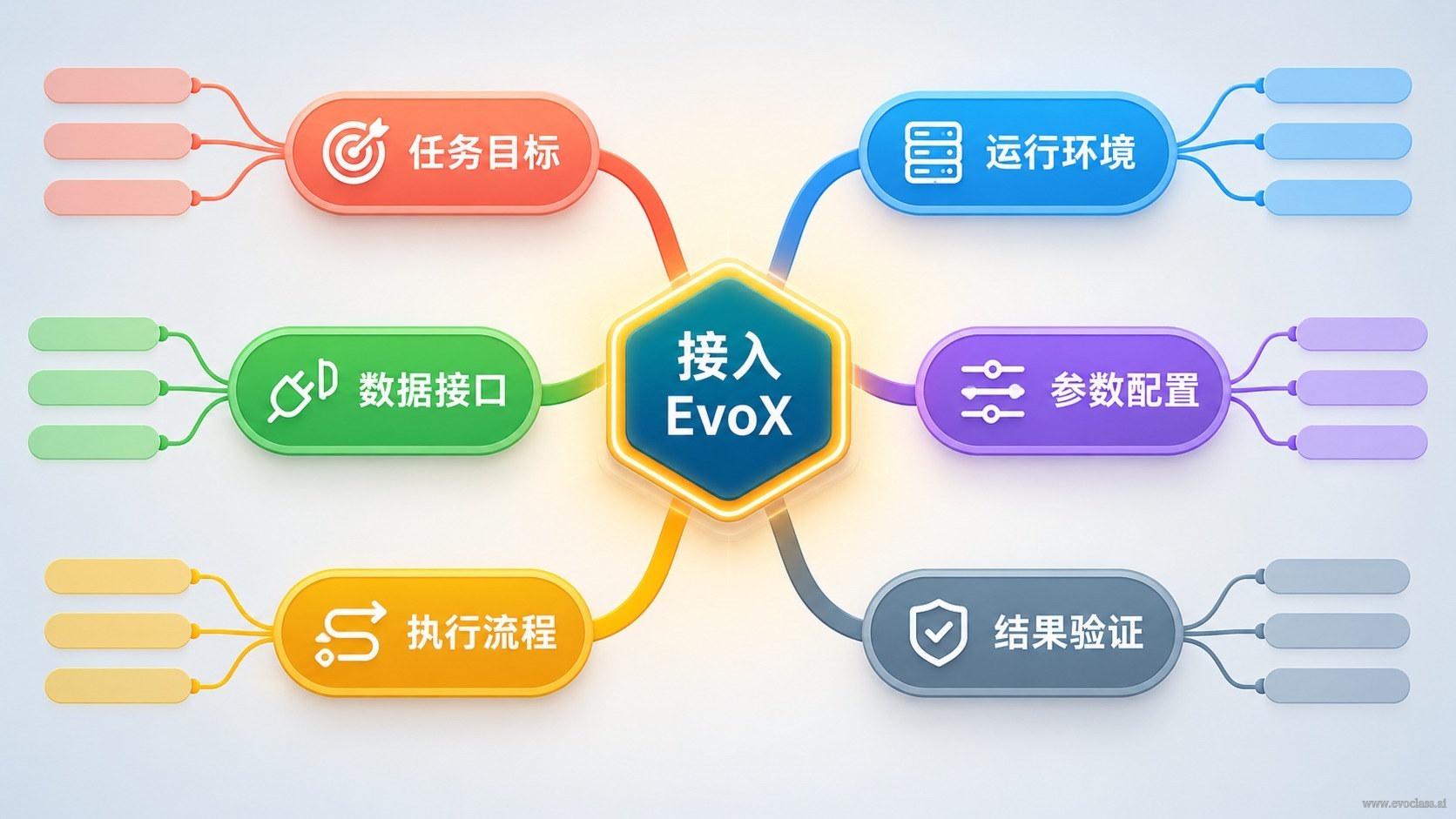
Integrating with EvoX is essentially about formalizing a real-world task intoan evolvable exploration system: first clearly define "what evolves, what is observed, and on what basis it is retained," and only then discuss operators and parallelism. In effect, the element-definition stage is designing, for the later tensorized organization, Runtime scheduling, and multi-objective evaluation,an executable contract—the clearer the contract, the more solid the basis for the ensuing computation graph and scheduling.
This aligns with the background behind EvoX's creation: large models possess powerful understanding, generation, and reasoning abilities, yet a single generation cannot prove its own correctness and struggles to remain effective as environments and models change. EvoX is precisely meant to bridge model capability and system capability, forming an evolutionary closed loop composed ofthe model generating possibilities, the environment providing feedback, and the system evaluating, selecting, and inheritingThe three-element definition is how this loop takes shape at the integration level: the mutable object delimits "what the model generates," the observable result determines "what the environment feeds back," and the retention criterion specifies "what the system selects and inherits."
Three Elements: What You Define Determines What You Can Do Later
- Mutable Object (Exploration Space): Clearly specify the objects allowed to change, together with their legal variation space and hard constraints, covering parameters, structures, and even program-level objects. Too narrow a boundary compresses diversity, while too wide a one makes the evaluation pipeline infeasible.
- Observable Result (Evaluation Signal): Determine which results can be observed and measured, distinguish objective metrics, constraint metrics, and necessary proxy signals, and assess their noise, cost, and repeatability.
- Retention Criterion (Selection Mechanism): Define the criteria for "a variation being retained," such as a fitness threshold, multi-objective dominance relation, constraint satisfaction level, or preference mechanism. This criterion determines whether exploration is guided or wasted.
The Three Must Form a Closed Loop
Explorable (variation space) × Executable (evaluation pipeline) × Verifiable (retention criterion)—none can be missing. If any link is absent, evolution degenerates into an unsustainable spinning loop: without a variation space there is no search, without an evaluation pipeline there is no feedback, and without a retention criterion there is no accumulation.
Engineering Implications
The clarity of the elements directly determines whether they can be efficiently mapped to the tensorized computation graph, Runtime scheduling, and heterogeneous compute management—and whether parallel scaling yields real gains. The mutable object defines the tensor dimensions and legal value ranges, the observable result defines the computation pipeline for batch evaluation, and the retention criterion defines the scheduling logic for per-generation filtering and inheritance. In other words, the element-definition stage is the first engineering blueprint for integrating with EvoX.
Mind Map of the Element Checklist for EvoX Task IntegrationObserve the mind map of the element checklist for EvoX task integration in the image, and share the key points you notice.