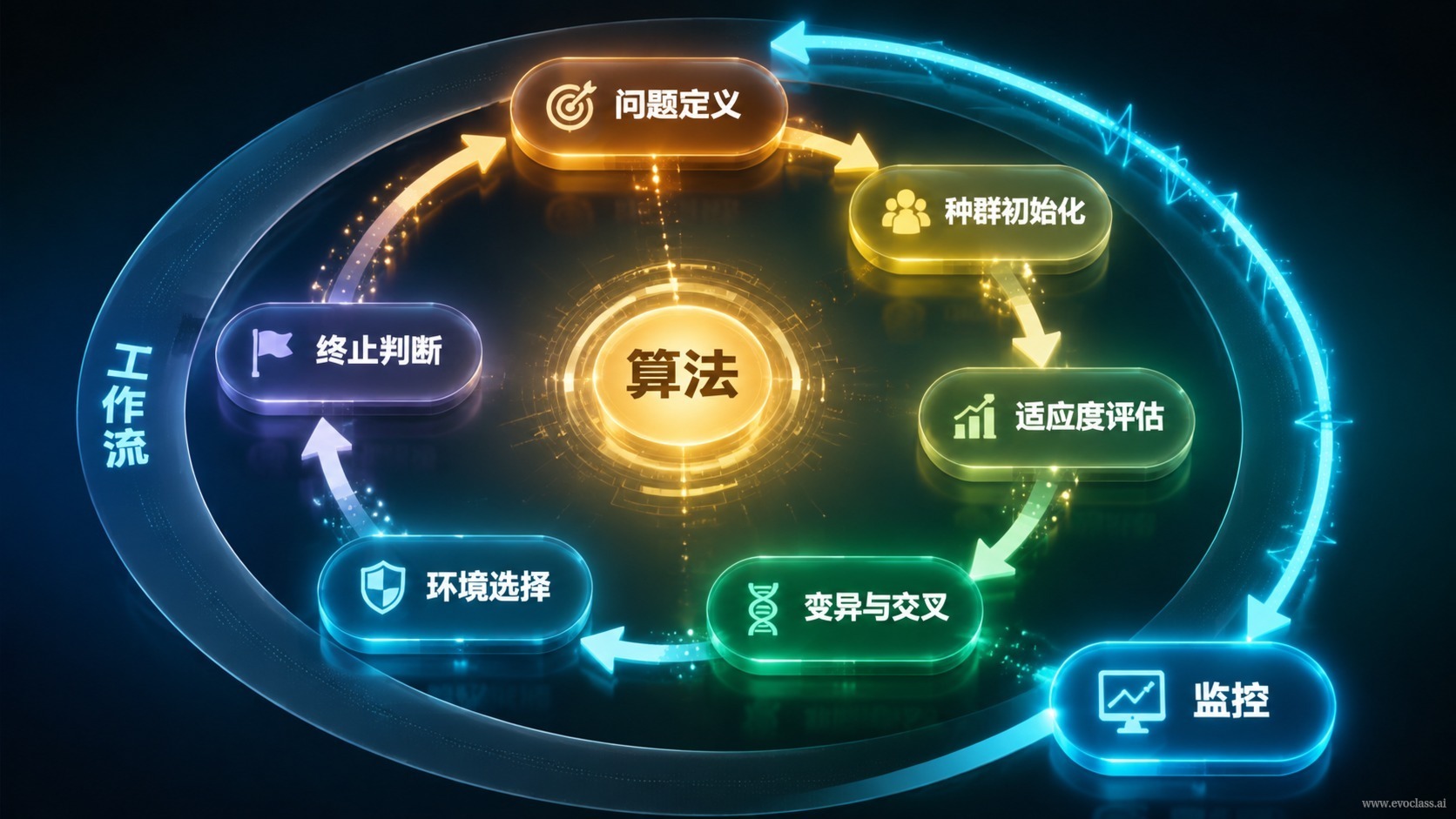
The EvoX Runtime is not a one-off inference call, but a closed-loop execution system built for evolutionary exploration . It organizes model capabilities, tool capabilities, and environmental feedback into a continuously operating pipeline: the model proposes candidates, the Runtime turns those candidates into real computation, the environment returns observable results, the evolutionary mechanism makes selections based on them, and the persistence system distills the validated outcomes into the starting point for the next round of exploration.
The Six Links of the Closed Loop
- Model proposes candidates: based on the current problem definition, historical state, and constraints, it generates candidates at the parameter, operator, strategy, and even program level, determining which entry points the search space opens from.
- Tools execute and trigger environmental changes: the Runtime invokes evaluators, simulation/surrogate models, operator libraries, and workflows, converting candidates into actual computation and observable environmental changes.
- Environment returns feedback: the task environment provides metrics, constraint violations, failure modes, and execution traces; these signals are used both for scoring and for guiding the next round of proposals.
- Evolutionary mechanism completes selection: through population updates, mutation/crossover, Pareto or preference-based selection, it retains high-value candidates while refining or eliminating low-value ones.
- Runtime organizes computation: responsible for module orchestration, state management, scheduling, heterogeneous compute allocation, and reproducible execution, decoupling algorithms from problems and enabling on-demand composition.
- Persistent system inherits outcomes: saves project-level state across Agent contexts, with strict validation determining which results are persisted as a trusted baseline.
Two Easily Underestimated Mechanisms
Project-level persistence across Agent contexts: the context of a single session disappears when the conversation ends, but evolution requires accumulation across sessions. EvoX writes candidates, evaluation records, and conclusions to project-level storage, so a new Agent session can directly load the history without repeating work already done.
Strict validation and historical inheritance: not all results deserve to enter the baseline. The acceptance gate checks metrics, constraints, and reproducibility, and only the versions that pass are written into history and inherited by subsequent rounds. This makes inheritance a trusted accelerator rather than an amplifier of errors.
The Significance of the Closed Loop
With this closed loop in place, the next round of exploration does not have to start from scratch, but continues evolving on the basis of vetted outcomes. The model is responsible for proposing possibilities, while the system is responsible for validation, selection, and accumulation — this is precisely the continuously operating foundation of AI Native research.
EvoX Runtime Closed-Loop Workflow Architecture DiagramStudy the EvoX Runtime closed-loop workflow architecture diagram and describe the key points you observe.