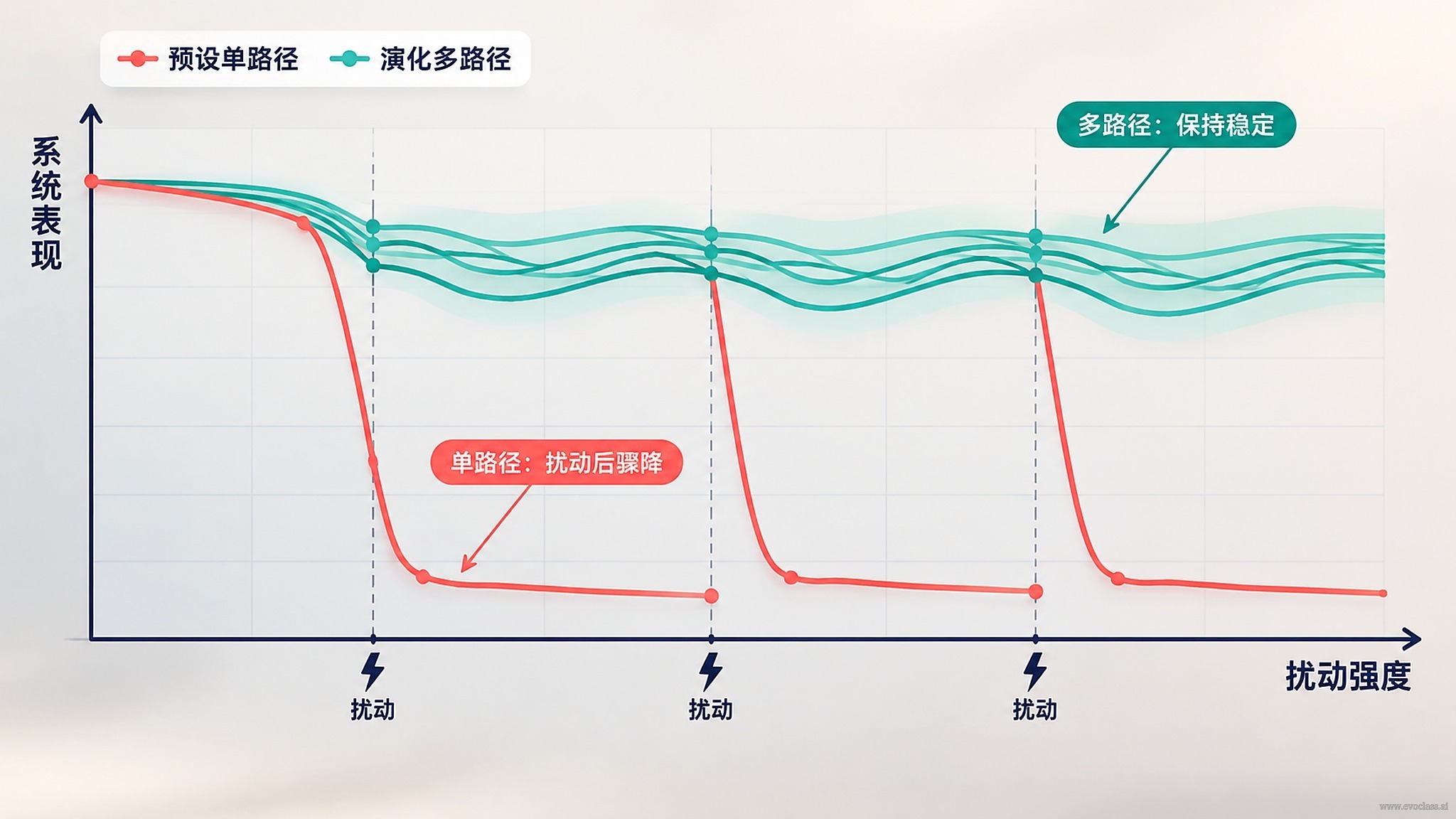
This page useshands-on classroom practiceto compare, on the same engineering optimization problem,a preset single pathandan evolutionary multi-pathunderunknown perturbationsin terms of performance. The point is not to prove that evolution is always better, but to analyze how multi-path search incorporates uncertainty, diversity, and online feedback into the search process, thereby improving robustness and adaptability.
Defining the Experimental Task
- Choose an engineering optimization problem into which unknown perturbations can be injected, such as dynamic parameter optimization or a search task with noisy constraints.
- Fix the objective function, evaluation budget, and perturbation sequence so that the two experimental groups are comparable.
Preset Single Path: Rigid Solving Under Offline Assumptions
Fix the algorithm, hyperparameters, and search direction, and solve in a single pass based on offline assumptions. It may perform well before perturbation, but without online adjustment it easily falls into local optima or suffers a sharp performance drop after perturbation.
Evolutionary Multi-Path: Parallel Exploration Driven by Online Feedback
under EvoX , run parallel searches with populations, multiple strategies, or multiple candidates, and continuously adjust through mutation, crossover, selection, and environmental feedback. Multi-path is not simply running repeatedly; it uses online information to build exploration redundancy.
The figure below shows how the performance retention rate of the two strategy types changes before and after perturbation. It marks the perturbation injection point, the magnitude of performance drop, the recovery window, and the diversity range of multi-path candidates, which can be analyzed directly against the metrics below.
Perturbation Design and Comparison Metrics
- Perturbation design: objective shifts, constraint changes, increased noise, environmental state switches, or unmodeled variables; focus on perturbations not seen during the preset phase.
- Comparison metrics: pre-perturbation optimum, post-perturbation performance drop, recovery speed, success rate, candidate diversity, and the computational and evaluation cost of reaching equivalent performance.
Key Explanations and Conclusions
The fragility of the single path stems from rigid assumptions and insufficient diversity; the advantage of multi-path comes from continuous exploration, fitness feedback, and selection pressure—but it must be balanced against computational cost, convergence stability, and engineering interpretability.
When facing unknown perturbations, evolutionary multi-path usually shows stronger robustness and adaptability; however, this conclusion should rest on fair budgets, reproducible experiments, and clearly defined perturbation boundaries, avoiding the misreading that "multi-path" is unconditionally better than single-path.
Line Chart Comparing Single-Path Perturbation Response vs. Multi-Path Evolutionary Interference ResistanceLook at the line chart comparing single-path perturbation response vs. multi-path evolutionary interference resistance, and think about how it relates to "comparing the robustness and adaptability of evolutionary multi-path when facing unknown perturbations."