Here is the whole course in a single sentence:intelligence is not a single product prescribed once and for all, but a process that keeps evolving through environmental feedback. The problem-solving path offered by evolutionary computation takespopulation, mutation, selection, and fitnessas its skeleton—it never promises a single correct solution written out in advance, but instead lets candidate solutions be reshaped and inherited through repeated evaluation and selection.
This line of thinking has a clear historical origin: as early as 1950, Turing proposed the idea of a "child machine," arguing that machines, like children, could gradually acquire abilities within an environment through education, experimentation, and reward and punishment—ability is not a product written once, but a process.Models generate possibilities, the environment provides feedback, and the system handles evaluation, selection, and inheritance. Wiring these three into a loop is exactly theevolutionary closed loopthat this course emphasizes; EvoX, discussed throughout the course, is precisely what bridges this loop between model capability and system capability. The diagram below places this loop back within its historical context: the four cards on the left are, in order, symbolism, connectionism, cybernetics, and evolutionary computation; the central node is the continuous evolutionary loop where they converge under environmental feedback (generate candidates → evaluate → select → inherit → iterate); and the timeline at the bottom marks four phases—biological inspiration, independent development, reunification, and large-scale parallel evolution.
The Historical Convergence of Four Intellectual Paths
- Symbolism: It places its faith in explicit representation and formal reasoning, assuming that the world can be fairly completely characterized by symbolic structures. It is efficient and interpretable on problems with clear rules and closed boundaries, but it readily breaks down in the face of ambiguity, noise, and a lack of common sense in open environments.
- Connectionism: It replaces handcrafted rules with distributed representation and learning, fitting an "input-to-decision" mapping from data. It excels at perception and generalization, but a single forward pass does not come with any proof of correctness, and it lacks mechanisms for self-verification and long-term accumulation.
- Cybernetics: It focuses on goal regulation within feedback loops—measuring deviation, applying an action, and measuring again. It answers the question of "how a system keeps its direction amid disturbances," which is precisely the closed-loop prototype that any continuously evolving system must possess.
- Evolutionary Computation: It provides population-based adaptation mechanisms for open search spaces, continuously exploring the solution space through "generate candidates—evaluate—select—inherit—iterate," and maintaining diversity and search pressure in the form of a population.
In their early days, these four paths competed with one another; today, within modern intelligent systems, they are moving toward complementarity: thesymbolic layerprovides interpretable structural constraints and verification conditions, theconnectionist layerprovides perception and generation capabilities, thecontrol layerensures feedback and goal regulation, and theevolutionary layeris responsible for searching uncertain environments and preserving diverse solutions. Only by understanding this division of labor can we explain why complex intelligent systems need to wire their capabilities "into a loop" rather than hoping for a one-shot output.
Biological Inspiration and Engineering Abstraction
Evolutionary computation draws on biological mechanisms such as mutation, selection, heredity, and population diversity, but in modern practice these are abstracted intocomputable, parallelizable, and composableoptimization processes: fitness is a measurable objective function, mutation is often characterized by probability distributions, and selection pressure is implemented through sampling and retention rules. Biomimicry is only the starting point; reproducible operators and measurable evaluation are what make it practical.
A common misconception is that "because the mechanism resembles evolution, the result must be correct." In fact, whether an evolutionary system is effective depends on whether the encoding scheme, fitness design, and selection pressure match the task—a biological metaphor in the mechanism offers no guarantee of correctness whatsoever.
Why Not Rely on a Preset Single Answer
Real-world tasks often share three characteristics at once:conflicting multiple objectives,sparse feedback,uncertain environments, and uncertain environments. When objectives constrain one another, there is usually no single-point solution that simultaneously optimizes all of them—only a set of trade-off solutions; when feedback is sparse and delayed, a complete evaluation cannot be obtained all at once; and when environmental parameters keep changing, any static "single optimal plan" quickly becomes obsolete. It is precisely under these conditions that prescribing a single path in advance fails.
Evolutionary computation's approach is to generate a large number of candidates in parallel, evaluate their trade-off performance across objectives, and retain diverse solutions for later decision-making, thereby deferring "which one to choose" to a stage when information is more complete or preferences are clearer.
This also explainsthe necessity of large-scale parallel exploration: when the search space is enormous, a traditional serial loop cannot complete enough sampling within an acceptable time, much less support "continuous evolution." GPUs, tensors, and unified runtimes turn population-level parallelism, operator parallelism, and long-term online iteration into an engineering foundation, greatly increasing the number of candidates that can be evaluated per unit of time and the population diversity. It must be emphasized that parallelism increases the "feasible scale," but does not replace fitness design or selection pressure design.
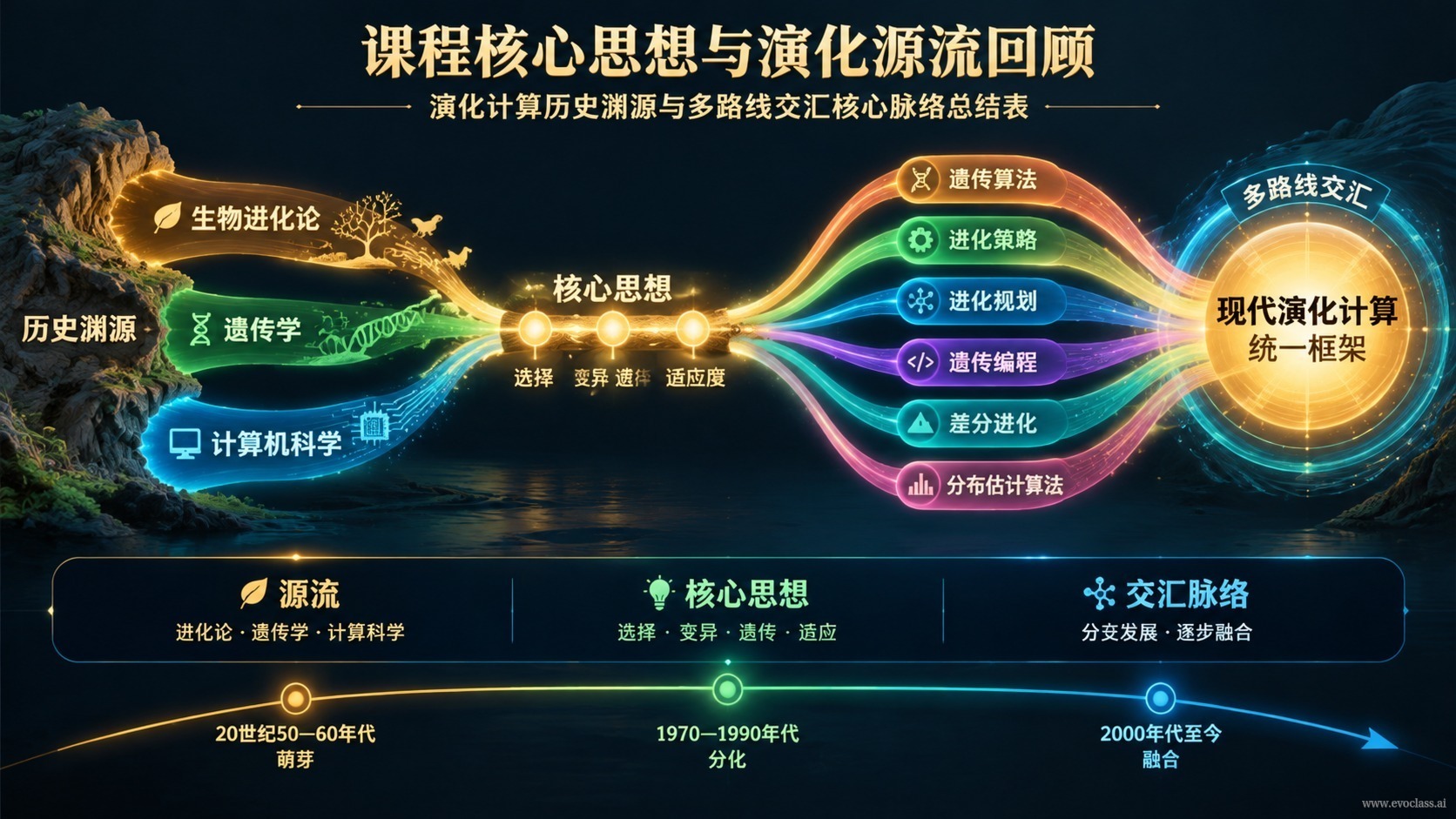
Summary Table: Historical Origins of Evolutionary Computation and the Core Threads of Multi-Path ConvergenceObserve the summary table of evolutionary computation's historical origins and the core threads of multi-path convergence, and consider how it relates to "tracing the convergence of symbolism, connectionism, cybernetics, and evolutionary computation."