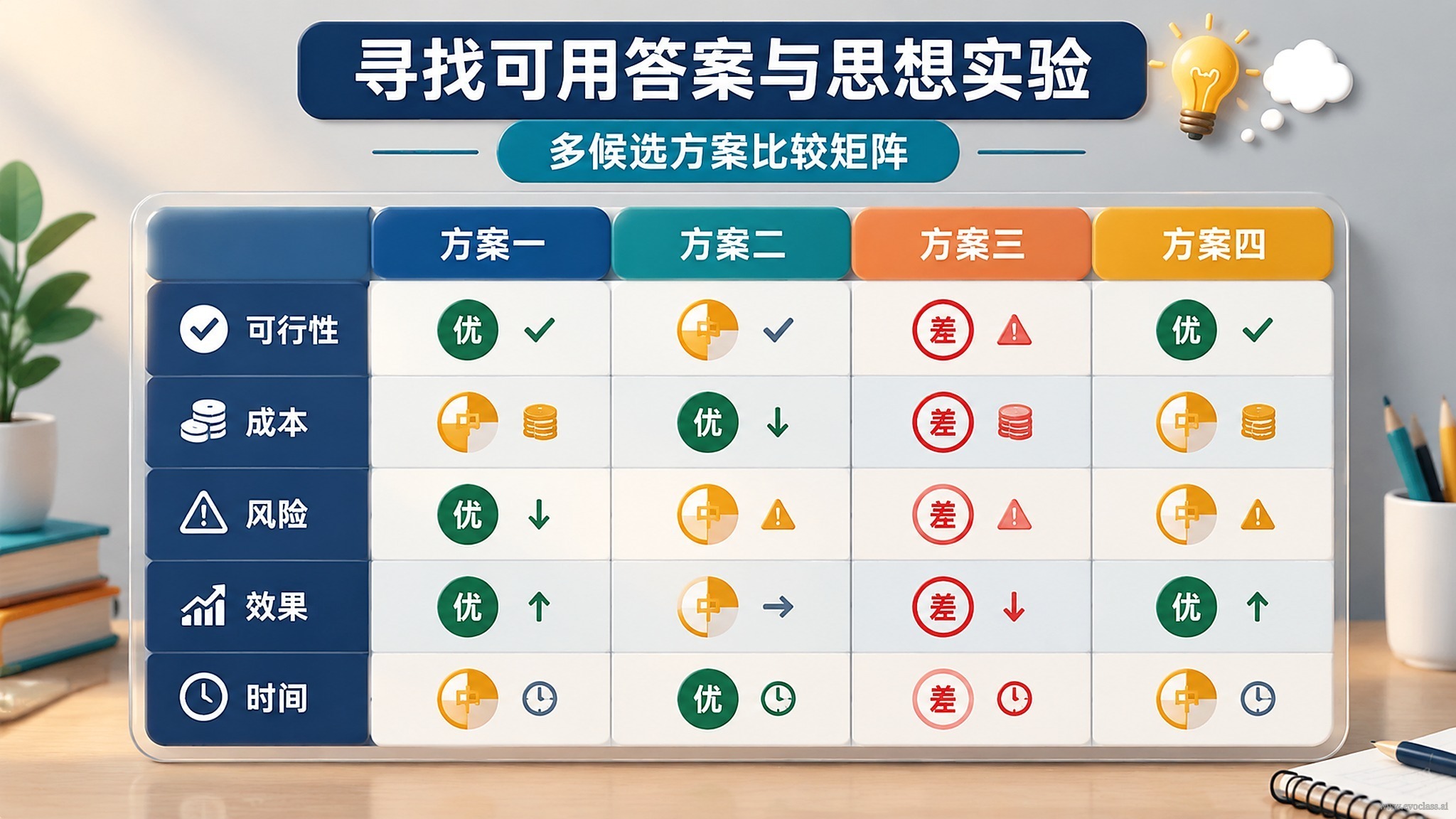
"Finding usable answers" is not about forcing out a single "optimal solution," but about turning a real-world probleminto an explorable, executable, and verifiable thought experiment: first define the variables, evaluation criteria, hard constraints, and comparison rules, then systematically explore along different directions. EvoX is meant to carry this exploration, not to rush to a single answer.
Why the Real World Rarely Has a Single Optimal Solution
Multiple objectives pull against one another. Increasing an aircraft's lift may simultaneously alter drag and stability; reducing a model's runtime latency may hurt task accuracy; improving system performance may increase energy consumption, cost, and safety risk. Progress on one metric often comes at the expense of another. So a single answer that is "best on every metric" usually doesn't exist—what exists is a set of trade-off solutions, each explainable under different preferences.
The First Task: Turn the Problem into the "Four Questions of Thought Experiments"
- What can be changed?List the variables and decision variables (parameters, structure, strategy, scheduling rules), and clearly mark which are given conditions.
- How do we evaluate the change?Determine the evaluation metrics and measurement scope: timeliness or energy consumption, peak or average, and which data segment to measure against.
- What conditions must be satisfied?Clarify hard constraints and boundaries: safety thresholds, latency limits, energy and budget caps, regulations and airspace permits; any solution that crosses these lines is eliminated outright.
- How do we judge which outcome is better?Define comparison rules and preferences: which objective matters more in which scenario, and what range of cost is acceptable.
Output: A Set of Diverse Candidate Solutions, Not a Single Point
Exploration should unfold in different directions, avoiding premature convergence on a supposedly "optimal answer." The system output should be a set of diverse candidate solutions, each accompanied by its benefits, costs, applicable conditions, and risks, so domain experts can easily compare and decide.
The role of a thought experiment is precisely to expose objective conflicts, constraint boundaries, and evaluation criteria before real execution, establishing a usable problem framework for subsequent EvoX multi-objective exploration.
Candidate Solution Comparison MatrixThe diagram uses a comparison matrix to set multiple candidate solutions side-by-side against criteria such as executable, evaluable, satisfies hard constraints, and explains trade-offs, illustrating that the output should be a set of diverse candidates rather than a single-point answer. Each solution must specify its benefits, costs, applicable conditions, and risks, so domain experts can compare and decide under different preferences.