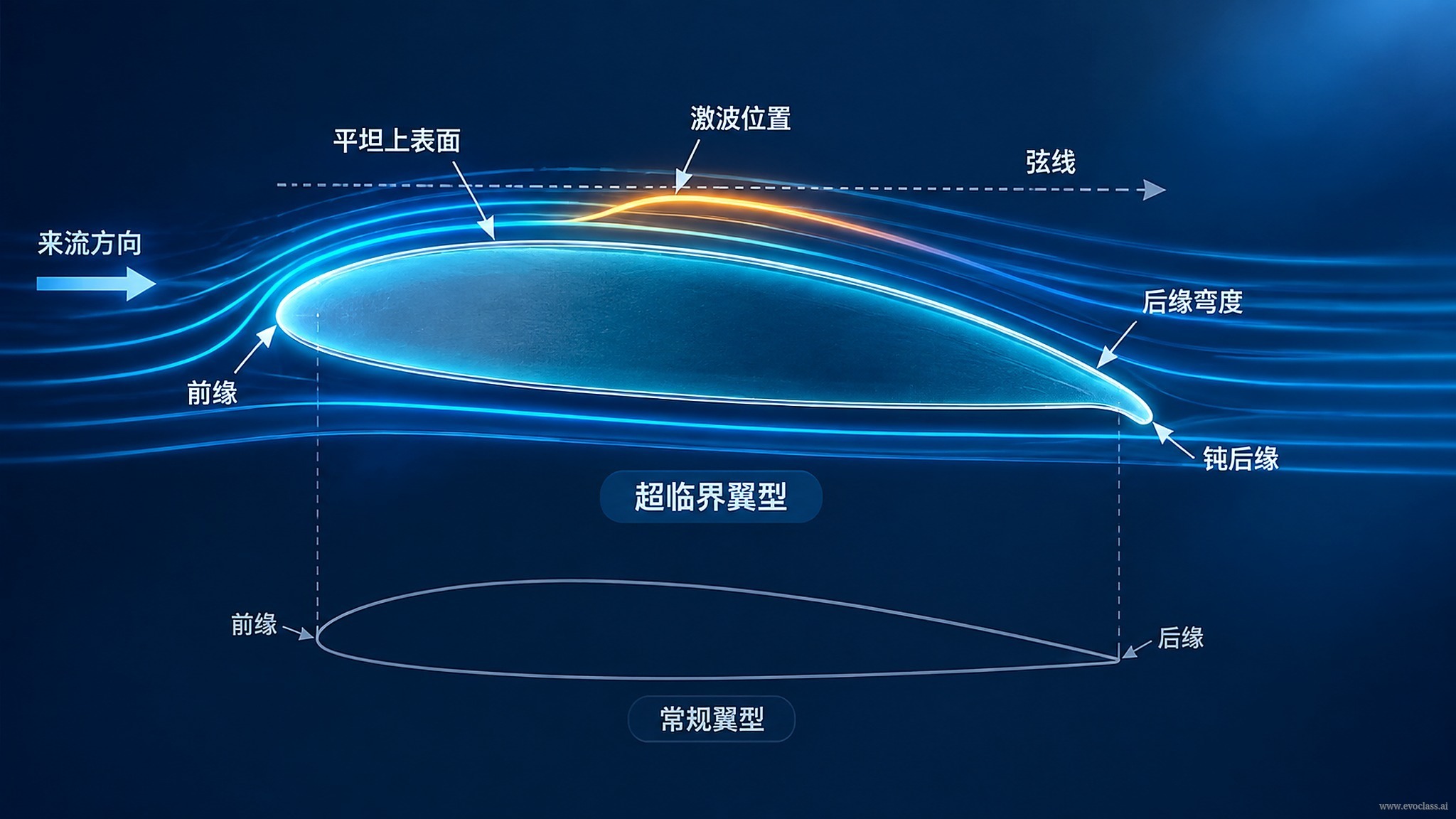
In real aerospace engineering,supercritical airfoildesign has never been about pushing a single metric to its extreme; rather, under the typical operating condition of transonic cruise, it must bring multiple engineering metricssimultaneouslywithin acceptable ranges. Airflow accelerates to supersonic speed over the upper surface of the airfoil and then decelerates through a shock wave; the shock's position and strength jointly determine both the drag level and the onset boundary of buffet, so this kind of problem inherently manifests asmulti-objective conflict and trade-off, rather than a single-objective optimization problem with a unique optimum.
Why the Three Constraints Must Hold Simultaneously
Taking COMAC's supercritical airfoil design as an example, designers face not one metric but three mutually constraining requirements:
- Critical Buffet Lift Coefficient: It defines the boundary of safe and usable lift. If buffet occurs prematurely, the buffet margin and usable flight envelope are compressed, so it carries strong safety implications and cannot be freely sacrificed for other metrics.
- Cruise Lift-to-Drag Ratio: It directly reflects aerodynamic efficiency and economics, determining cruise range, fuel consumption, and operating costs—the benefit most valued in supercritical airfoils.
- High-Fidelity Simulation Cost: A single high-fidelity aerodynamic evaluation is computationally expensive, and point-by-point trial and error or serial screening struggles to cover a sufficiently large design space, severely limiting the exploration budget.
Where the Conflict Comes From
Improving the cruise lift-to-drag ratio typically requires a stronger leading-edge suction plateau and a more rearward shock wave, but this weakens the buffet boundary; conversely, softening the airfoil to preserve buffet margin may sacrifice cruise efficiency. Thus "improving one, worsening another" becomes the norm. What engineering truly needs is not a unique optimum but a set oftrade-off solutionsthat hold under different preferences, enabling decision-makers to make justifiable choices among safety, efficiency, and cost.
This is exactly where evolutionary computation and generative modeling can step in: the system continuously generates and predicts from a base airfoil combined with perturbation samples, outputting diverse candidate solutions that balance all metrics—thus bypassing the traditional bottleneck of "prohibitively expensive high-fidelity simulation" and turning a serial screening process into parallelizable multi-objective exploration.
Supercritical Airfoil Cross-Section DiagramThe diagram illustrates how, during transonic cruise, airflow over the upper surface of a supercritical airfoil accelerates to supersonic speed and then decelerates through a shock wave; the shock's position and strength jointly affect drag and the buffet boundary. As a result, the critical buffet lift coefficient, cruise lift-to-drag ratio, and simulation cost constrain one another, and the design must seek a balanceable trade-off solution under multiple constraints.