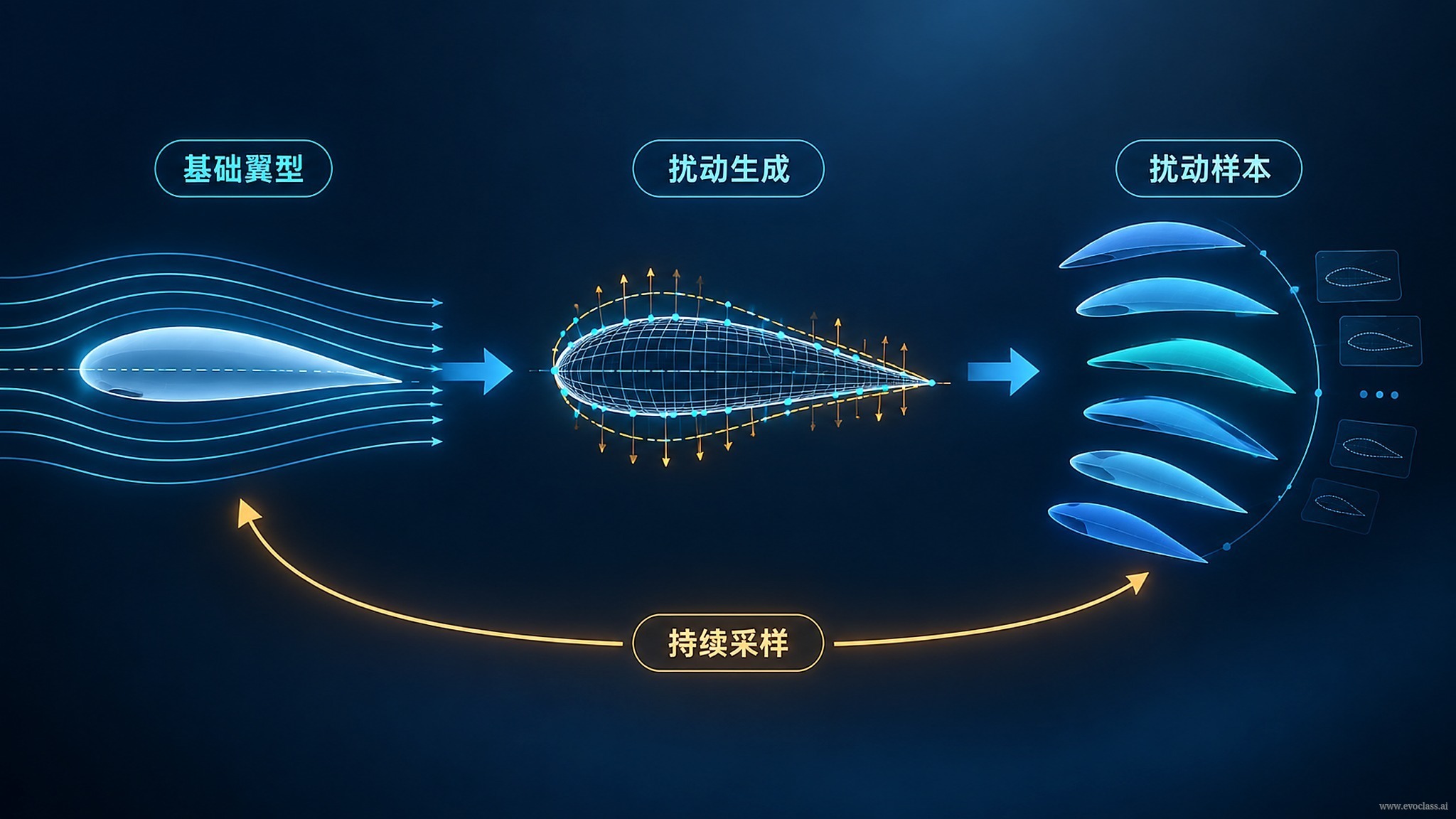
In airfoil optimization,the base airfoilserves as a stable reference that satisfies the task constraints, anchoring the parameterization, perturbation range, and evaluation criteria. Without a baseline, the search space tends to drift without order, and candidate airfoils become difficult to compare fairly.
Around the base airfoil, applycontrolled perturbationsto the thickness distribution, camber, or control point parameters, continuously generating perturbation sample families in batches or online. Local fine-grained search and global diversity coverage must be balanced simultaneously, so the perturbation intensity, direction, and sampling distribution should remain controllable.
Each round, samples are fed in batches into theprediction/evaluationstage, which outputs the performance of multiple candidates on the objectives. These results then enterevolutionary selection, update, and resampling, which in turn adjusts the perturbation generation for the next round.
This forms a closed loop ofbaseline—perturbation—prediction/evaluation—evolutionary feedback—continuous generation: the base airfoil provides a stable anchor, perturbation samples provide diversity, and evolutionary feedback makes multi-objective exploration sustainable and scalable.
Four Control Points in the Loop
- Base airfoil selection: First confirm the baseline satisfies the task constraints, then define the parameterization space and perturbation range to avoid unregulated drift in the search space.
- Continuous perturbation sample generation: Expand samples in batches or online—small local perturbations for fine search, large perturbations for global coverage.
- Combining multi-sample prediction with evolution: Batch evaluation outputs the performance of multiple candidates, serving as the basis for evolutionary selection, update, and resampling.
- Continuous closed loop: Adjust perturbation intensity, direction, or sampling distribution based on evolutionary feedback, so that the base airfoil and perturbation samples jointly support stable, scalable multi-objective exploration.
Airfoil Perturbation Generation WorkflowThe diagram uses the base airfoil as a stable anchor, applying controlled perturbations to the thickness, camber, or control point parameters to continuously generate the sample families needed for local fine search and global coverage. Samples are fed in batches into prediction/evaluation and evolutionary selection, and then feedback is used to adjust the intensity and direction of the next round of perturbations, forming a closed loop of baseline, perturbation, evaluation, and evolutionary feedback.