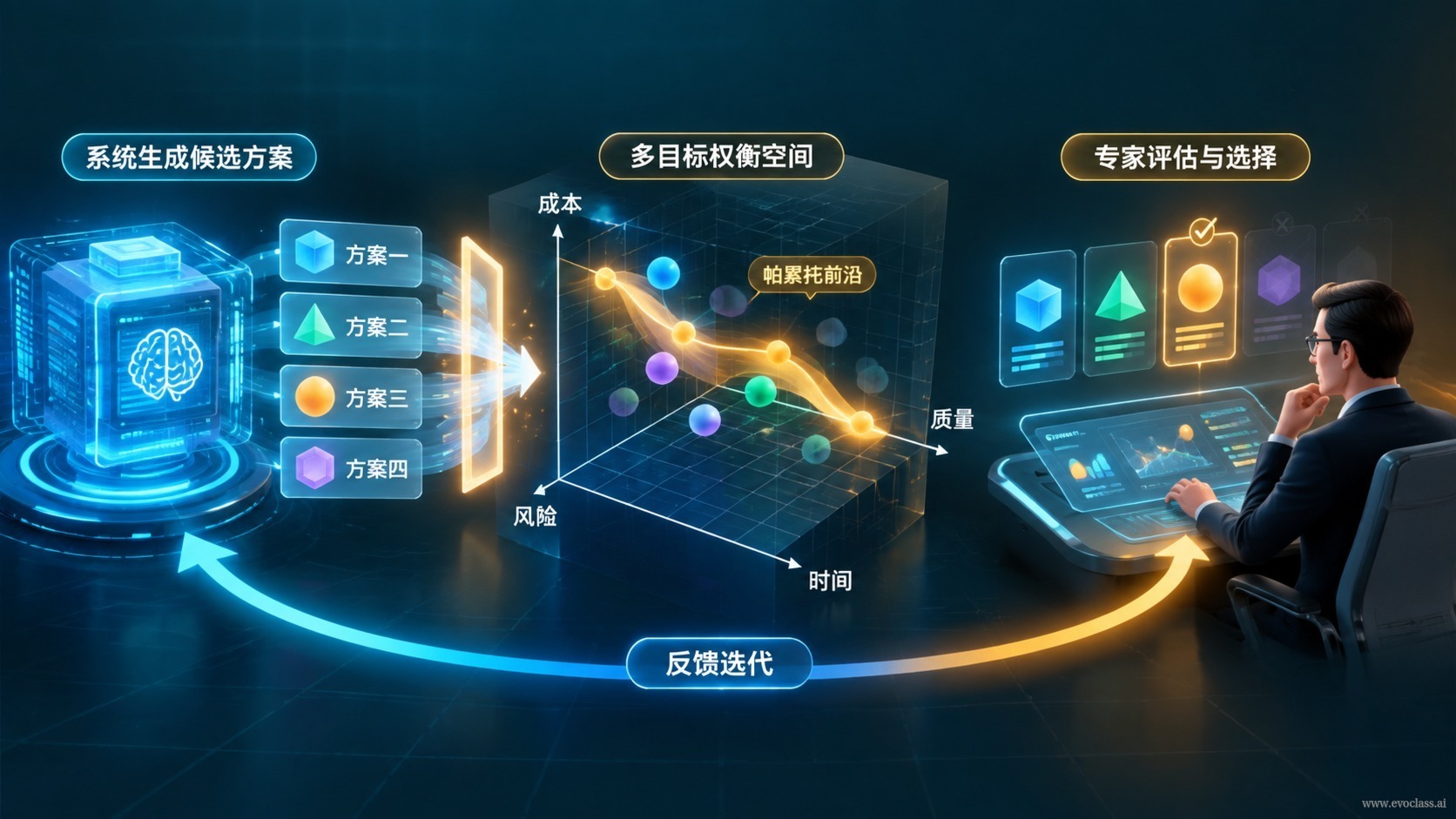
In EvoX'smulti-objective exploration workflow, the automated system and the domain expert are not substitutes for each other but twin engines working in concert: the system handles "generation and screening," while the expert handles "judgment and decision-making." The system opens up the space of possibilities; the expert narrows them down to a single deliverable choice.
This division of labor builds on the technological lineage from Lesson 2: EvoX traces its origins to the convergence of symbolism, connectionism, cybernetics, andevolutionary computation—where evolutionary computation is the most direct source: rather than predefining a single answer, it balances multiple conflicting objectives through mutation and selection in real-world evaluation. This is precisely why the system side is naturally suited to parallelism: candidates in a population can be generated and evaluated simultaneously. Traditional engineering has long been constrained by the high cost of maintainingdiversityand the tedium of serial scheduling; the large-scale parallel exploration and intelligent generation enabled by GPUs and large models are exactly the engineering foundation that alleviates this tension.
Division of Responsibilities: Who Generates, Who Decides
- System Side: Handles large-scale candidate generation, surrogate model prediction, Pareto front characterization, and diversity preservation, answering "what are the possibilities?"
- Expert Side: Determines objective priorities, hard constraints, risk tolerance, and real-world suitability, answering "which one, and why?"
Evaluation Dimensions: Single-Objective Optimum Does Not Equal a Deliverable Solution
Solution evaluation must turnPerformance Gainsandengineering costsinto explainable, auditable decision-making evidence. Beyond performance gains, evaluation must simultaneously consider computational and manufacturing costs, robustness, maintainability, uncertainty, and the trustworthiness of conclusions under sparse feedback. Focusing only on a single-objective optimum often yields solutions that cannot be realized in engineering or are extremely fragile to perturbations. In problems with conflicting objectives and complex constraints, it is precisely multidimensional evaluation that lets each of the multiple candidates retained by the evolutionary search reveal its own applicable scenario.
Decision Methods: Turning Domain Expertise into Reviewable Logic
Through explicit preferences, hierarchical evaluation, decision matrices, threshold vetoes, and sensitivity analysis, domain expertise can be expressed as testable, reproducible selection rules. A common sequence is: first use hard constraints to veto any candidate that violates baseline requirements, then weigh benefits against costs for the remaining candidates, and finally use sensitivity analysis to confirm whether the conclusion is robust to weight perturbations.
Sparse Feedback and the Accountability Loop
When high-fidelity evaluation is expensive and feedback is sparse, experts must decide whether to review, resample, or terminate the search based on the surrogate model's confidence, candidate diversity, and observed failure patterns, rather than blindly trusting the "optimal solution" given by the surrogate model. The choice of the final solution and the assumption of risk belong to the domain expert; the rationale for that choice should feed back as preferences, constraints, or evaluation signals to guide the next evolutionary search, forming a closed accountability loop.
Expert Decision-Making and System Generation Collaboration DiagramThe diagram distinguishes the division of labor between the system side and the expert side: the system handles large-scale candidate generation, surrogate prediction, and Pareto front characterization, while the expert handles objective priorities, hard constraints, risk tolerance, and the final decision. Evaluation must consider benefits, costs, robustness, and trustworthiness simultaneously, and the rationale for the selection then feeds back as preferences and constraints, forming a closed accountability loop.