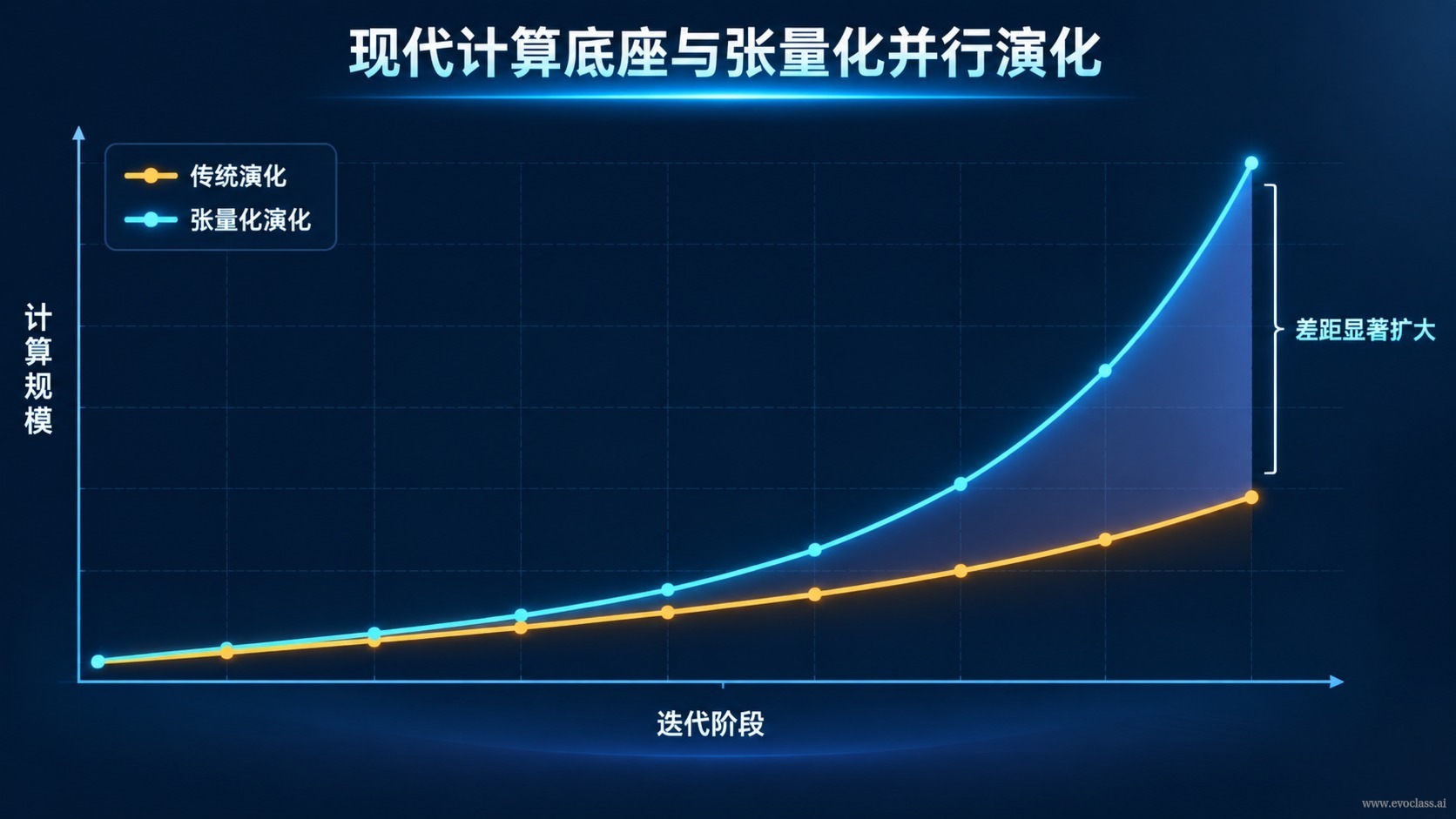
Modern evolutionary computing faces a structural contradiction:evolution's effectiveness depends on population diversity, yet diversity translates directly into evaluation counts, state management, and scheduling costs; the traditional approach of executing individual-by-individual in CPU loops quickly hits a throughput ceiling. The modern computing foundation's response is to reorganize the population, evaluations, and state into holistically computabletensors, using GPU-basedbatch parallelismto replace individual-by-individual loops, thereby advancing a large number of candidates simultaneously within a single round.
Why Serial Loops Hit the Ceiling First
In a serial implementation, each iteration requires calling the objective function for each individual separately, updating state separately, and logging separately. When the population size grows from dozens to thousands, the number of evaluations grows linearly with size, and wall-clock time grows almost equally linearly; once a single simulation (e.g., high-fidelity aerodynamic computation) becomes expensive, overall throughput is locked to a "single-core rhythm." The higher the diversity and the more costly the evaluations, the more pronounced the serial bottleneck becomes.
Tensorization: Organizing Population, Evaluations, and State into Tensors
- Population Tensor: Stack the parameters of all candidates into a 2D tensor (individuals × dimensions), so that a single operator call completes mutation and update for the entire population, rather than looping individual by individual.
- Evaluation Tensor: Package batch evaluation requests and dispatch them, executed in parallel by GPUs or batch services, then merge the return values.
- State Tensor: Maintain intermediate states such as fitness, constraint violations, and rankings in tensor form, so that selection, sorting, and updates can all be computed holistically.
- batch parallelism: The three points above together constitute this page's core term—batch parallelism. It transforms "the computational load brought by diversity" from a burden into a scale that throughput can absorb. It is therefore not an optimization detail, but an infrastructure problem for modern evolutionary computing.
Large Models Push Candidate Generation to New Boundaries
Once computational scale is unlocked, the key question shifts from "can we compute it" to "where do candidates come from." Large models can understand natural language, code, domain knowledge, and project context, and use them to construct structurally complex candidates, expanding the objects of evolution from a set of numeric parameters to programs, algorithms, and even complete system states. Encoding and mutation methods that previously relied on manual design can now be generated with model participation. Two forces thus converge: GPUs allow vast possibilities to be explored simultaneously, large models enable the system to generate richer possibilities, and evolutionary mechanisms feed candidates into real tasks, using execution and evaluation to decide which changes are worth retaining.
A System-Level Architectural Trade-off
For algorithm engineers and system developers, the above changes bring not local optimization but architectural trade-offs: a system-level balance must be struck among the richness of candidate generation, the throughput of batch computation, and engineering complexity. Diversity is the prerequisite for evolutionary effectiveness, but it must be absorbed by throughput.
Serial vs Tensorized Parallelism ComparisonA line chart comparing the computational scale of traditional serial evolution versus tensorized batch parallelism: with traditional CPU individual-by-individual evaluation, the number of evaluations and wall-clock time grow nearly linearly with population size, hitting the ceiling first when expensive simulations are involved; tensorization organizes the population, evaluations, and state into tensors, advancing large numbers of candidates in the same round on GPUs, making diversity and large-scale exploration simultaneously feasible. Large models further extend the boundaries of candidate generation.