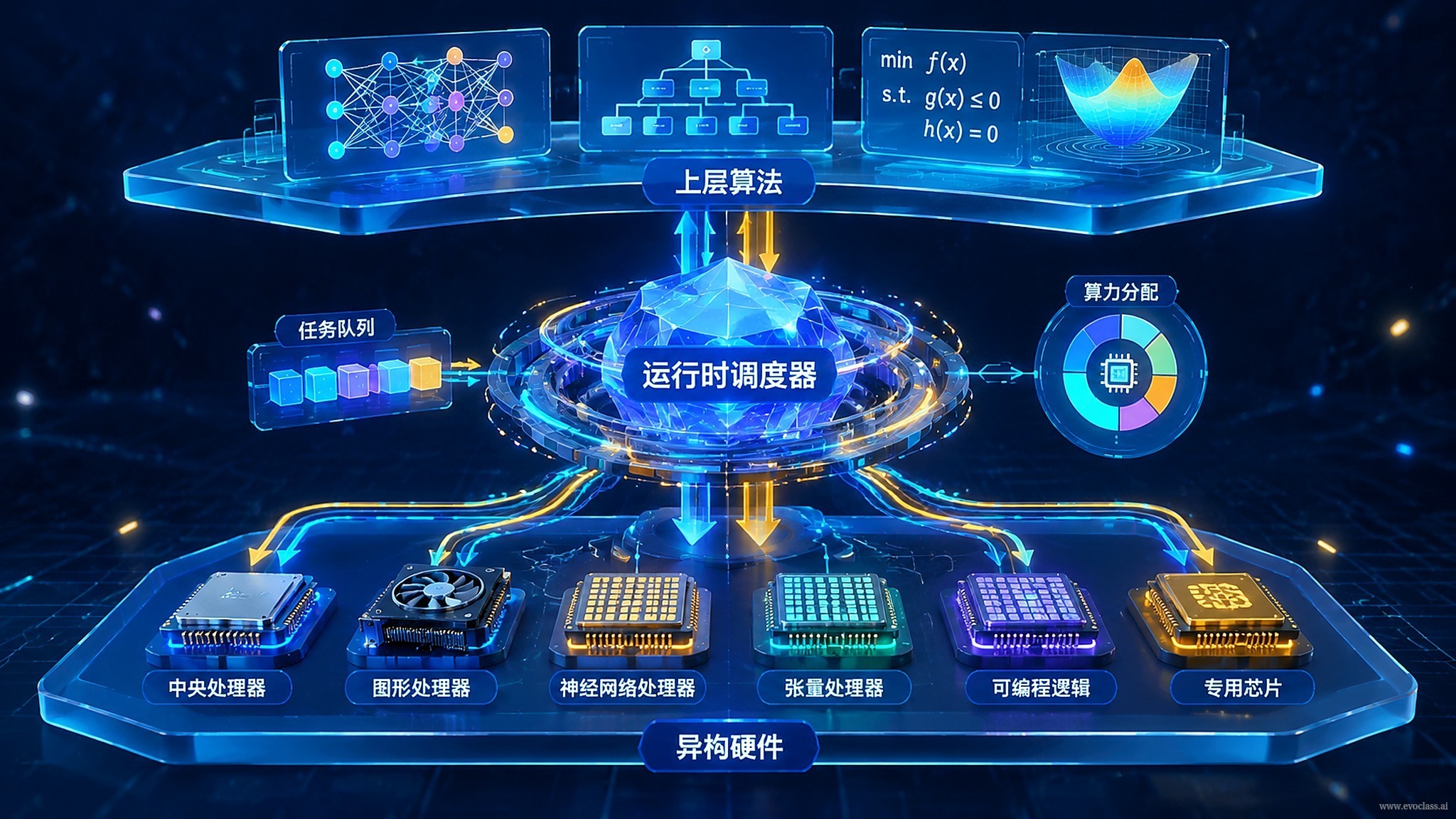
In the EvoX architecture,the Runtime scheduleris the execution hub that connects algorithm logic with physical hardware. It maps upper-layer evolutionary algorithms, problem definitions, and workflows onto heterogeneous compute resources such as GPUs, accelerators (e.g., TPU/NPU), and distributed clusters, abstracting away hardware differences while maintaining the efficient composability of algorithm modules.
Core Responsibilities
- Heterogeneous compute scheduling: Uniformly manages execution resources such as GPUs, accelerators, and distributed clusters, assigning tasks, operators, and tensor computation graphs in evolutionary computation to the most suitable hardware backend.
- Dependency and state coordination: Coordinates dependencies and execution states among tasks, ensuring that every stage of parallel evolutionary exploration is properly synchronized.
- Unified scheduling interface: The algorithm layer submits compute tasks through a unified interface without being tied to a specific device or cluster form, thereby reducing hardware coupling.
- Module composability: Supports modular composition, replacement, and reuse of algorithms, problems, operators, and execution backends, so the same codebase can easily migrate to different hardware environments.
Value and Examples
The core value of the Runtime scheduler lies in enabling parallel evolutionary exploration to run efficiently across hardware without compromising the modular design of upper-layer algorithms. For example, when the same evolutionary algorithm switches from a single-machine GPU to a multi-machine cluster, the algorithm-layer code remains unchanged while the Runtime re-maps the compute tasks and execution backends. This design lets researchers focus on algorithm innovation without rewriting code for each type of hardware.
Architecture diagram of the Runtime scheduler connecting hardware devices with upper-layer algorithmsThe Runtime scheduler sits between algorithm logic and physical hardware. Through a unified scheduling interface, it maps evolutionary tasks, operators, and tensor computation graphs onto GPUs, accelerators, or distributed clusters, while coordinating task dependencies and execution states. The algorithm layer therefore only needs to describe what to do without being tied to a device form, and the same codebase does not need to be rewritten when migrating from a single-machine GPU to a multi-machine cluster.