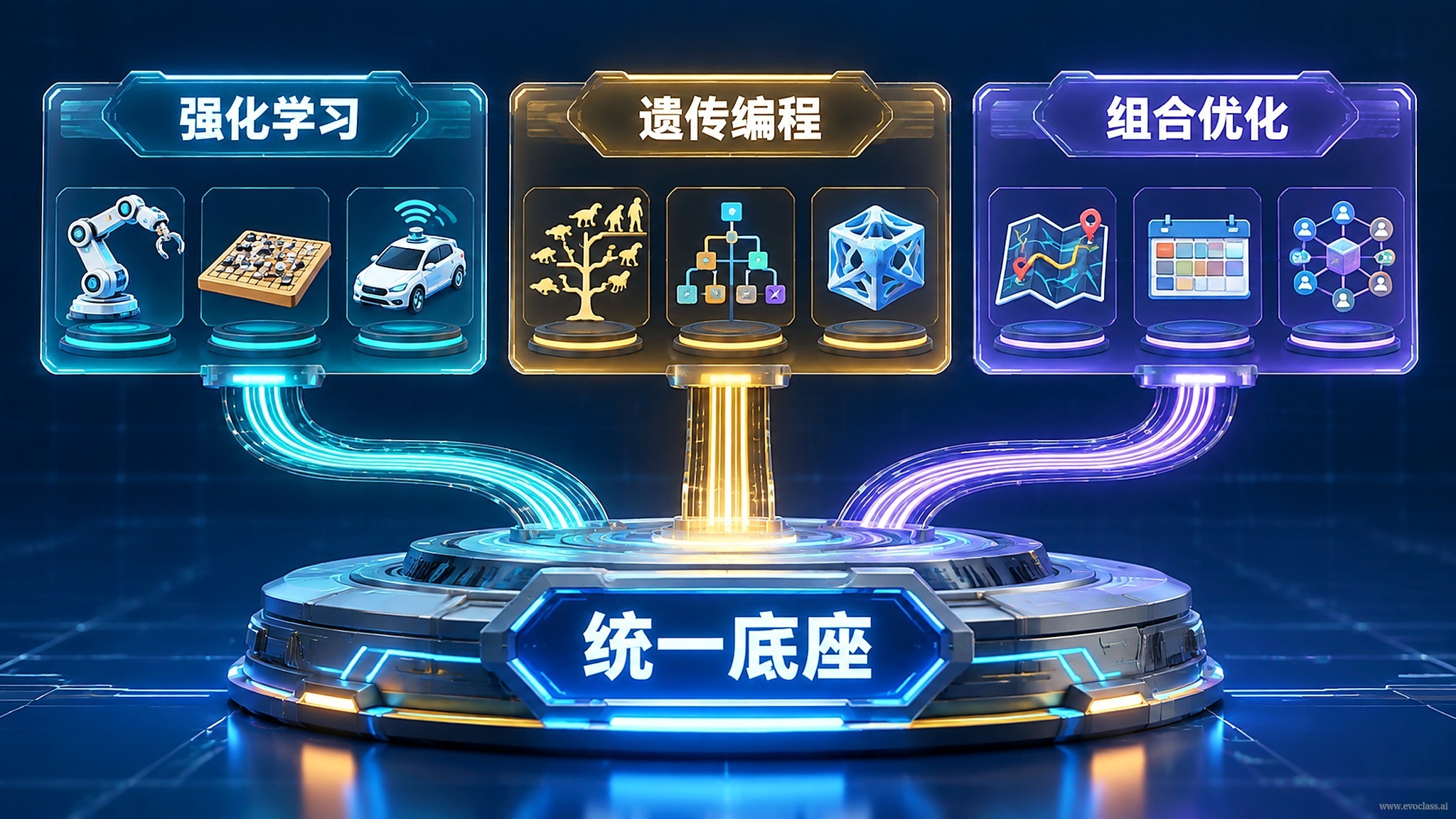
Real-world engineering problems come in highly heterogeneous forms: control and decision-making tasks require continuous interaction with a changing environment, structural design tasks require searching through a variable-length space of programs and expressions, and resource allocation and path planning tasks require solving over discrete permutations and constraints. If a separate system were rebuilt for each type of problem, evaluation interfaces, state storage, operator libraries, and compute scheduling would all have to be reimplemented, making engineering migration costs extremely high.unified baseis to use the same evolutionary infrastructure to support these heterogeneous tasks, allowing multi-domain applications to share evaluation, state, operators, and compute management.
The unified base is built on three pillars:open integration(integrating tasks through unified registration and interface specifications),tensorized execution(organizing candidate solutions into batches for parallel batch evaluation),runtime scheduling(allocating tasks across heterogeneous compute and maintaining state). Together, these three pillars ensure cross-domain reuse and explain why the capability of “providing a unified open integration base for reinforcement learning, genetic programming, and combinatorial optimization” deserves its own discussion.
How three typical task types map onto the same base
- Reinforcement Learning: The base provides parallel environment interaction, supporting batch sampling across multiple environment instances, parallel evaluation of a batch of candidate policies, and forming a closed loop with evolutionary optimization.
- Genetic Programming: The base supports the evolution of variable-length, hierarchical structures such as program trees, handling structural representations along with their mutation and crossover within a unified population and evaluation pipeline.
- Combinatorial Optimization: It adapts discrete decisions, selections, permutations, and constrained objectives to tensorized solving, boosting search throughput through batched candidates and parallel evaluation.
What Is Shared, What Is Adapted
Domain differences are absorbed by theadaptation layer: reinforcement learning focuses on the parallelism of environment stepping, genetic programming focuses on the evolution of program tree structures, and combinatorial optimization focuses on mapping discrete decisions to tensors. All three share the underlying Runtime scheduling and state management—sharing the evaluation pipeline, state carriers, operator organization, and compute management, rather than rebuilding a system for each type of problem. To judge whether the boundary is drawn correctly, ask one question: if a domain-specific structure is written directly into the shared scheduling logic, then the abstraction level has been chosen incorrectly.
The Pillars of the Unified Base and Mapping of Three Task TypesThe unified base uses three pillars—open integration, tensorized execution, and runtime scheduling—to support heterogeneous tasks: reinforcement learning emphasizes parallel environment interaction, genetic programming evolves variable-length program trees, and combinatorial optimization maps discrete decisions to tensors. All three share the evaluation pipeline, state carriers, operator organization, and compute management, with domain differences absorbed by the adaptation layer, avoiding the need to rebuild a system for each type of problem.