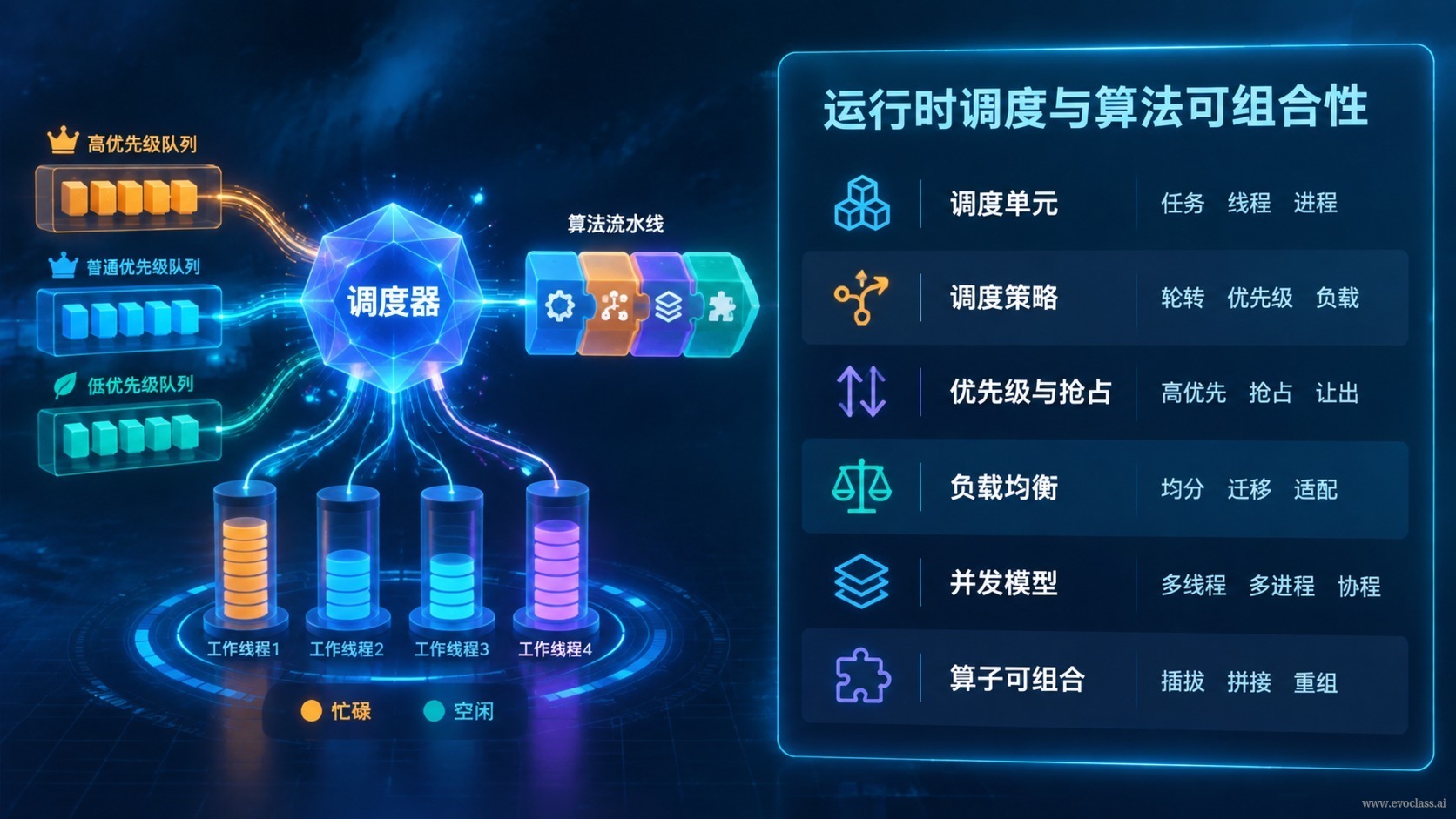
Learning Objectives:Understand the role of the Runtime in scheduling heterogeneous compute resources and preserving algorithm composability.
Core Concepts:Heterogeneous compute scheduling.
Runtime: The Scheduling and Abstraction Layer in a Unified Foundation
In the unified EvoX foundation, the Runtime bridges the layers above and below: it connects upward to algorithm, problem, and workflow modules, and manages heterogeneous compute resources such as CPUs and GPUs downward. Through interface isolation, it preserves algorithm composability, keeping the algorithm layer from being directly bound to underlying hardware, parallel strategies, or compilation details. This way, when users swap algorithms like DE or PSO or change optimization problems, there is no need to rewrite low-level GPU/CPU parallel code; the Runtime schedules evaluation and update tasks through a unified workflow, decoupling algorithm composition from hardware execution.
Key Takeaways
- The Runtime's Role in Heterogeneous Compute Scheduling: Based on the workflow and the state of monitoring modules, it schedules tasks such as population, evaluation, and operators to appropriate devices, and centrally manages parallel execution and resource usage.
- Conditions for Algorithm Composability: Algorithms, problems, and operators are composed through modular interfaces, without being directly bound to underlying hardware, parallel strategies, or compilation details.
- Underlying Hardware Isolation: Device differences, tensorized execution, and compilation optimizations are absorbed by the Runtime, keeping the algorithm layer device-agnostic for easier replacement and reuse.
- The Boundary Between Scheduling and Composition: Abstraction incurs scheduling and data movement overhead, requiring trade-offs among flexibility, performance, and engineering complexity.
- Value of the Unified Foundation: A single Runtime can support multi-domain applications and provides a stable execution environment for method evolution and algorithm replacement.
Summary of Key Points on the Scheduling Mechanism
| Scheduling Target | Heterogeneous Resources | Decoupling Mechanism | Composability Benefit | Main Trade-off |
|---|---|---|---|---|
| Algorithm/Problem Modules | CPU/GPU | Unified Interface | Swappable Algorithms | Interface Abstraction Overhead |
| Population/Evaluation/Operator | Multiple Devices | Workflow Scheduling | Parallel Execution | Data Movement Overhead |
| Workflow | Heterogeneous Compute | Hardware Isolation | Cross-Domain Reuse | Scheduling Complexity |
Key Points of the Runtime Scheduling MechanismThe Runtime sits between algorithms and hardware. Upward, it connects to algorithms, problems, and workflows through modular interfaces; downward, it schedules populations, evaluations, and operators onto heterogeneous resources such as CPUs and GPUs. Interface isolation allows swapping DE, PSO, or changing problems without rewriting parallel code, at the cost of overhead from interface abstraction, data movement, and scheduling complexity.