On EvoX's modern computing foundation, tensorized parallelism and a unified Runtime have alreadycomputing scalegreatly unlocked this bottleneck: populations, evaluation results, and algorithm states can now enter GPUs, accelerators, or distributed clusters as a whole, so tens of thousands of candidate evaluations no longer need to be processed one by one in serial. Once computing power is unlocked, the shortfall constraining evolutionary performance shifts elsewhere—the method for generating candidate solutions is still manually predefined and remains fixed during execution.
The Limits of Traditional Optimization: It Finds Solutions but Doesn't Improve the Search
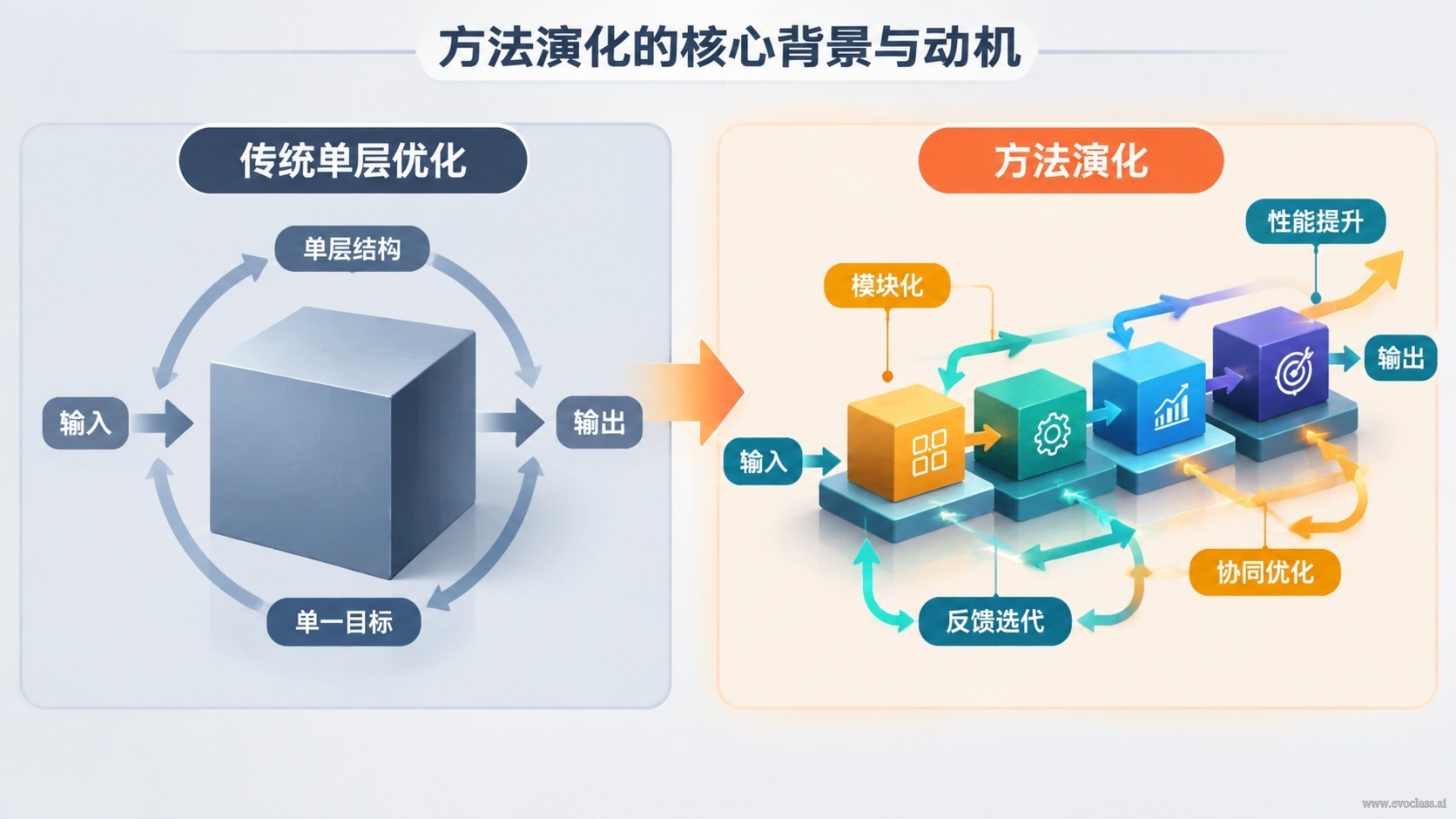
Traditional optimization algorithms are very good at finding solutions within a given search space: given a mutation strategy, a set of parameters, or a neighborhood structure, they repeatedly generate candidate solutions, evaluate them, and select. The problem is that this candidate-generation mechanism is anexternallydesigned constant, and the algorithm never changes it throughout the entire run. In other words, only the "solution" is searched—the "way of producing solutions" is not.
- The search strategy, parameters, or candidate-generation mechanism are manually predefined and remain fixed during execution.
- Once the method for producing candidates is fixed, the system can only repeat the same routine and struggles to adaptively expand with the problem, environment, and feedback.
- Although the algorithm can find solutions, it does not participate in improving the search process itself.
EvoX's Key Move: Shifting the Problem Up One Level
Method evolution turns "how to generate candidate solutions" from an external design choice into something that can be searched and evolved. EvoX's core move is not only to optimize candidate solutions but also to optimize the method that produces them: settings such as the mutation strategy, scaling factor F, and crossover rate CR in differential evolution can all enter the evolutionary loop and be continuously adjusted with feedback.
The system then searches on two levels simultaneously:the "solution" and the "way of producing solutions". When the problem form changes, the environment drifts, or the feedback signal shifts, the method level can be rewritten accordingly—rather than forcing one fixed heuristic strategy to handle every scenario.
Why This Motivation Is the Foundation for What Follows
It explains the watershed between EvoX and ordinary optimizers: how the boundary of evolutionary objects continues to expand outward, how the algorithm itself can be improved, and how the system moves toward cascading and continuous evolution—all rest on this "shift upward." The computing foundation solves "can we compute at scale," while method evolution solves "can the search method grow alongside computing at scale."
Architecture Diagram Comparing Traditional Single-Layer Optimization and Method EvolutionThe diagram contrasts two levels of search: traditional optimization repeatedly generates, evaluates, and selects solutions within a fixed search space, keeping the candidate-generating strategy and parameters unchanged; method evolution instead brings the way solutions are produced—such as the mutation strategy, scaling factor F, and crossover rate CR—into the evolutionary loop. The system then searches on two levels at once—the "solution" and the "way of producing solutions"—allowing it to continuously adapt to the problem and feedback, rather than switching to another algorithm that is then fixed again.