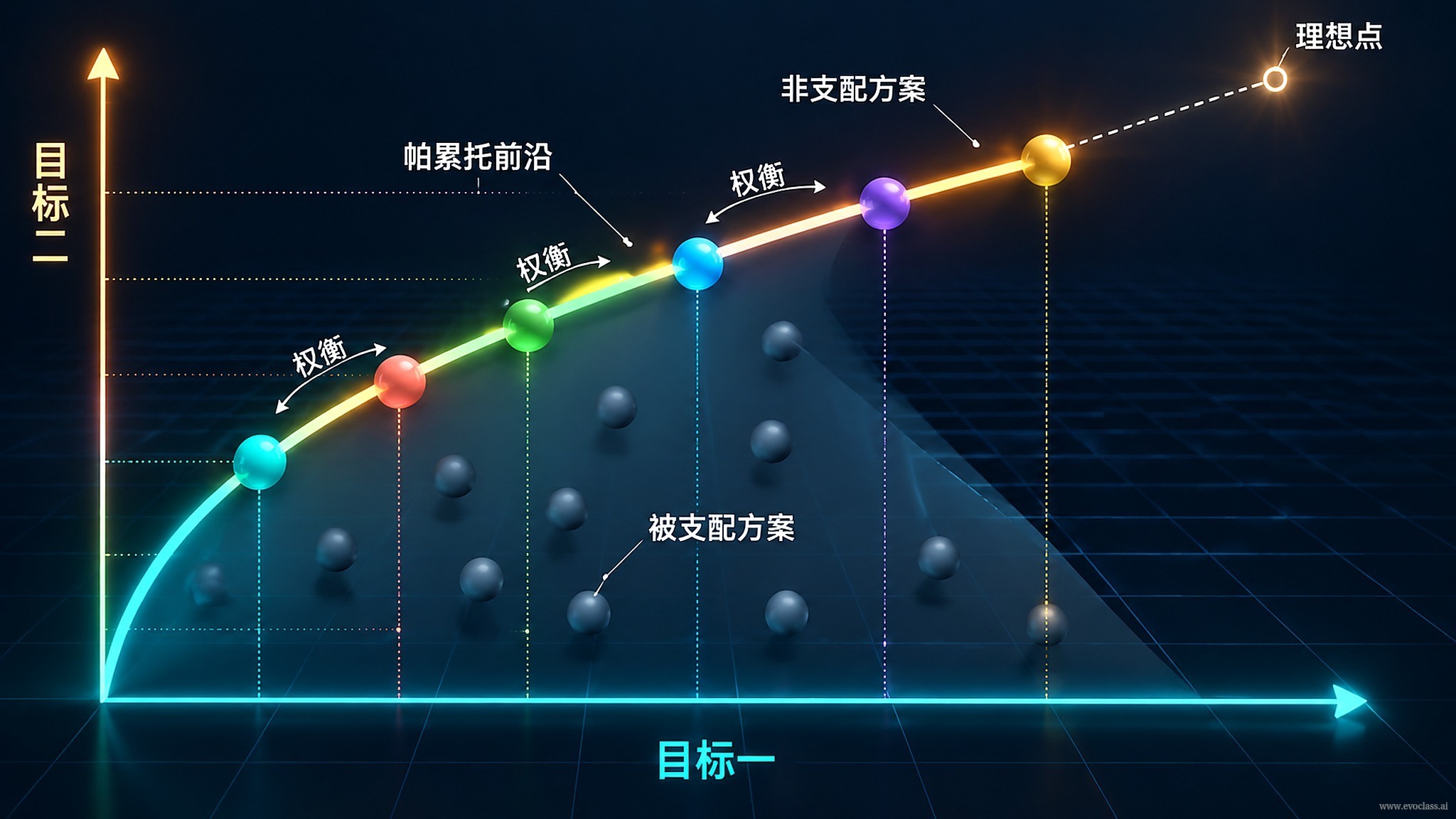
Real-world optimization tasks rarely look like textbook problems: a single objective, clear constraints, and an optimum you can write down. In engineering and research, the norm is thatmultiple objectives pull against and conflict with one another— cutting charging time often shortens cycle life; improving aerodynamic performance usually increases drag; scaling up evaluation size costs money and latency. Improving any single metric typically requires conceding on another, so there is no globally "free optimum." This is exactly where EvoX positions itself for real-world tasks: rather than delivering a single "answer" as early as possible, it explores in parallel along different preference directions, keeps a set of differentiated candidates, and hands the final trade-off back to domain experts and real-world constraints.
1. Conflict: objectives often can't all be satisfied at once
- Real trade-offs exist between metrics: increasing lift usually raises drag, and thinning the airfoil helps aerodynamics but weakens structural strength.
- "Optimal" must come with a stated preference: the same set of candidates yields different recommendations under a cost-weighted versus a safety-weighted preference.
- A more accurate framing is not "find the optimal solution" but "find an acceptable and explainable trade-off solution under a given preference."
2. The solution is not a single point but a set of trade-off solutions
The solution set of a multi-objective problem is called the Pareto front: each point on the front represents a reasonable preference orientation, and no objective can be improved further without worsening another. Solutions on the front do not dominate one another; there is no absolute ranking, only "under which preference it fits better."
3. Exploration takes priority over convergence
- Narrowing down to a single solution too early loses structural information about the solution space, leaving the system unable to answer "if the constraints change, what alternatives remain?"
- Population diversity should be maintained so that different preference directions are sampled and evaluated simultaneously, preventing all individuals from collapsing into a narrow region of the front.
- The value of differentiation lies in responsiveness to change: when engineering constraints, costs, or risks shift, decision-makers can quickly switch alternatives without having to re-solve.
For this kind of multi-directional expansion to actually run, it needs a matching computational foundation. EvoX organizes candidates, evaluation results, and algorithm state as tensors that can be computed as a whole, so mutation, evaluation, and state updates enter the computation graph together for compiler optimization; the Runtime scheduler then distributes batch computation to GPUs, accelerator devices, or distributed clusters. Precisely because tensorized parallelism delivers high-throughput batch evaluation, maintaining a large population and covering the entire front becomes an engineering-viable choice rather than being crushed by the overhead of serial evaluation.
4. Sparse feedback, expensive evaluations
Real-world evaluations come from simulation, bench testing, or prototyping; each run is costly and the signal is sparse (perhaps only pass/fail, or a few noisy metrics). This calls for spending the limited budget on regions that expand the trade-off space: using surrogate models to replace some high-fidelity evaluations, allocating budget to candidates with high uncertainty that may improve front coverage, and maintaining sampling breadth across the entire front rather than repeatedly refining the neighborhood of the current "optimum."
5. Who holds decision authority
The algorithm's job is to unfold the trade-off space and provide a comparable candidate set; human experts' job is to make the final call based on scenario preferences, regulations, and business constraints. Neither can replace the other: the algorithm cannot substitute for judgments about preferences and risk, and experts cannot manually enumerate the breadth of the trade-off space.
Multi-Objective Pareto Front and Candidate DistributionThe diagram presents multi-objective optimization as a Pareto front: objectives such as charging time and lifespan pull against each other, improving one often sacrifices another, and solutions on the front do not dominate one another. EvoX maintains a large population through tensorized parallelism, samples along different preference directions, and keeps differentiated candidates for decision-makers to trade off against constraints.