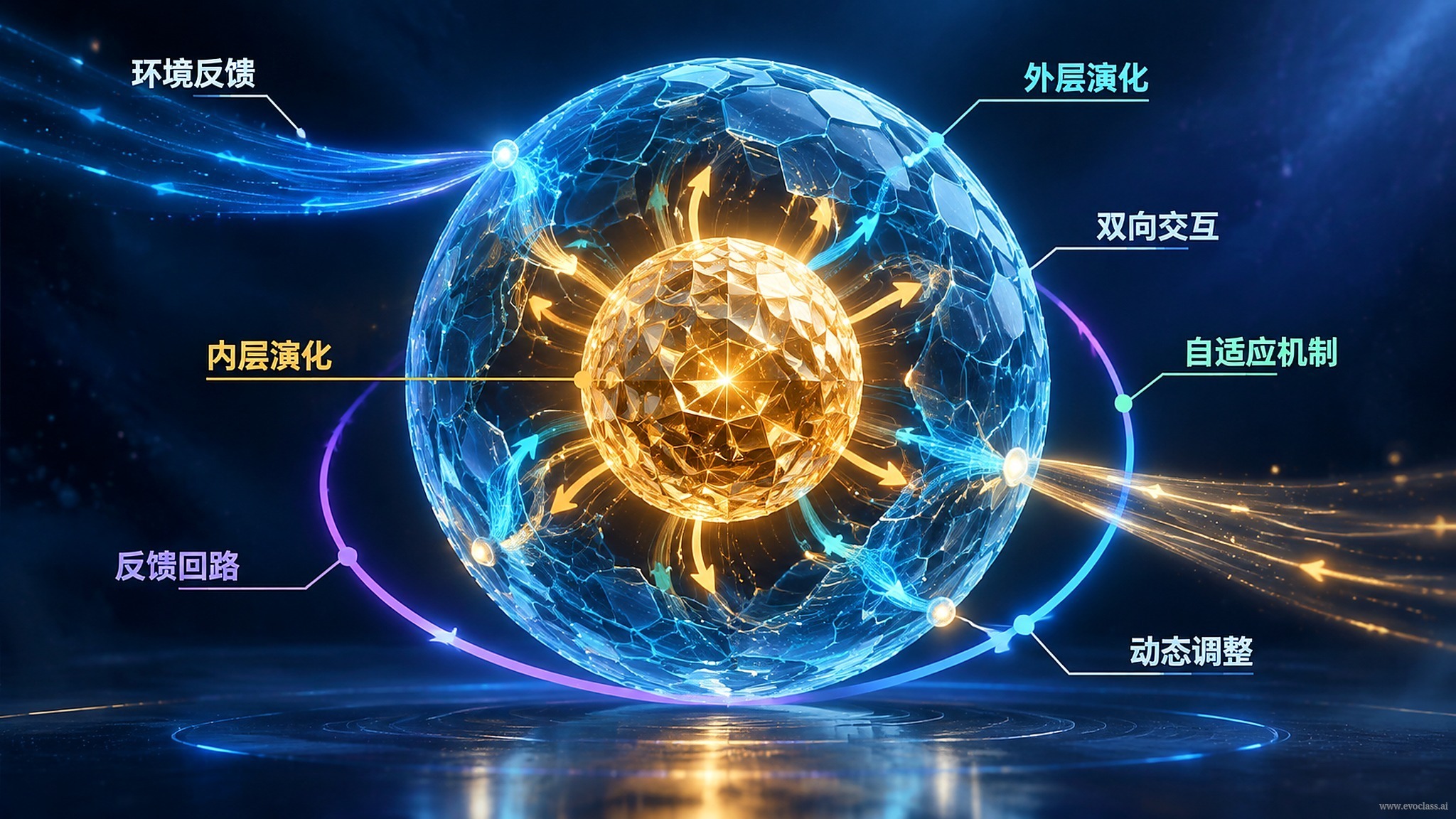
Dual-Loop Evolutiondecouples “solving specific tasks” and “improving solution methods” into two interacting evolutionary loops:the inner looptargets task solving and produces runtime performance,the outer loopevolves the inner algorithm's configurations and strategies based on that performance, forming an adaptive algorithm-improvement mechanism. It is not a simple chaining of two algorithms; rather, it adds an evolvable meta-level control layer above the task-solving layer, shifting the system from “manually setting algorithms” to “algorithms automatically adapting to tasks.”
Division of responsibilities between the inner and outer loops
- Inner-loop role: solves real tasks and generates candidate solutions, objective values, and runtime performance data. It is responsible for “solving the problem.”
- Outer-loop role: does not solve the original task directly; instead evolves the inner algorithm's configurations, strategies, and parameters. It is responsible for “improving the problem-solving method.”
- Feedback loop: the evaluation results of inner-loop tasks are aggregated into an outer-loop fitness signal, used to select, mutate, and update better inner-loop configurations.
- Adaptive mechanism: the outer loop continuously adjusts inner-loop strategies in response to changes in tasks and environments.
- Parallel support: the GPU can run many inner-loop tasks in parallel, providing richer statistical feedback for outer-loop evolution and reducing search wait time.
MetaDE: Using Evolution to Improve Evolution
Take MetaDE as an example: the inner DE handles concrete optimization tasks, while the outer evolutionary algorithm selects and adjusts DE's configurations and strategies based on inner-loop runtime performance. The results of many inner-loop tasks in turn guide outer-loop configuration selection, forming a dual-loop closed cycle: “using evolution to improve evolution.”
Learning objectives
Master the collaborative relationship between inner-loop task solving and outer-loop strategy optimization, understand that method evolution adds an evolvable meta-level control layer above the inner loop, and be able to explain how GPU parallelism provides the outer loop with more reliable statistical feedback.
Dual-Loop Evolution Architecture InteractionThe diagram depicts the division of labor via two loops: the inner loop solves real tasks and produces candidate solutions and runtime performance, while the outer loop aggregates that performance into fitness, then selects, mutates, and updates the inner algorithm's configurations and strategies. GPU parallelism runs many inner-loop tasks, providing richer statistical feedback for the outer loop and forming a dual-loop closed cycle: “using evolution to improve evolution.”