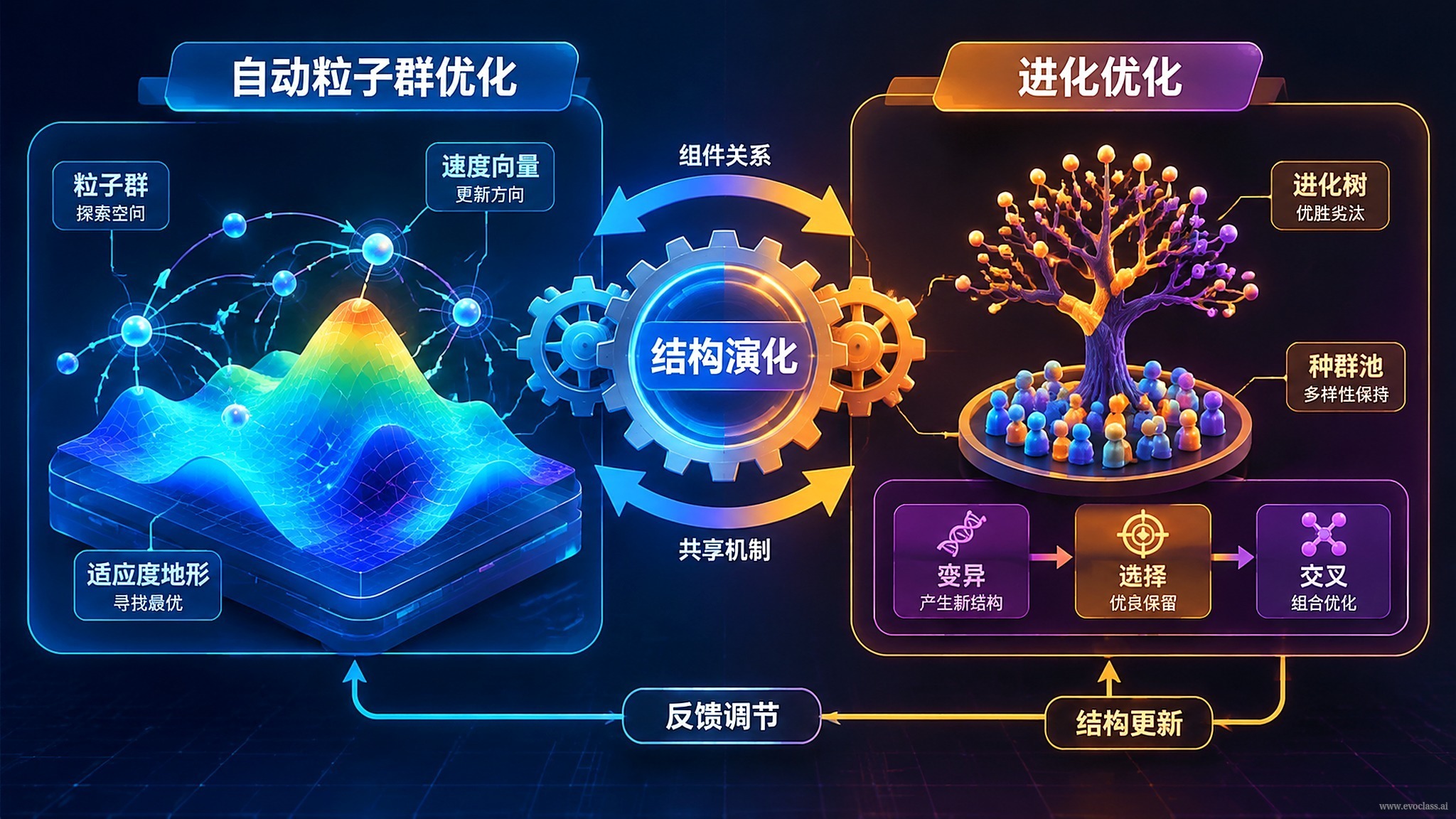
In methods like MetaDE, evolution happens at theparameter level: the inner algorithm solves real tasks while the outer algorithm tunes the inner algorithm's configuration and strategy. In contrast, AutoPSO and EvoGO raise the evolved object up another level—directly evolving thealgorithm structure itself: how components are combined, how candidates are generated, and how update rules are organized.
The Criterion: What Is the Outer Layer Actually Searching?
To distinguish "parameter tuning" from "structure modification," don't just look at the method's name—look at thehierarchical level of the outer search space. For methods like MetaDE, the outer search space consists of the inner algorithm's configuration and strategy (values such as learning factors, mutation probabilities, and selection pressure); for AutoPSO / EvoGO, the outer search space is the algorithm structure—which components participate in the combination, what the candidate generation process looks like, and how states are updated.
- parameter level: structure is fixed, only values are tuned. The reachable scope is the "intensity" of behavior.
- Structure level: components and connections are variable. The reachable scope is the "form" of behavior.
AutoPSO: Breaking Classic PSO into a Component Pool
The velocity–position update formula in classic PSO is hard-coded. AutoPSO decomposes this process into composable components: velocity terms, neighborhood topologies, perturbation terms, restart strategies, and more—then the outer layer of evolution selects and assembles them into new candidate generators. It no longer sticks to a fixed classic update structure; instead, the "update structure" itself becomes a searchable variable. Tuning learning factors only changes behavioral intensity; changing component combinations changes behavioral form.
EvoGO: Letting Historical Feedback Decide Where the Structure Changes
EvoGO focuses on integrating historical feedback into the structure evolution path: past search trajectories and performance records are no longer used merely for "selecting solutions" but to decide "where the structure changes next." Feedback thus shifts from a result filter to the steering wheel for structure updates—it changes the direction of the next round of structure candidates, rather than just picking a good result from a batch of completed candidates.
The Shared Two-Layer Skeleton and Its Engineering Implications
Both share the same skeleton: the inner algorithm runs on real tasks, and the outer layer evolves the structure based on inner-layer performance. The critical prerequisite is sample density—running large numbers of inner tasks in GPU-parallel batches makes the "structure–performance" comparison samples dense enough that the outer layer's selection is statistically meaningful and won't be swayed by the noise of a single run.
Structure Evolution Relationship: AutoPSO and EvoGOThe diagram contrasts parameter-level and structure-level evolution: MetaDE's outer layer searches over configuration values such as learning factors and mutation probabilities while the algorithm structure stays fixed; AutoPSO and EvoGO's outer layer searches over how components are combined and how candidate generation and update rules are organized. AutoPSO breaks PSO updates into a component pool—velocity terms, neighborhood topologies, perturbation, restart, and so on—for the outer layer to select and assemble, while EvoGO uses historical trajectory feedback to decide where the structure changes next.