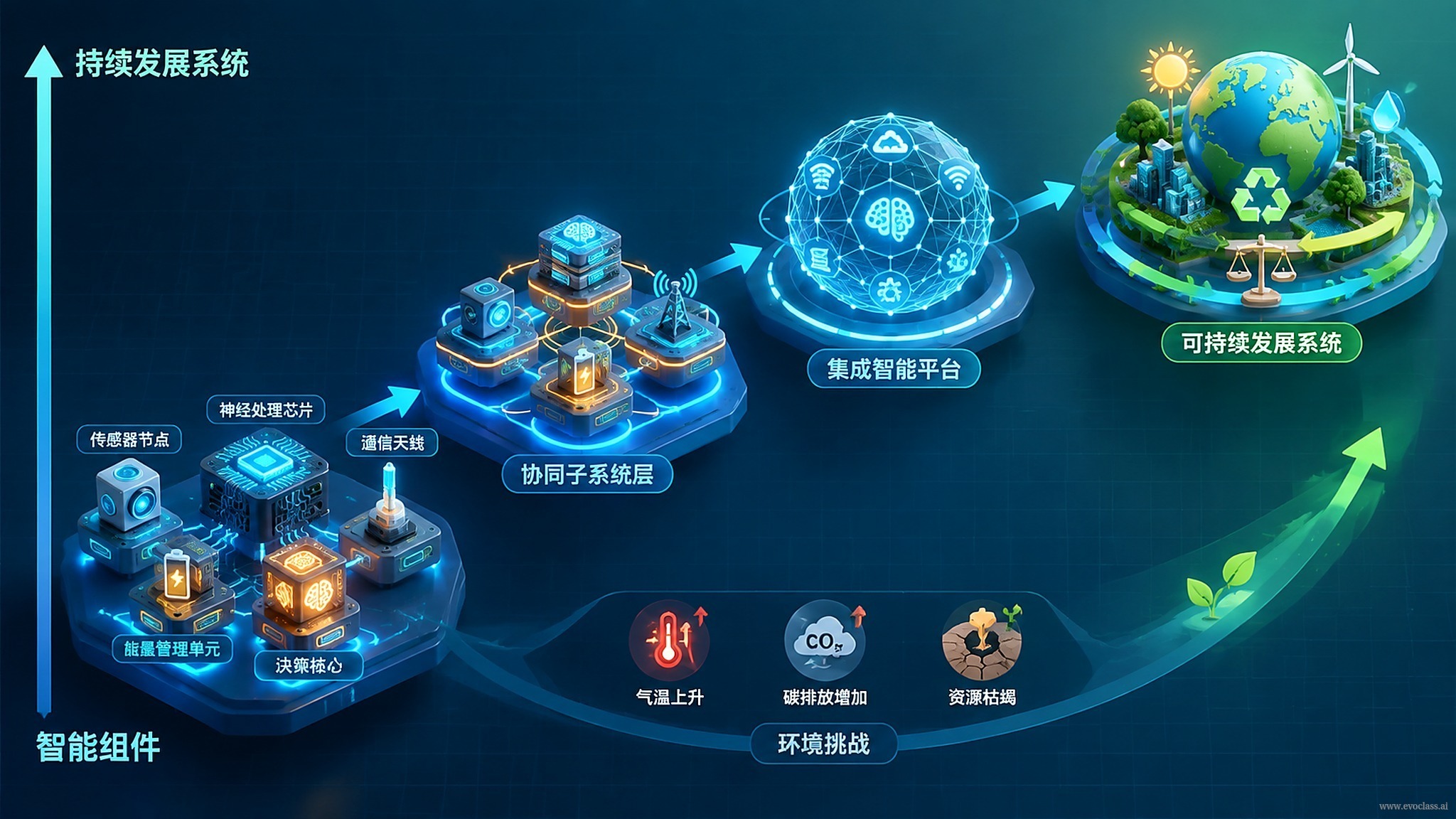
When we discussthe sustainable development of intelligent systems, intuition tends to focus on "how powerful the intelligent components are": larger models, stronger generation and reasoning capabilities, higher benchmark scores. But in real-world scenarios that run over the long term, a more critical question is:powerful intelligent components are not the same as a sustainably evolving system. Powerful intelligent components such as large models are merelymaterial; without a system framework that organizes their sustainable development, isolated capabilities can hardly translate into long-term environmental adaptability.
Connecting intelligent components to a system is only the first step. True sustainable development requires the system to continuously producedifferentcandidates and let them enter the real environment for validation, rather than optimizing only within preset objectives or offline metrics; after validation, the system must also have selection and memory mechanisms: accepting effective changes, rejecting modifications that would damage existing capabilities, and persistently preserving validated results. As a result, the focus shifts from "what intelligent components can do" to "how the system organizes sustainable development and responds to real-environment challenges."
The Four Essential Stages of Sustainable Development
- Candidate Generation: The system must continuously produce candidates that are genuinely different in strategy, structure, or parameters; if candidates are highly homogeneous, evolution loses its raw material.
- Real-Environment Validation: Let candidates be evaluated in real tasks and with real feedback, exposing failure modes that offline metrics cannot see, such as distribution drift, boundary conditions, and long-tail scenarios.
- Change Screening: Accept effective changes and reject modifications that would damage existing capabilities—the latter are often the main source of long-term system degradation.
- Result Persistence: Preserve validated and effective solutions, strategies, or experience so they can be reused in later candidate generation, forming a cumulative development trajectory.
Why "Offline Optimal" Is Not the Same as "Long-Term Adaptation"
Offline metrics describe performance on past data, while the real environment is constantly changing: task distributions drift, resource constraints shift, and new demands keep pouring in. Optimizing only within preset objectives or offline metrics means the system is circling around a closed proxy objective; once the environment changes, modifications that have never been validated in reality may quietly erode existing capabilities. Therefore, after environmental validation,screeningandmemoryare equally critical—they give the system stable judgment about "what to accept, what to reject, and what to retain."
A Shift in Perspective: From Component Capability to System Organization
A large-model agent with strong generation and reasoning capabilities, if it has neither a candidate generation mechanism nor real-environment validation, change screening, and result persistence, may still repeat the same mistakes in long-term tasks, or even damage capabilities it had originally mastered during updates. Conversely, when these four mechanisms are organized into a closed loop, the strong capabilities of intelligent components can be steadilyaccumulatedand become system capabilities that deepen continuously as the environment evolves.
From Intelligent Components to a Sustainable Development SystemThe figure positions powerful intelligent components such as large models as system material. Sustainable development also requires four stages forming a closed loop: continuously generating genuinely different candidates, validating them in real tasks and with real feedback, screening and rejecting changes that damage existing capabilities, and persisting validated results for later reuse. Without these organizational mechanisms, isolated intelligent capabilities struggle to become long-term environmental adaptability, and improving offline metrics does not mean the system has completed its evolution.