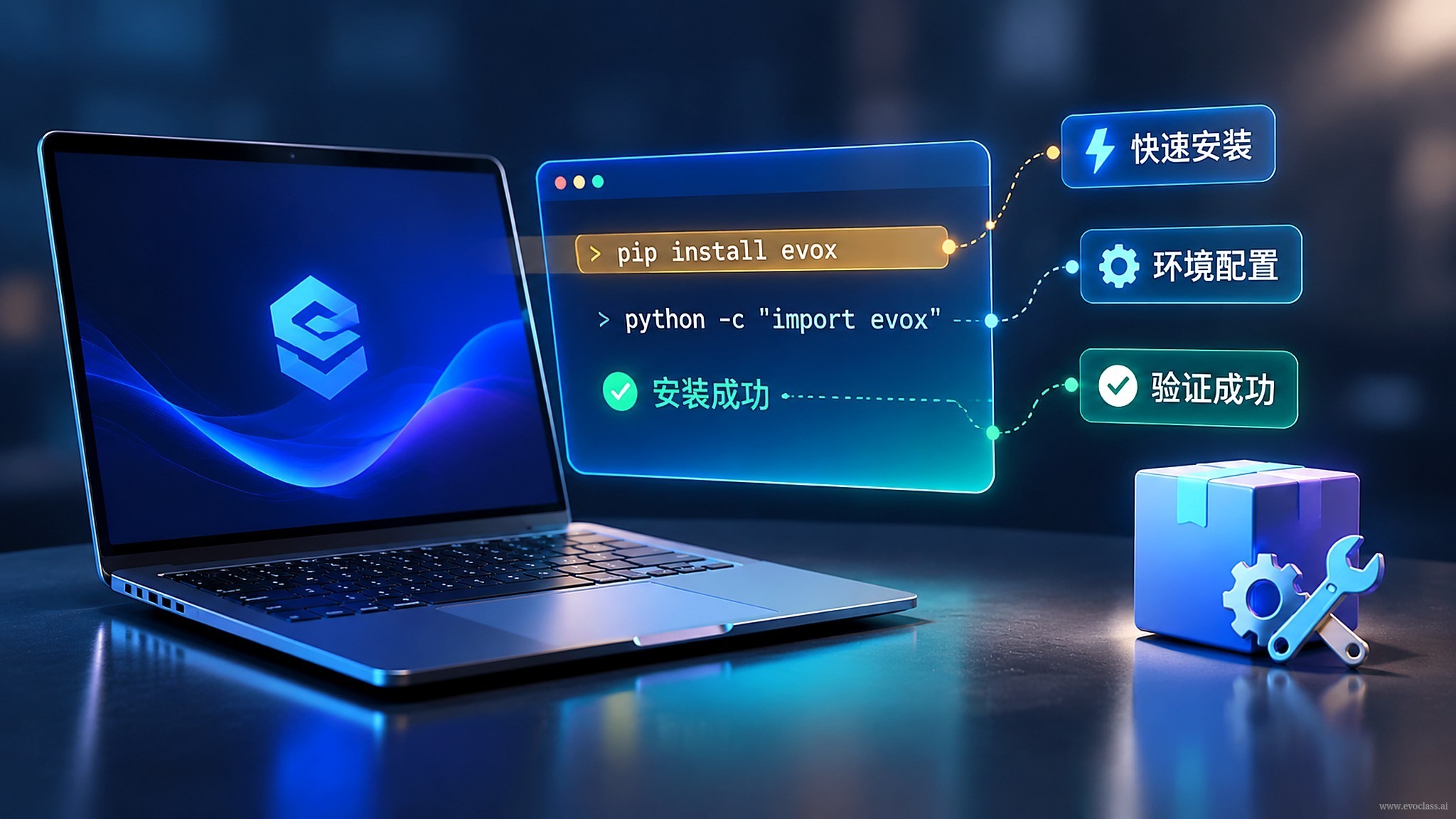
Before you can actually run evolutionary experiments, the first obstacles are rarely algorithmic — they're environmental: how to install packages, how to align dependencies, how to choose a device, and how to troubleshoot errors when things fail to run.Quick Start & Simplified Environment SetupThis section addresses exactly that friction — using an AI-assisted minimalist workflow to install and initialize EvoX, and connecting underlying compute resources with the evolutionary environment through standardized interfaces, so researchers can get back to designing problems as quickly as possible.
AI-Assisted Minimal Onboarding
Installing EvoX, pulling matching dependencies, and writing base configuration files — steps that once required digging through documentation and troubleshooting errors one by one — can often be compressed into just one or two natural-language instructions with the help of AI tools. The tool translates those instructions into executable install and configuration actions, and offers targeted fix suggestions when version conflicts, missing dependencies, or unavailable devices arise. Its value isn't in doing research for you, but in continuously lowering the barrier to adopting the framework and keeping non-research engineering overhead to a minimum.
The Four-Step Minimal Workflow: Install → Configure → Verify → Run
- Install: Get EvoX itself and its dependencies, and confirm that the versions are mutually compatible.
- Configure: Complete base environment initialization and determine whether this experiment will use CPU, GPU, or a cluster.
- Verify: Check that dependencies are complete and that the target compute device can actually be recognized and invoked.
- Run: Run a minimal example end to end to confirm that the full "problem → algorithm → run → result" pipeline works.
Once you've completed all four steps, what you get isn't just a working environment but a trustworthy baseline: any future anomaly can be compared against it to determine whether the problem lies in the environment or in the experiment design.
Standardized Interfaces: Decoupling Compute from the Evolutionary Environment
Minimal configuration doesn't mean reduced capability. EvoX connects underlying compute resources with the higher-level evolutionary environment through a unified standardized interface: algorithms, problem modules, and workflows are written only against that unified interface, while GPUs, local multi-core CPUs, and distributed clusters are scheduled beneath it. As a result, switching hardware or adjusting parallel scale usually requires no rewriting of algorithm code, andthe coupling cost between algorithms, problems, and computedrops significantly. Researchers can therefore move more quickly into core problem design, algorithm composition, and experiment iteration.
Quick Installation & SetupThis image corresponds to the EvoX quick-start section, showing how AI assistance can compress installation, dependency pulling, and base configuration into natural-language instructions, and how to run a minimal example through the four steps of install, configure, verify, and run — establishing a trustworthy baseline for comparison in later experiments.