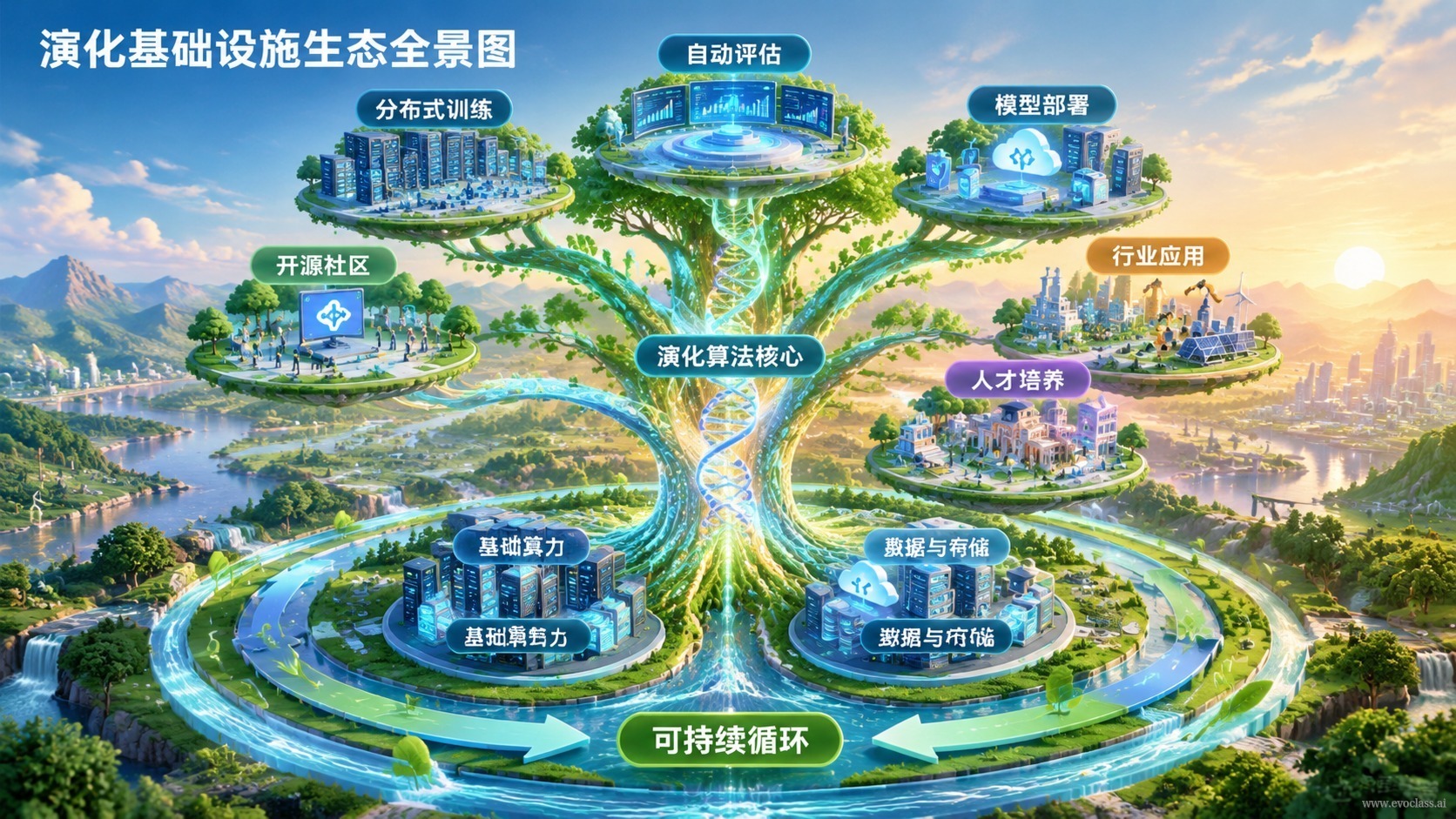
EvoX is positioned not as a one-off solver, but as anopen infrastructurefor the real world and long-term evolutionary processes. It lets evolutionary systems enter real environments, receive real feedback, and generate, validate, and retain improvements through continuous operation.
Why "Infrastructure" Rather Than a "Solver"
Traditional optimization is often one-off: given a static benchmark, run an algorithm once, get a solution, and you're done. But the real world keeps changing: objectives drift, constraints update, and evaluation is costly with delayed feedback. By packaging evolutionary capabilities as a foundation that can run over the long term, the system can repeatedly connect new problems, new environments, and new feedback through the same set of open interfaces—without having to rebuild the entire pipeline every time.
Four Key Capabilities
- Connect to the Real WorldEvoX must be able to connect to real environments and real feedback, not merely complete a single optimization on a static benchmark. Costly simulations, robotics tasks, and online systems can all serve as evolutionary environments.
- Support Long-Term EvolutionOver long-term operation, the system continuously generates candidates, validates their effects, and accumulates effective improvements, forming an evolutionary loop that compounds over time.
- Address Complex, Changing ProblemsThe infrastructure serves real-world scenarios that are complex, dynamic, involve conflicting objectives, and require continuous exploration for answers.
- Open and SustainableIt hosts algorithms, problems, runtime, and feedback mechanisms as open infrastructure, making capabilities scalable, reusable, and sustainable.
The Operating Loop: Run Continuously—Validate—Retain—Re-evolve
The core of the infrastructure is not a single search, but a loop that can run over the long term: the system continuously generates candidates and deploys them to real environments; the environment returns evaluation signals; effective candidates and improvements are retained and accumulated; and when objectives or environments change, new evolutionary explorations continue to be scheduled on the same foundation.
A Concrete Scenario
For example, connect costly engineering simulations or robotics tasks to EvoX as environments, and the system continuously receives evaluation signals and retains effective candidates; when objectives or environments change, new evolutionary explorations can continue to be scheduled on the same infrastructure. This means algorithms, operators, runtime, and feedback mechanisms do not need to be rebuilt from scratch—they can be continuously extended and maintained like urban utilities.
Evolutionary Infrastructure at a GlanceThis diagram presents EvoX as infrastructure connecting the real world with long-term evolutionary processes: the system continuously generates candidates, receives environmental feedback, and retains effective improvements, forming a loop of run continuously—validate—retain—re-evolve, making algorithms, problems, runtime, and feedback mechanisms scalable and reusable.