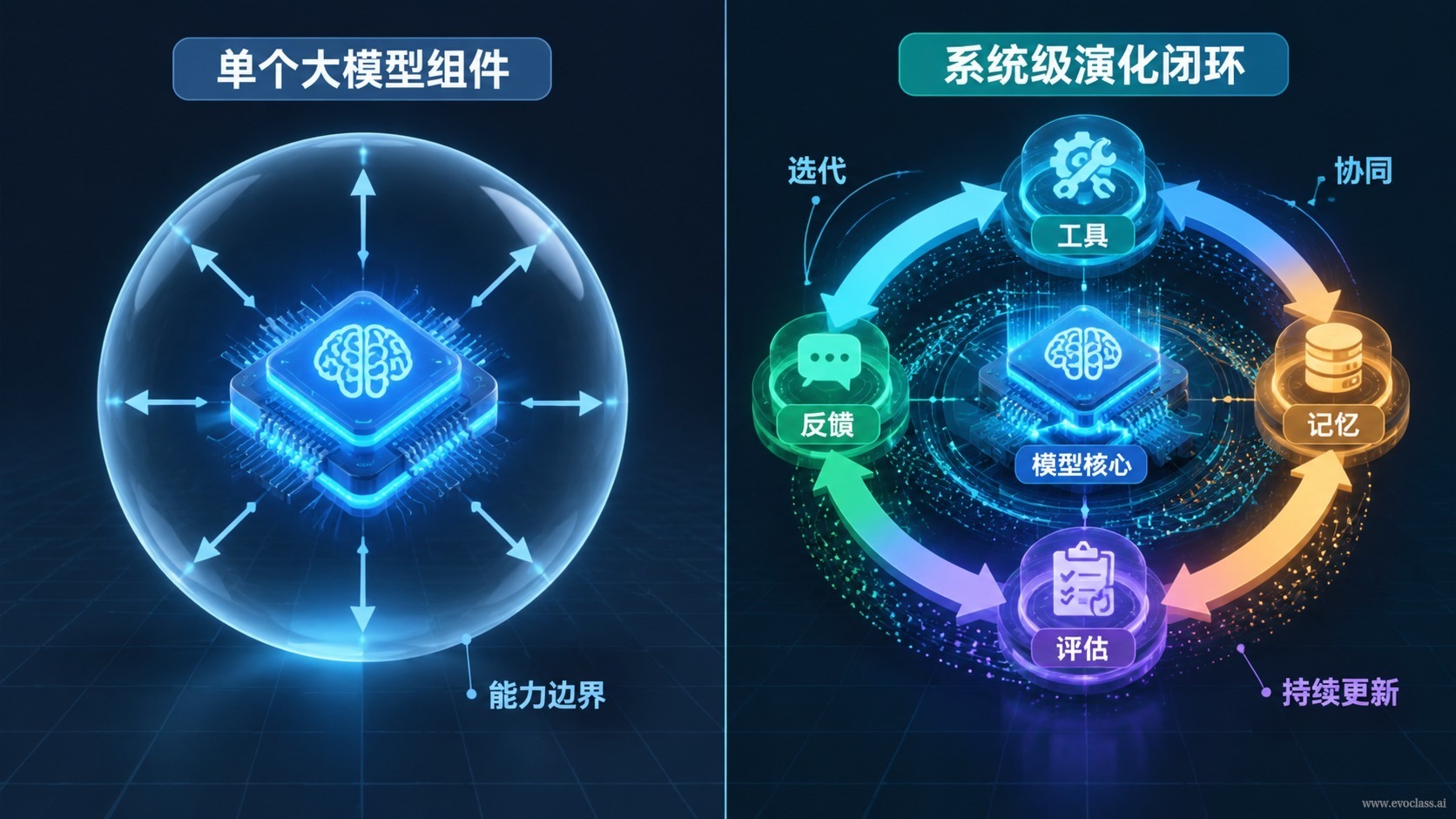
Core Thesis:Large models are powerful intelligent components, but they are not self-sustaining systems. They already possess usable capabilities in understanding, generation, reasoning, and tool calling, and can serve as high-quality hypothesis proposers and code producers; however, they lack the state, goal, and feedback mechanisms required for continuous evolution across a lifecycle.
Three Structural Boundaries:
- State Boundary:Limited context window and lack of persistent cross-session memory make long-cycle projects unsustainable on their own;
- Goal Boundary:Real-world problems often involve multi-objective conflicts and preference trade-offs, and models struggle to independently provide defensible criteria for making trade-offs;
- Feedback Boundary:There is a lack of actionable mechanisms for evaluation, selection, and elimination, so generated solutions cannot be objectively verified or retained through iteration.
Conclusion:Model capability gains ≠ system capability gains. Capability is a snapshot; the environment is a process. Large models must be embedded in an evolutionary loop of "generate—evaluate—select—accumulate": using swarm intelligence to maintain candidate diversity, surrogate models to compress the high cost of evaluation, and selection and accumulation mechanisms to retain effective experience—only then can intelligence remain adaptive in dynamic environments. This is precisely where EvoX takes its stand, and it also provides the necessity argument for the subsequent topics of "extending evolutionary objects from parameters to programs," "methods evolving themselves," and "project-level persistence."
Comparison of a Monolithic Large Model's Capability Stack vs. a System-Level Evolutionary LoopOn the left, the large model is treated as a standalone capability stack, whose understanding, generation, reasoning, and tool calling yield only a static snapshot. On the right, the LLM is demoted to a module embedded within a "generate—evaluate—select—accumulate" loop, using swarm intelligence to maintain candidate diversity, surrogate models to compress evaluation costs, and selection and accumulation mechanisms to retain effective experience—demonstrating that model capability gains do not equal system capability gains.