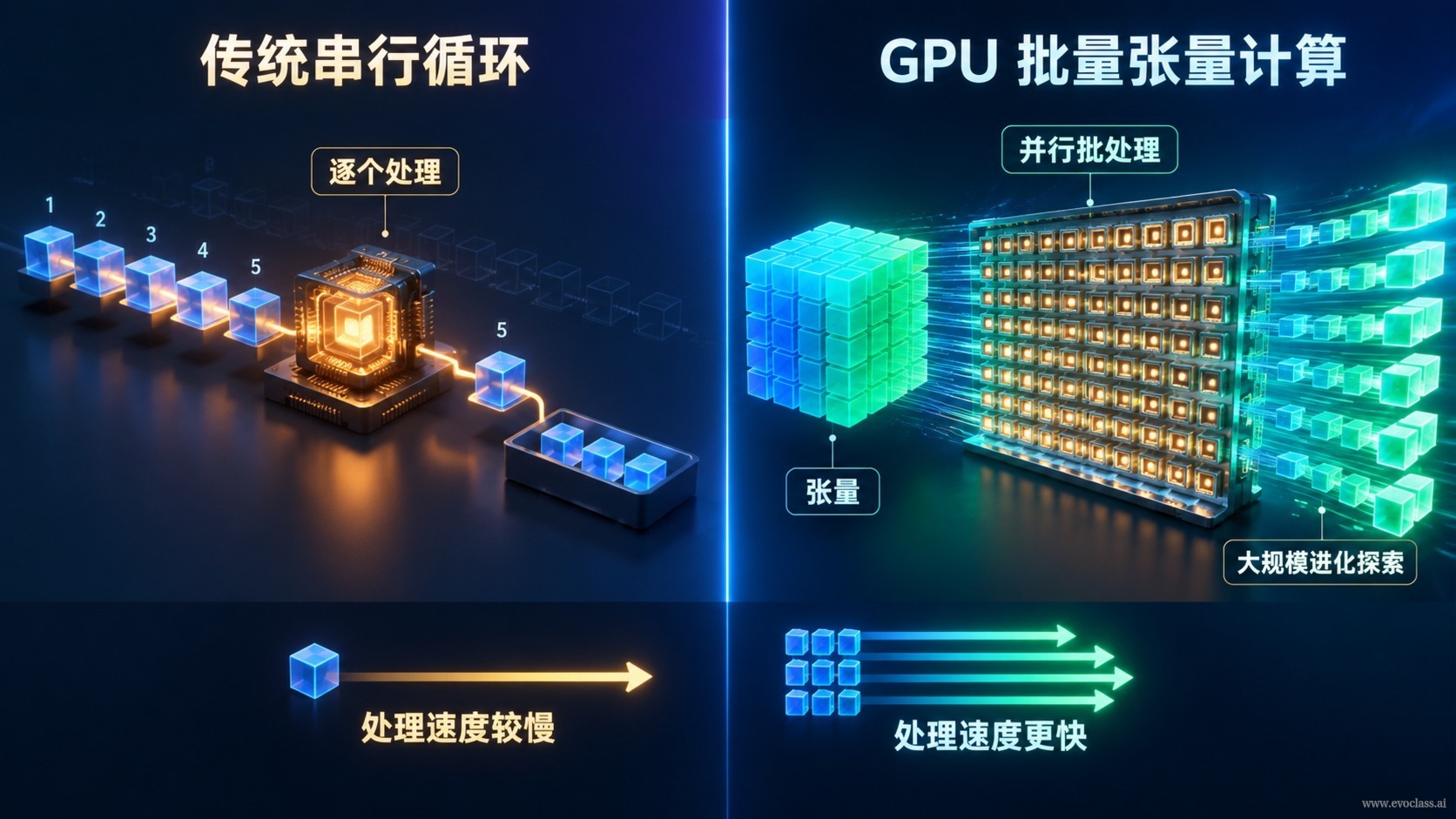
When population sizes grow from a few dozen to tens of thousands,evolutionary computationthe real bottleneck is no longer "can we find a good solution" but "can we evaluate enough candidates within a limited time." EvoX's engineering answer consists of two mutually reinforcing lines of work:tensorized computationrewrites the per-individual serial loop as batched tensor operations, whilea unified architecturedecouples algorithms, problems, workflows, and runtime scheduling, so that this parallel mechanism can be reused across different evolutionary algorithms and tasks.
Why Diversity Demands Throughput
Evolutionary search relies on population diversity: the more dispersed the candidates, the higher the chance of escaping a local optimum. But "maintaining diversity" is fundamentally a compute problem—it requires that each generation can evaluate and update the state of a large number of candidates. If the method for generating candidates is still fixed in advance by hand and evaluation is still performed one individual at a time, the system can only repeat the same predetermined routine, and the benefits of diversity are canceled out by the throughput bottleneck.
Method Evolution: Bringing the "Method That Generates Candidates" into the Evolutionary Loop
Once compute scale becomes available, EvoX pushes the object of optimization up one level: rather than merely solving a problem, it brings the very method that produces candidate solutions into the evolutionary loop—this ismethod evolution. In MetaDE , for example, an inner-level algorithm solves the actual task, while an outer-level algorithm evolves the configurations and strategies of the inner algorithm (such as the mutation strategy and hyperparameters of differential evolution), running large numbers of inner tasks in parallel on the GPU so that task performance in turn guides the selection of outer-level configurations;AutoPSO and EvoGO go further, composing particle swarm components and using historical feedback to learn how candidates are generated, crossing over from "tuning parameters" to "reworking algorithm structure." This inner-outer two-level evolution inherently requires that large numbers of inner tasks be batch-evaluated and have their states updated in the same generation—even at the same instant—placing even higher demands on compute throughput and parallelism.
Tensorized Computation Graph: Replacing Loops with Batched Tensors
A traditional serial CPU loop typically executes "evaluate—record—update" on a per-individual basis, triggering only small-scale operators each time, which incurs three kinds of costs:high scheduling overhead,fragmented operators,poor GPU utilization. The tensorized computation graph approach organizespopulation maintenance, batch evaluation, and state updatesas a whole into batched tensor operations, allowing candidates from the same generation—or even multiple generations—to be computed in parallel. For example, when a single generation contains N candidate solutions, a serial implementation loops over individuals, whereas a tensorized implementation organizes the population as a single tensor and completes batch evaluation and parallel state updates in one pass, thereby substantially reducing scheduling overhead and increasing GPU occupancy.
Unified Architecture: Making the Parallel Mechanism Reusable
Simply rewriting loops as tensors is not enough—if algorithms, problems, and scheduling logic are coupled to one another, switching to a different evolutionary algorithm or a different class of task means rewriting everything from scratch. By decoupling modules such asalgorithms, problems, workflows, and runtime scheduling, the unified architecture enables the tensorized parallel mechanism to be reused across different evolutionary algorithms and tasks (such as method-evolution scenarios like MetaDE and AutoPSO); combined withheterogeneous compute scheduling, it can perform batch task-level management of resources such as CPUs and GPUs, thereby supporting composable, scalable parallel exploration.
Why This Is a Foundational Capability
The engineering foundation brought by GPUs and large models elevates tensorized batch computation from a local optimization to a foundational capability that supports system-level evolutionary exploration. In other words, tensorization solves "running fast," while the open, decoupled unified architecture solves "swapping easily": the former provides throughput, and the latter provides a composable, scalable boundary for reuse. Only when the two are combined does high-intensity, high-diversity parallel evolutionary exploration truly become an engineering capability.
Serial Loop vs. GPU Batched Tensor Computation ArchitectureOn the left, the traditional CPU serial approach executes "evaluate—record—update" per individual, triggering only small-scale operators, which leads to high scheduling overhead, fragmented operators, and poor GPU utilization; on the right, population maintenance, batch evaluation, and state updates are organized as a whole into tensor operations, computing candidates from the same generation—or even multiple generations—in a single pass, and decoupled from runtime scheduling so the parallel mechanism can be reused across different algorithms and tasks.