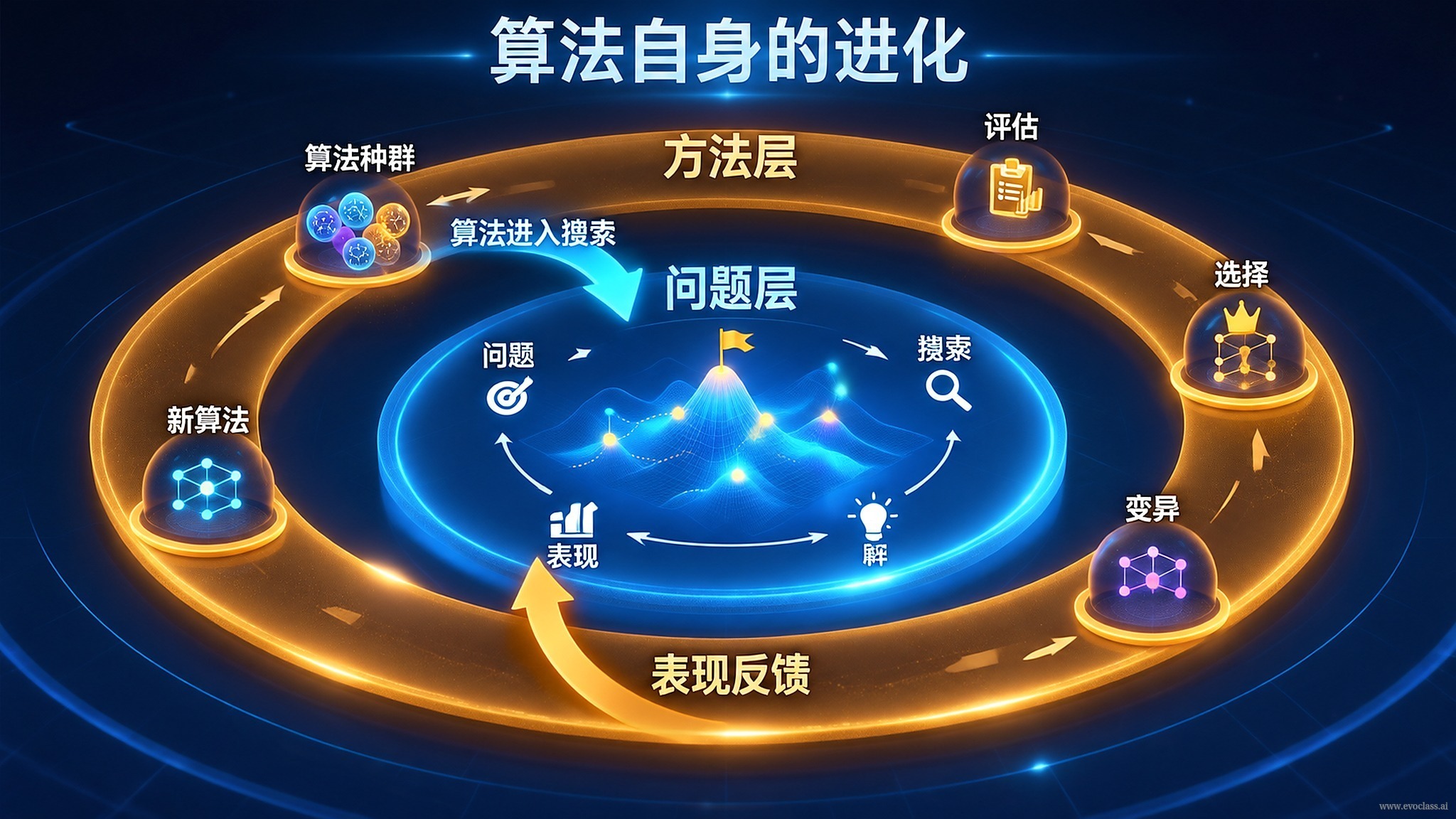
Traditional evolutionary algorithms operate under afixed generation mechanism: rules such as selection, crossover, and mutation—the rules of "how to produce answers"—are written in advance by humans, so the search only moves within the answer space, and what is optimized is always thecandidate solution. Once compute scales up, this preset assumption becomes the ceiling instead—if the method for generating candidates stays fixed, the system can only repeat the same established pattern.
Meta-Evolutionpushes the problem up one level: the algorithm not only outputs better answers, but also continuously improves—through an outer search—thestrategies, parameters, and componentsthat produce those answers, completing the evolution from "solving answers" to "improving methods." EvoX is a work that advances precisely along this line, bringing the method of candidate generation itself (such as the mutation strategy and parameter settings of differential evolution) into the scope of evolution.
Two-layer logic: the inner layer seeks answers, the outer layer improves methods
- Inner layer: uses theCurrent methodto solve specific problems and produce candidate solutions.
- : based on feedback such as solution quality, preference signals, stability, or cost, it improves the method used in the next round.:依据解质量、偏好信号、稳定性或成本等反馈,改进下一轮使用的方法。
- The object moved up into the search space is not some solution, butthe candidate generation mechanism itself; precisely for this reason, it becomes an object that can be evaluated, selected, and updated.
Which layer should preference optimization go in?
Preference optimization can participate in upper-layer feedback, but two types of objectives must be kept separate:evaluating the current answerandimproving the method that generates answers. Reading "this solution is more likable" directly as "this strategy is better" means passing off answer preference as method superiority, and the outer search will be dragged around by the noise of single-run results.
What You Gain, What You Pay
This shift moves algorithm design from one-off manual tuning toward sustainable self-adaptation, but the costs are just as clear:search space expansion(the method space is far larger than the solution space),rising evaluation cost(every candidate method must run the inner-layer task, usually relying on GPU parallel batch evaluation to amortize the cost), andincreased verification complexity(whether the outer-layer improvement truly generalizes requires an independent validation design).
Two-Layer Evolution Logic DiagramThe diagram divides evolution into an inner and an outer layer: the inner layer uses the current method to solve specific problems and produce candidate solutions, while the outer layer, based on feedback such as solution quality, preference, stability, or cost, improves the strategies, parameters, and components used to generate candidates in the next round; the object being searched is thereby shifted up from the solution to the candidate generation mechanism.