Supercritical airfoil design is a real-world engineering example of EvoX as amulti-objective practice case. Changes in airfoil geometry parameters simultaneously affect multiple aerodynamic metrics, and the design must satisfy strict constraints on lift, angle of attack, thickness, and more; the focus of this practice is not to find a single optimal solution, but to generate adiverse set of candidate solutions, leaving it to domain experts to evaluate the different benefits and trade-offs.
- Conflicting Objectives:The camber, thickness, trailing edge, and other geometry parameters of a supercritical airfoil are coupled with one another. Improving one metric often comes at the expense of another, and conflicts among objectives are common. Multi-objective trade-offs are therefore required, rather than single-objective optimization.
- Strict Constraints:Requirements on lift, angle of attack, thickness, and more define the feasible design space. The search must be conducted within these constraints to ensure the candidate solutions are engineering-ready.
- Candidate Set Output:EvoX turns the output into a diverse set of solutions that balance various metrics, rather than a single answer; the candidate set supports expert comparison, trade-off, and decision-making.
- Methodological Value:This case demonstrates the value of "turning a real, complex problem into an explorable process" — finding interpretable, evaluable trade-off solutions amid constraints and conflicting objectives.
The roadmap below summarizes this process: continuous exploration in the airfoil parameter space, then approaching the multi-objective trade-off frontier, and finally forming a candidate set for expert evaluation.
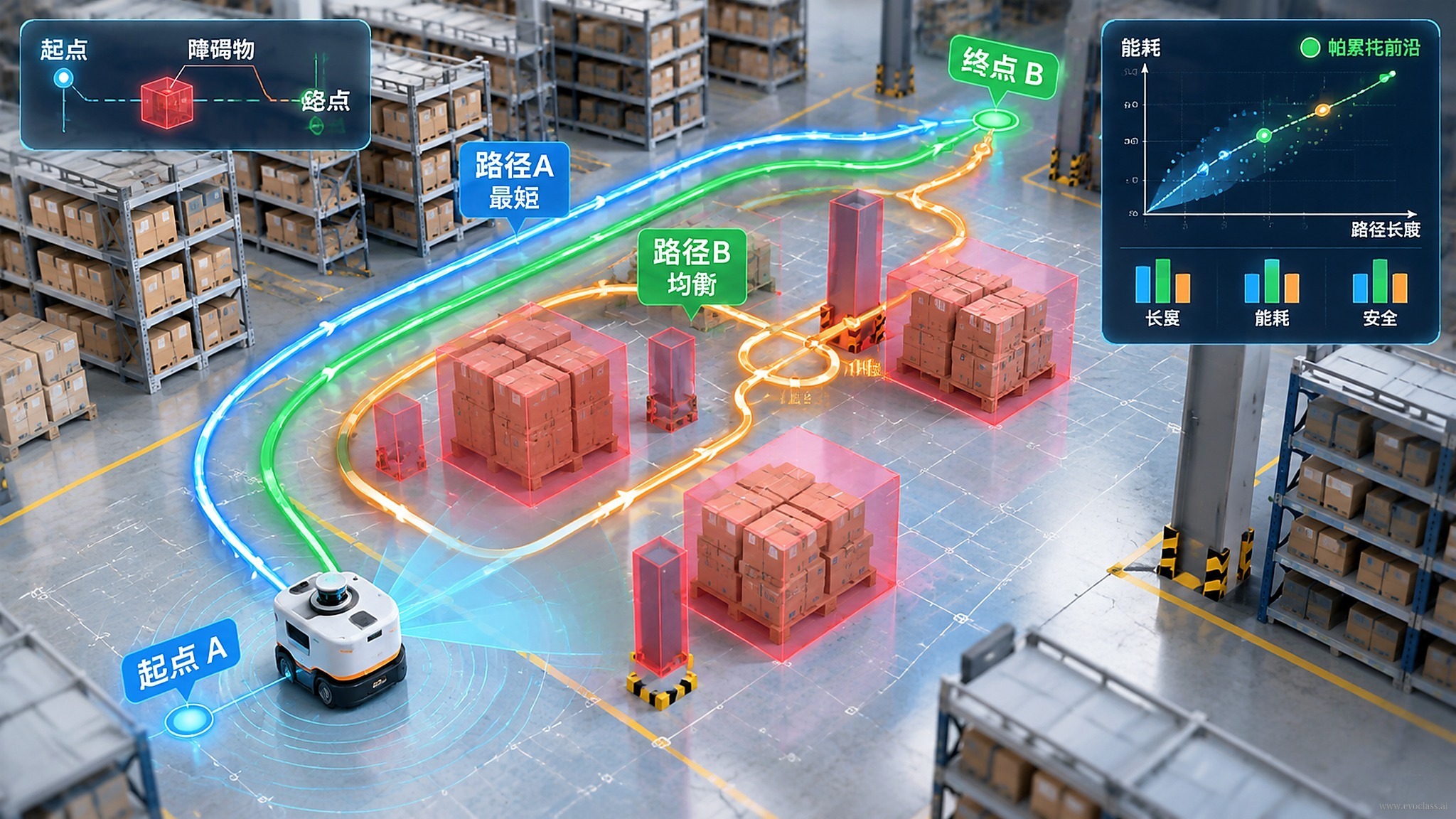
Multi-Objective Optimization RoadmapThe diagram uses warehouse robot obstacle-avoidance pathfinding as a multi-objective optimization example, illustrating the path from exploring the path space to approaching the trade-off frontier and then forming a candidate solution set. It mirrors the same logic as the airfoil design on this page: geometry parameters are coupled with one another, and conflicting objectives together with constraints on lift, angle of attack, thickness, and more define the feasible space, ultimately producing diverse solutions for expert evaluation.
Multi-Objective Optimization Roadmap
The diagram uses warehouse robot obstacle-avoidance pathfinding as a multi-objective optimization example, illustrating the path from exploring the path space to approaching the trade-off frontier and then forming a candidate solution set. It mirrors the same logic as the airfoil design on this page: geometry parameters are coupled with one another, and conflicting objectives together with constraints on lift, angle of attack, thickness, and more define the feasible space, ultimately producing diverse solutions for expert evaluation.