This page closes out the course: it elevatesintelligent evolutionfrom "a single search, a single optimization" intosoftware infrastructure built for the real world. Earlier lessons already addressed whether "the method that generates candidates can itself take part in evolution"—for example, MetaDE uses outer-level evolution to tune the mutation strategies and parameters of the inner algorithm, while AutoPSO learns how to generate candidates by combining particle swarm components with historical feedback. This page answers a higher-level question: once evolution spans beyond a single task and beyond a single agent, what keeps the systemopen, reliable, and always connected to real problems?
Four Key Points
- Upgrading the Evolution Target: Genesis extends the evolution target from candidate solutions for a single task toProject-Level Continuous Evolutionspanning agents and task cycles. The end of a run no longer means the state is wiped clean.
- The Engineering Accumulation Paradigm: Through strict acceptance, historical inheritance, and experience accumulation, the system turns "finishing a run" into "leaving behind reusable assets," forming a stable and reliable engineering path.
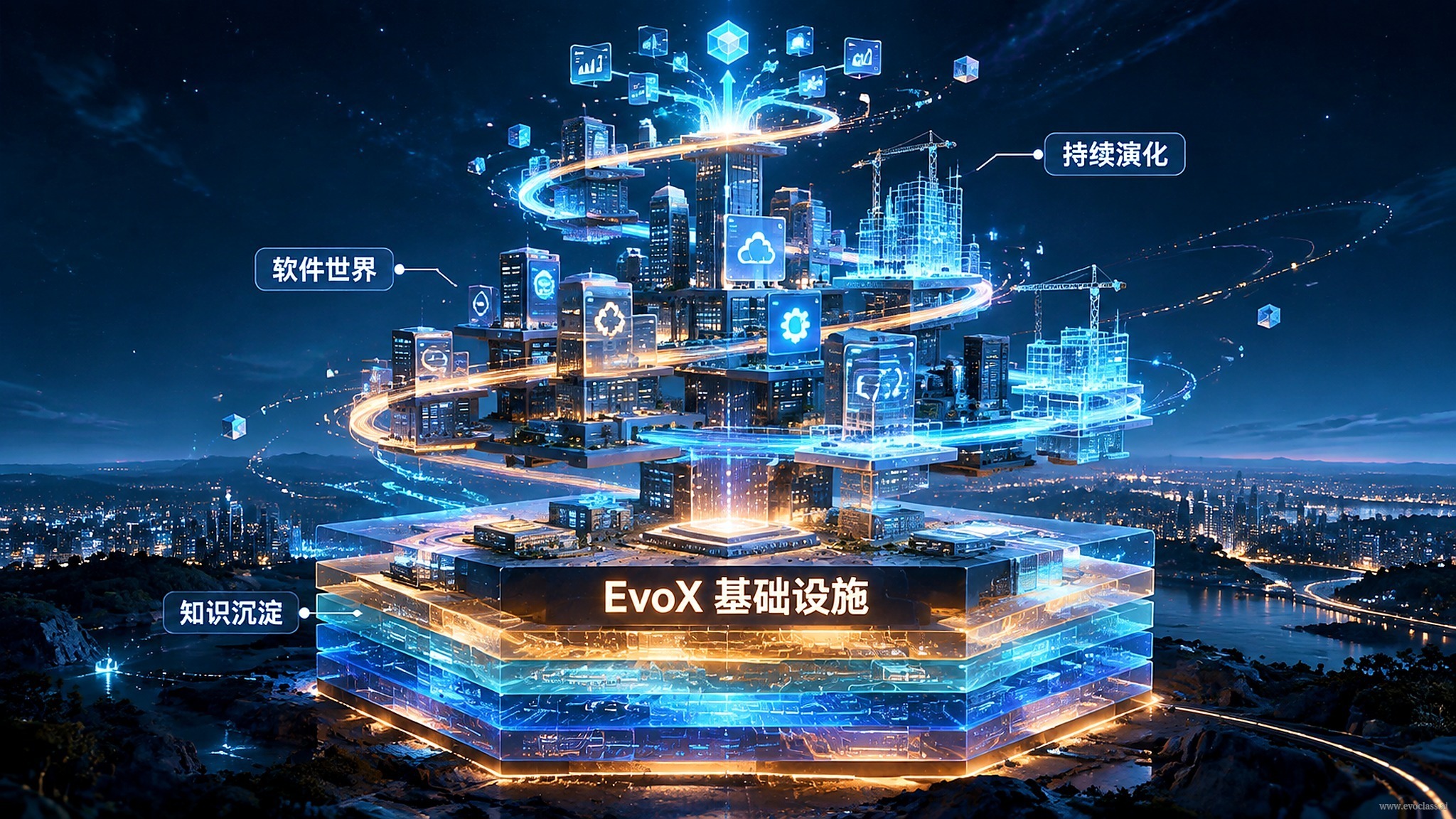
- Positioning of EvoX: EvoX is the intelligent evolution infrastructure that connects to the real world, supporting the construction of open, composable, and continuously accumulating systems above it.
- The Ultimate Vision: The software world is not a static deliverable, but intelligent infrastructure that can evolve continuously, accumulate continuously, and keep connecting to real-world problems.
A Practical Way to Organize It
Imagine a research project spanning several months: multiple agents handle literature search, code implementation, and experiment reproduction respectively; every exploration is written into the experiment log; milestone results must pass acceptance before entering the shared library; and the next round of tasks directly inherits the verified artifacts and conclusions from the previous round. At this point the project is no longer a collection of documents to "finish and archive," but a pipeline ofTask → Explore → Accept → Inherit → Re-evolve: the end of every task is not a finish line, but an inheritable asset for the next round of evolution. It is precisely in this sense that EvoX plays the role of a "foundation"—it lets problems, agents, and project assets above it keep growing on the same runtime.
Panorama of Continuously Evolving InfrastructureThe panorama positions EvoX as the intelligent evolution infrastructure connecting to the real world: multi-agent and cross-task projects run on top of it, forming a pipeline of task, exploration, acceptance, inheritance, and re-evolution. Reusable accumulation is not ordinary documentation, but accepted artifacts that can be invoked by later evolution, structured experience, strategies, and configurations, so that the end of one task becomes the starting point of the next round of evolution.