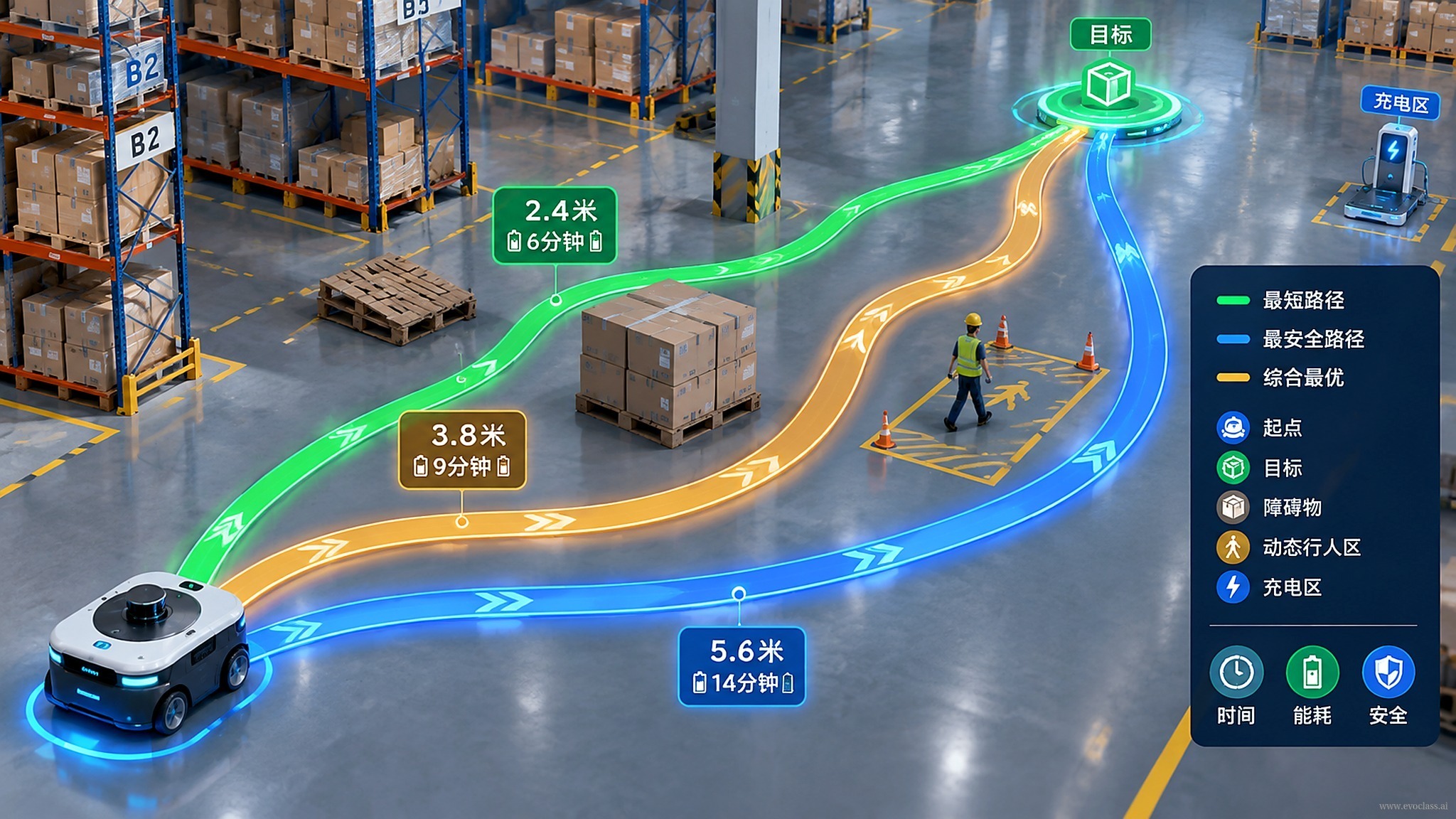
In thewarehouse robot pathfindingtask, we face a fixed warehouse layout: the shelves, aisles, obstacles, and the robot's start and goal points are all predetermined. The goal is to find acollision-free obstacle-avoiding routewithin these constraints while keeping the path length as short as possible. Path length and obstacle-avoidance safety are usually not fully aligned: a shorter route may hug the shelves or cut through high-risk areas, while a safer route may take a longer detour. Therefore, this is a classicmulti-objective optimizationproblem, not a single shortest-path problem.
From Task Description to EvoX Call
AI acts as a "task translator" here: it automatically converts the natural-language description — fixed warehouse layout, obstacle environment, start point, goal point, obstacle-avoidance requirements, and path-length objective — into an executable EvoX call configuration, reducing the cost of manual coding and parameter tuning. Then,EvoX NSGA-II performs population evaluation and search in parallel on the GPU, while preserving multiple trade-off solutions to form a route family spanning from "short but risky" to "long but safe".
Objective Definition and Multi-Objective Trade-offs
- Path length objective: minimize the robot's total travel distance from start to goal.
- Obstacle-avoidance safety objective: minimize collision risk with obstacles, or maximize collision-free feasibility.
- Constraints: the route must stay within the aisles, must not pass through shelves or obstacles, and must satisfy the robot's kinematic limits.
- Decision variables: path waypoints, curve control points, turning radius, speed profile, and other route representation parameters.
Result Presentation
After optimization finishes, the system outputs a visualization of candidate routes and a convergence trend curve. The route visualization is used to observe path feasibility, route diversity, and the recommended collision-free route; the convergence trend is used to judge whether NSGA-II is progressively finding better trade-off solutions. For example, if the path-length curve levels off while collision risk no longer drops significantly, the search can be considered to have reached a plateau; if both still show clear room for improvement, you can keep increasing the iteration count or adjust the population size.
Warehouse Robot Obstacle-Avoiding Pathfinding Route MapThe figure presents a typical multi-objective result for warehouse robot pathfinding: shortest path and obstacle-avoidance safety conflict with each other, and EvoX NSGA-II evaluates candidate routes in parallel on the GPU, preserving a set of trade-off solutions ranging from short but risky to long but safe. The route map is used to check path reachability and the soundness of obstacle avoidance, while the convergence curve is used to judge whether the search is still improving.