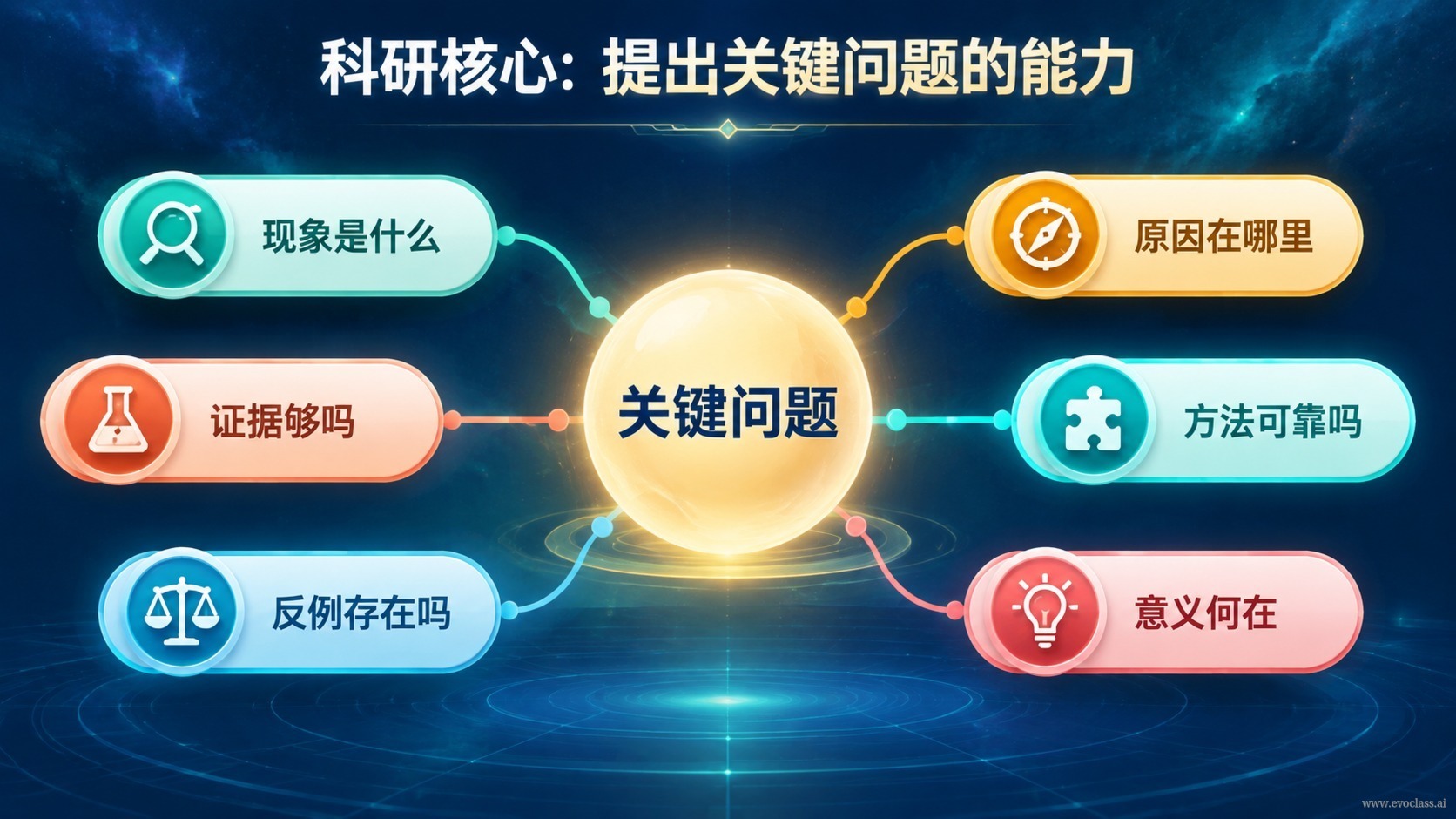
In AI-native research,automated programmingand large-model capabilities have already driven the cost of "producing answers" very low: code generation, solution search, and experiment execution can all be delegated to AI. When answers become cheap, the focus of research is no longer "can it be built," but ratherwhether it is worth doing and where to direct the effort—and this is precisely the ability ofasking key questions.
What a Key Question Typically Needs to Make Clear
Asking key questions is not about probing implementation details, but about transforming vague intuition into atestable, evolvable, and division-of-labor-readyresearch structure. It must at minimum define the following clearly:
- True goals and multi-objective conflicts: What is the quantity that truly needs improvement? How should multiple objectives be traded off, and which takes priority?
- Non-negotiable constraints: Which conditions are hard boundaries that no solution may violate?
- Observable evaluation metrics: What quantity, measured under what conditions, can make the conclusions hold up?
- Candidate space boundaries: How large is the feasible range for search and evolution, and what diversity and robustness are needed?
- Verification protocol and failure criteria: What evaluation budget to use, what process to follow for verification, and which outcomes should be judged as failures?
Question Quality Determines Solution Space Quality
The solution space AI explores is bounded by the problem definition. The clearer the problem definition, the more likely search and evolution will land in meaningful regions, and the more likely the output will beinterpretable and reusable. The vaguer the problem definition, the more the model can only randomly probe an excessively large space, and results often appear feasible yet fail to accumulate. Take "using EvoX for optimization" as an example: the key questions should be reframed as: "What is the real conflict? How are goals and constraints quantified? What are the evaluation budget and verification criteria? What diversity and robustness are needed? Which outcomes should be judged as failures?" Only then can AI efficiently produce answers while humans steer the direction.
Human-AI Division of Labor and the Researcher's Core Taste
The core of human-AI division of labor is:AI expands the answer space and execution paths, while humans control the direction, trade-off criteria, and scientific significance. In system-level continuous evolution practices like Genesis, this is especially evident—candidate modifications must pass compilation, testing, and higher-level acceptance before they can enter an accepted project version and become the historical foundation for subsequent work. If the key questions fail to clearly define the evaluation protocol and failure criteria, the acceptance gate has no basis for judgment, AI output remains a one-off code artifact, and it cannot accumulate persistently across agent contexts and task cycles.
Therefore, the researcher's core taste manifests as three kinds of judgment:what is worth asking,what evidence is acceptable,what solutions are feasible but not worth pursuing. In EvoX practice, key questions should lead to a runnable, evaluable, and iterable workflow, rather than merely pursuing a one-off implementation result.
Additional thread: human-AI division of labor and the researcher's core taste—AI expands the answer space, while humans safeguard the direction, trade-off criteria, and scientific significance.
Key Questions Checklist Mind MapThis mind map breaks key questions into true goals and multi-objective conflicts, non-negotiable hard constraints, observable evaluation metrics, candidate space boundaries, and verification protocols and failure criteria. It shows that question quality determines which region AI search and evolution will land in: taking EvoX optimization as an example, only when conflicts, quantification, and acceptance criteria are made clear can output be more interpretable and reusable.