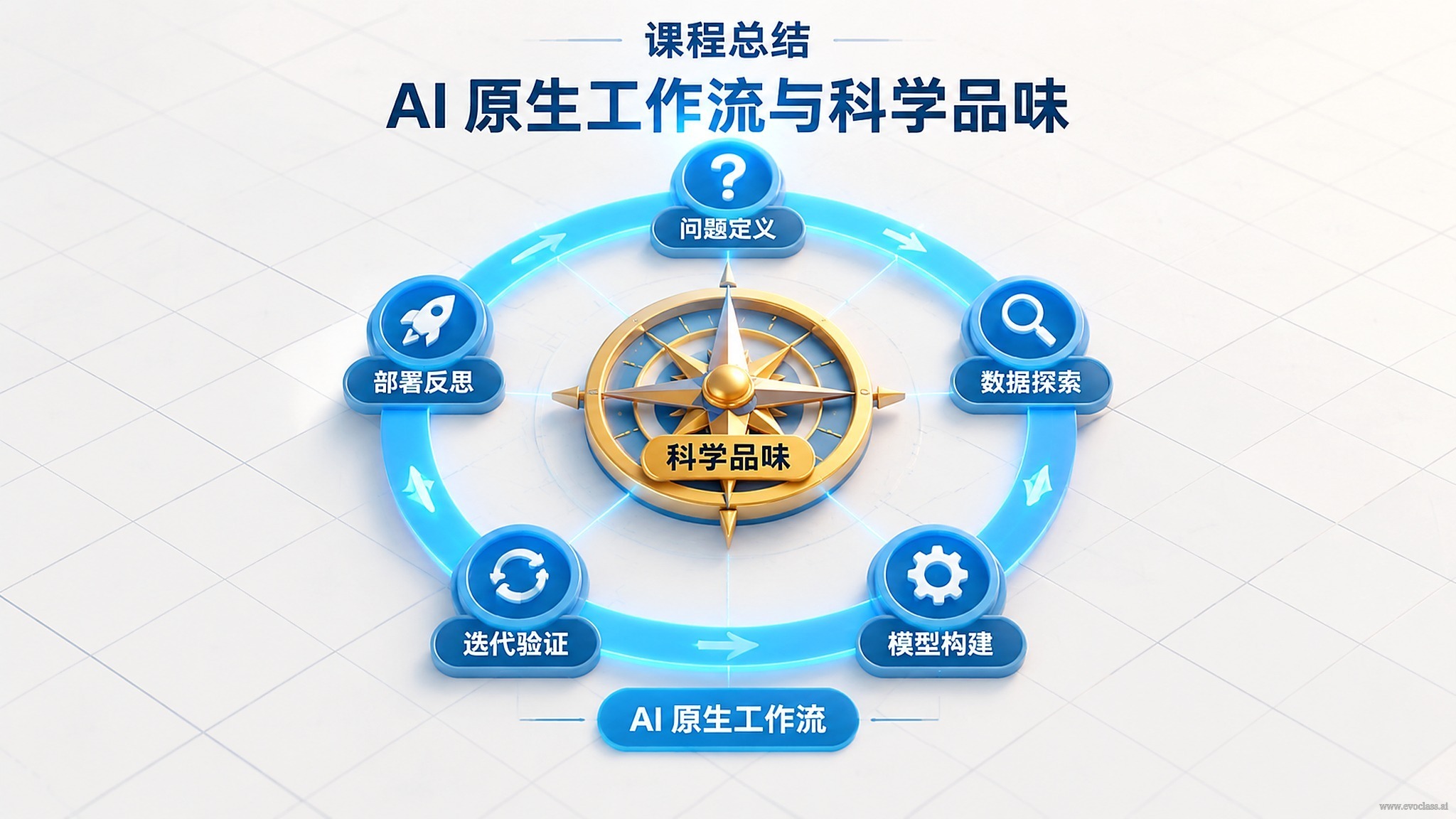
This page concludes the entire course by bringing together EvoX's AI-native workflow and the researcher's irreplaceable scientific taste into a single conclusion: when tools drive the cost of "implementing an answer" to near zero,"defining what is worth doing and judging which results are credible"becomes the dividing line of research value.
1. AI-Native Workflow: The Shortest Path from Idea to Runnable Experiment
The AI-native workflow uses natural language dialogue as its entry point to drive the full-chain experimentation of EvoX:configure environment → build the problem → run evolution → visualize and analyze results. What it compresses is not the experiment itself, but the path cost from "idea" to "first runnable experiment." The script skeleton, parameter interfaces, and plotting code that once took days to build can now take shape in a single conversation, giving researchers a much higher frequency of experimental iteration.
2. Responsibility Rises with Convenience
The easier tools are to use, the clearer human responsibility becomes. What automation transfers isexecution burden, notjudgment responsibility. When AI produces a set of candidate solutions within minutes, questions like "is this set of multi-objective trade-offs reasonable," "is this metric improvement credible," and "which direction should we explore next" are not answered along with it. Instead, because output is faster, they are placed in front of researchers more frequently. Convenience raises trial-and-error throughput, but it equally amplifies the speed at which poor decisions propagate.
3. Where Scientific Taste Takes Hold
Scientific taste is not an abstract aesthetic; it lands concretely in the following identifiable stages:
- Problem definition: deciding what to study and what to abandon—that is, "what is worth doing."
- Goal and constraint setting: translating vague research intent into optimizable objective functions and hard constraints.
- Multi-objective trade-offs: offering defensible preferences among convergence speed, diversity, robustness, and cost.
- Result credibility judgment: distinguishing "it ran" from "the conclusion holds up."
- Evolutionary direction setting: deciding where to explore in the next round, rather than passively accepting the current optimum.
These stages cannot be replaced by tools, because they are not computational problems but problems of value and judgment.
4. Where Critical Thinking Takes Hold
AI outputs should be subjected to structured verification and questioning, covering at least four questions:
- Do the assumptions hold?AI often silently fills in unstated premises, and these premises may not apply to your problem.
- Are the metrics being misread?Metric improvements may stem from data leakage, changes in evaluation criteria, or overfitting to the test set.
- Can the results be reproduced?Random seeds, parallel scheduling, and dependency versions all affect reproducibility.
- Have boundary and failure modes been tested?Whether the solution still holds under extreme constraints, sparse data, or high-dimensional conditions.
5. Human–AI Division of Labor and Continuous Evolution
The division-of-labor principle of this lesson can be compressed into one sentence:AI implements the answer, humans control the direction;Code is cheap. Taste matters. the former is a question of throughput, the latter of direction and value. The same holds for project-level and system-level continuous evolution: no matter how high the degree of automation, acceptance criteria and evolution direction must still be set by humans. Once this kind of judgment is missing for a long time, the gap in taste is magnified by time into technical debt that is hard to repay. Tools make "building it" cheap, and precisely for that reason, "what to do and what to trust" becomes the true dividing line.
Course Core Summary DiagramThe diagram places the two main threads of the course side by side: the AI-native workflow handles rapid implementation from idea to runnable experiment, while scientific taste and critical thinking handle problem definition, goal setting, multi-objective trade-offs, result verification, and evolutionary direction judgment. The conclusion is that tools make implementation cheap, and human judgment is the true dividing line of research value.