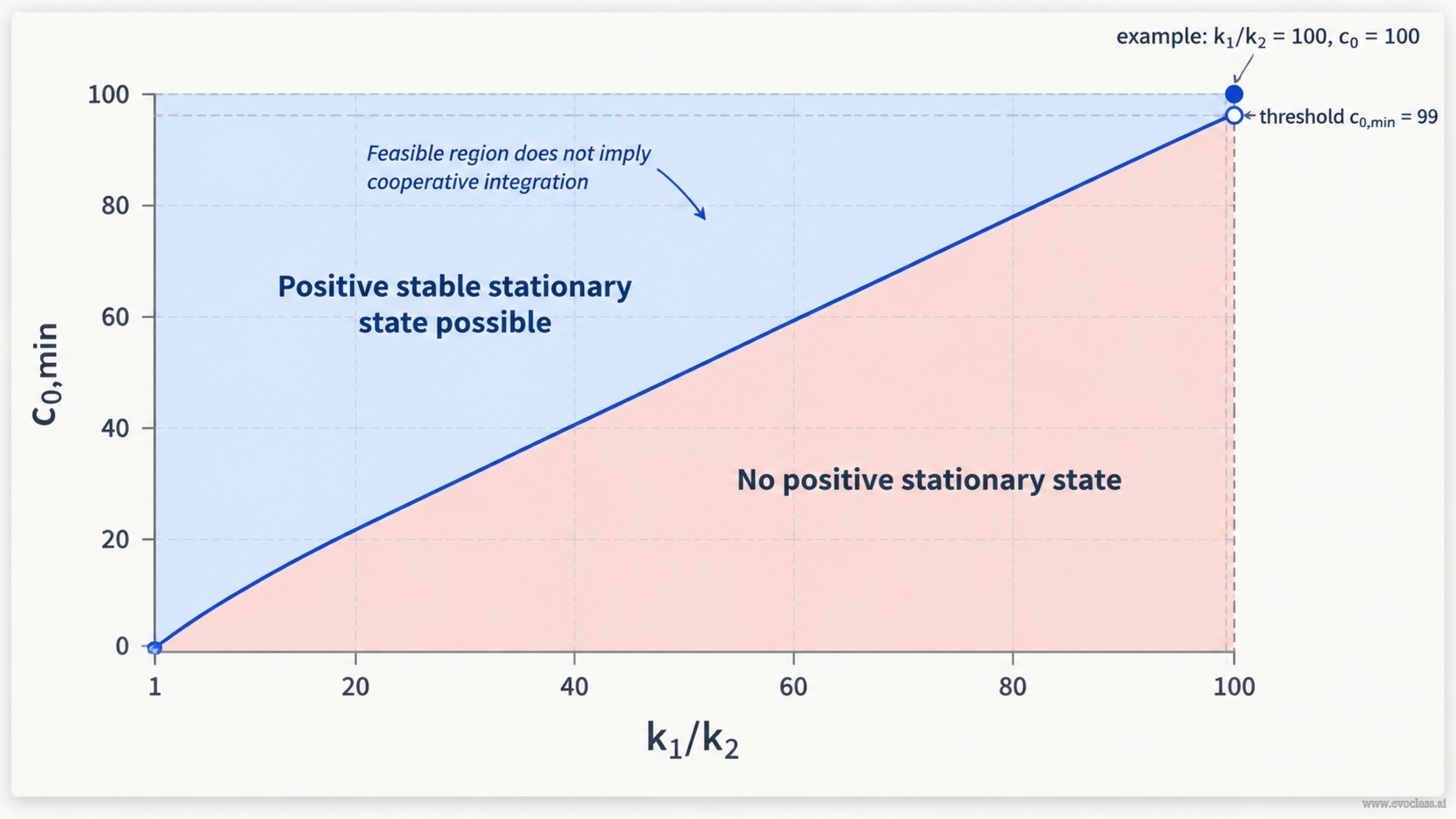
In an open catalytic chain under constant organization, a stable positive stationary state is not evidence of cooperative self-organization. The stability of a stationary state is governed by two conditions: a rate-constant condition and a total-concentration condition.
Stability Conditions
- Rate-constant condition: The first member’s rate constant must dominate all downstream constants:
≫ kⱼ for every . - Total-concentration condition: The total concentration must exceed the threshold
ⱼ₌2ⁿ ( ⱼ)/kⱼ. Below this threshold, required downstream concentrations become nonpositive, so no positive stationary state exists in the concentration simplex.
Stronger dominance by the first member (larger
Example
For a two-membered chain, the conditions reduce to
Why Stability Does Not Imply Integration
When both conditions are satisfied, the system may settle to a stable stationary state. However, this state remains an open, first-member-dominated chain. The open chain lacks cyclic feedback: downstream species do not return to influence the first member. Consequently, perturbations do not engage the whole chain as a joint functional unit. Therefore, the chain cannot stabilize a joint function; stability of the stationary state is not equivalent to integration into a hypercyclic collective.
In this framework, selective advantage for a molecule corresponds to a larger rate constant. A molecule with a higher k outcompetes others, but this competitive advantage does not produce a joint function—it merely shifts the stationary state toward domination by that molecule.
Stability Threshold DiagramPlot of the threshold c 0,min = Σⱼ₌ 2 ⁿ (k 1 − kⱼ)/kⱼ against the ratio k 1 /k 2 for