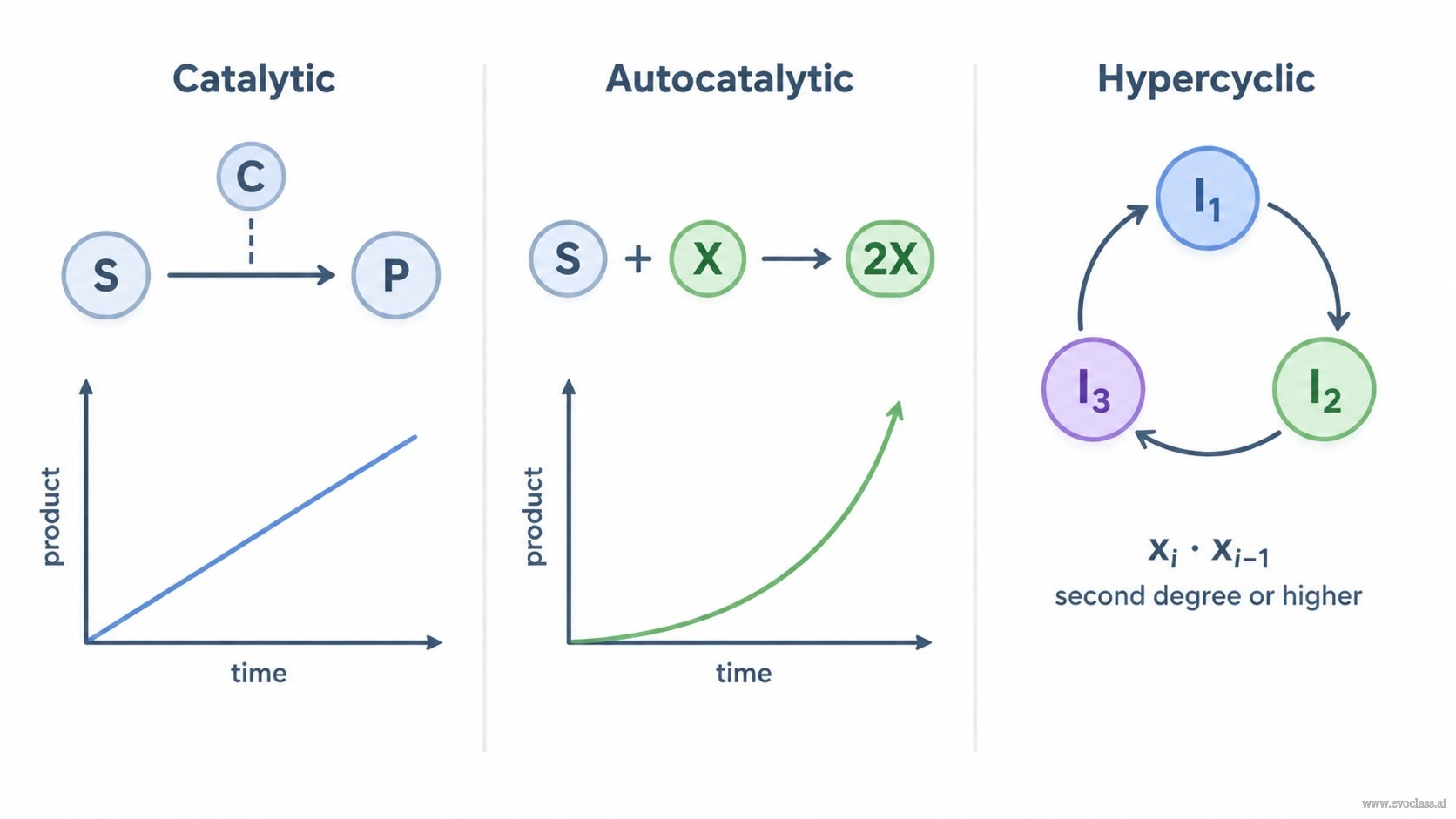
分子複製系における増殖モードは、次の二つの要素によって同時に区別されます。すなわち 反応次数 と ネットワークトポロジー (反応種を結びつける構造)です。同じ基質供給と同じ速度定数のもとでは、三つの様式が現れます。すなわち、通常の触媒反応(線形)、自己触媒反応(指数関数的)、そしてハイパーサイクル的増殖(二次以上・協同的)です。
1 · 通常の触媒的増殖:生成物は自身の生成を助けない
触媒 C が S → P を媒介します。[C] が一定に保たれる場合(緩衝された酵素、安定した供給、または鉱物表面など)、S が枯渇しない限り速度 d[P]/dt ≈ k[C][S] は一定に保たれるため、生成物は 線形に 時間とともに蓄積します。このスキームのどこにも P が自身の生成を触媒する要素はありません。増殖項に [P] の因子は含まれず、反応はより広いネットワークと結合していません。
2 · 自己触媒的増殖:一次の自己増幅
S + X → 2X では、鋳型 X が生成物として再生されるため、X は自身の生成を触媒します。基質が緩衝されている場合、d[X]/dt = k[S][X] となり、解は指数関数的で、
3 · Hypercyclic growth: a closed catalytic loop
Hypercyclic growth appears when self-replicative units I1, I2, ...,
Two criteria that identify a hypercycle
- Network criterion. A hypercycle is not a mixture of independent autocatalysts. Its catalytic links must close into a cycle, so growth and selection act on the coupled loop as a single unit.
- Degree criterion. Catalytic hypercycles are systems of second or higher degree, because their reproduction terms contain products of at least two concentration variables, such as xixi-1. Higher-order terms can arise from complex formation, translation-coupled replication, or saturating kinetics.
Consequence for selection
Hypercyclic growth is cooperative and nonlinear. It cannot be reduced to independent exponential competitors, because the fate of each member is tied to its cyclic predecessor: removing, slowing, or exploiting one unit changes the growth of the whole loop. That is precisely why the hypercycle foreshadows the later questions of integration, stability and parasitic challenge.
CatalyticThe three regimes of molecular growth compared on one canvas. Plain catalysis with a constant catalyst C gives a straight product-versus-time line, autocatalysis (S + X → 2X) gives an exponential curve, and a hypercycle closes its catalytic links into a loop so that each unit is catalysed by its cyclic predecessor, producing second-degree growth terms of the form xᵢ·xᵢ₋ 1.