3
Concentration Pulses from Unequal Rate Constants
HYC-1979Lesson 6: Concentration, Hypercycles, Fixed
00:00

In a hypercycle of dimension n ≥ 5 under constant organization, the concentrations evolve according to the elementary hypercycle equations. The parameter is the catalytic rate constant for production of species by its predecessor xi−1 in the cyclic order → → … → → .

(ki xi−1 − Φ),   j kj xj xj−1,   , indices modulo n.

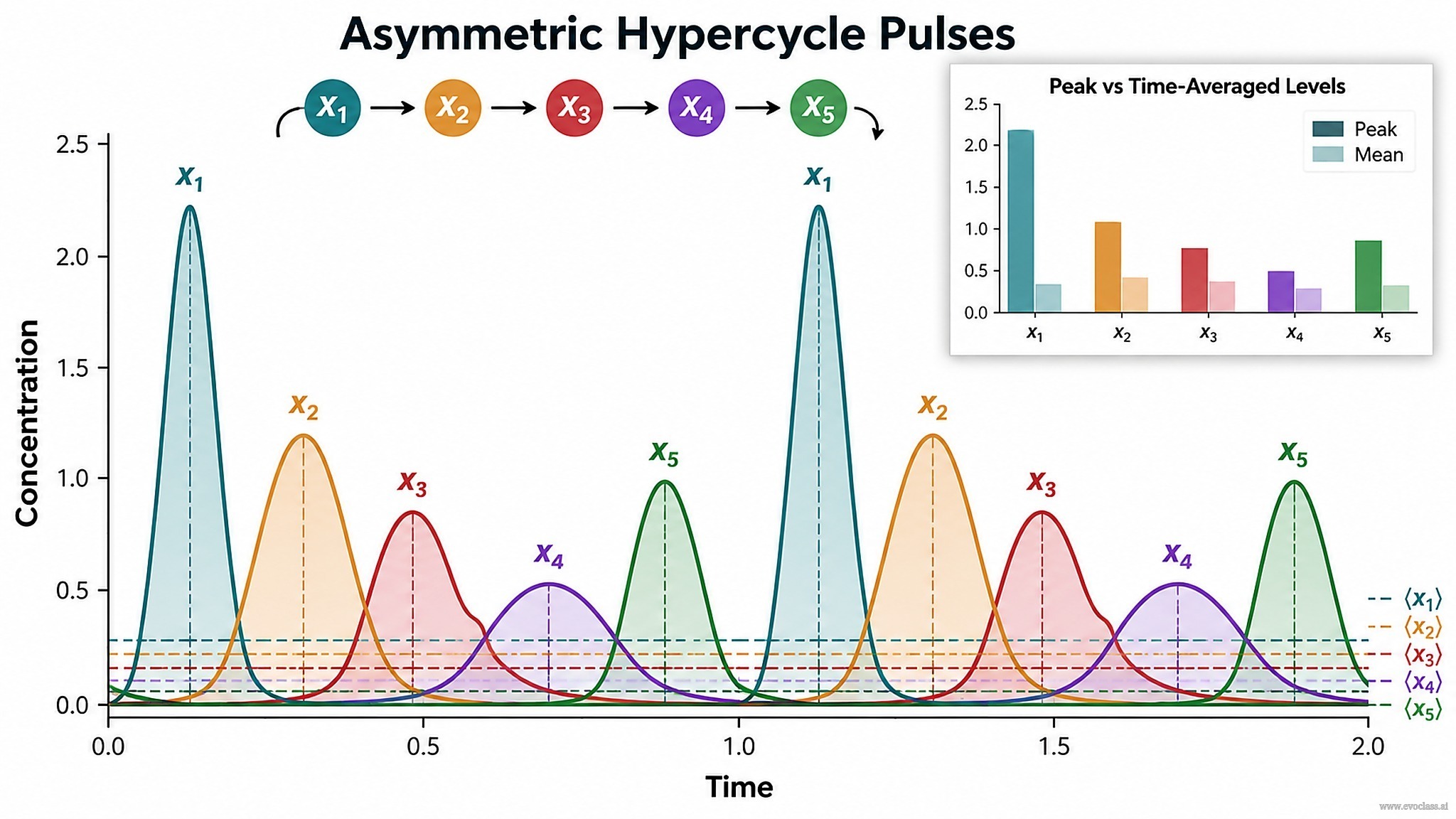
Concentration pulses for unequal kᵢ (n = 5)x₁x₂x₃x₄x₅concentration xᵢtime t (two periods)Peak vs. time averagepeaktime average ⟨xᵢ⟩x₁x₂x₃x₄x₅x₁x₂x₃x₄x₅time-averaged level ⟨xᵢ⟩Unequal kᵢ keep the cyclic order but change peak height, width, and phase lag.A fast step shortens the lag; a slow step lengthens it.⟨x₁⟩ = ⟨Φ⟩ / k₂the mean is set by the downstreamrate constant, not by the peak height

Rotational symmetry and its breaking

When all catalytic rate constants are equal, = … = , the hypercycle possesses a symmetric rotating-wave limit cycle. Every species shows an identical pulse, and the pulses are equally spaced in phase. The whole pattern rotates around the catalytic cycle without changing shape.

Unequal rate constants break this rotational symmetry. The cyclic order of pulses remains → → … → → , but pulse height, width, and phase lag become species-specific. A species with a larger catalytic advantage reaches a higher peak concentration. Peak order still follows the catalytic cycle.

Phase lags encode rate-limiting steps

Phase differences need not be uniform. A fast step shortens the delay between the predecessor pulse and the product pulse; a slow step lengthens it. Thus pulse timing encodes which catalytic step is relatively rate-limiting. For example, if is large, the pulse follows with a shorter lag than in the symmetric case.

Time-averaged concentrations

Time-averaged concentrations obey ⟨⟩ = ⟨Φ⟩ / ki+1. A species' mean level therefore depends on the downstream rate constant, not simply on its own peak height. A tall pulse can coexist with a modest time average if the next catalytic step is fast.

Common misconception. A large raises the peak of but does not by itself raise ⟨⟩. The average is governed by ki+1 and the global selection flux Φ.

Example: five-membered hypercycle

Consider with . The pulse tends to peak higher and follow with a shorter lag. Its average is not simply proportional to its peak. The relation ⟨⟩ = ⟨Φ⟩ / shows that the mean level of is coupled to the downstream rate driving .

The pulses remain coupled through Φ and constant organization. Unequal constants modulate hypercyclic organization without destroying its cyclic topology.