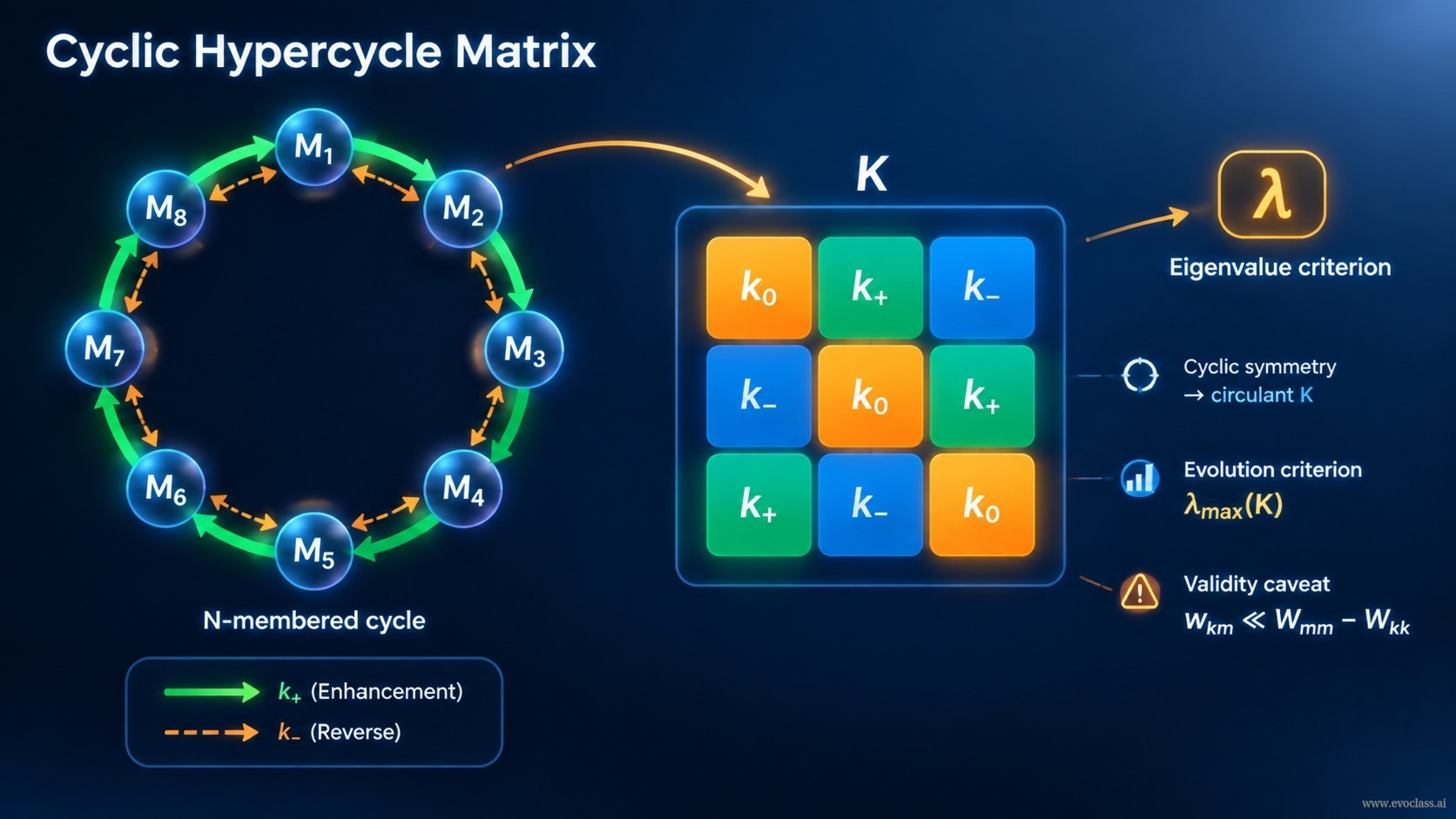
1. ๆฌกใฎๅ ดๅใฎKใฎไธ่ฌๅฝขใๆธใใ and explain why no member is structurally privileged.
Answer: K is a 4ร4 circulant matrix. Its first row can be written [ใ , 0, ] (or equivalently [ใ , 0, ] depending on orientation), and each subsequent row is a cyclic shift of the previous row. The three coupling classesโself , forward (), and reverse ()โare distributed symmetrically around the ring, so every member experiences the same structural role. No member is privileged because the matrix is invariant under cyclic permutation.
ๅ
2. Explain how (K) generalizes the evolution criterion and state the validity condition.
Answer: The evolution criterion uses (K), the maximum eigenvalue of the circulant matrix, to encode the integrated effect of the whole cyclic coupling pattern rather than isolated pairwise interactions. A hypercycle configuration is favored when its exceeds that of competing alternatives. The eigenvalue approximation is valid as long as (cf. Table 2). Higher approximations can use in whichever form it is expressed; nonlinear saturating kinetics such as correspond to the linear/weak-coupling limit.
which is valid, as long as w_km โช W_mm - W_kk (cf. Table 2). Higher approximations could be obtained using in which-ever form it is expressed. Eqs. (16)-(18) would change accordingly. III. 6. Generalizations rate ~ / () or / ()