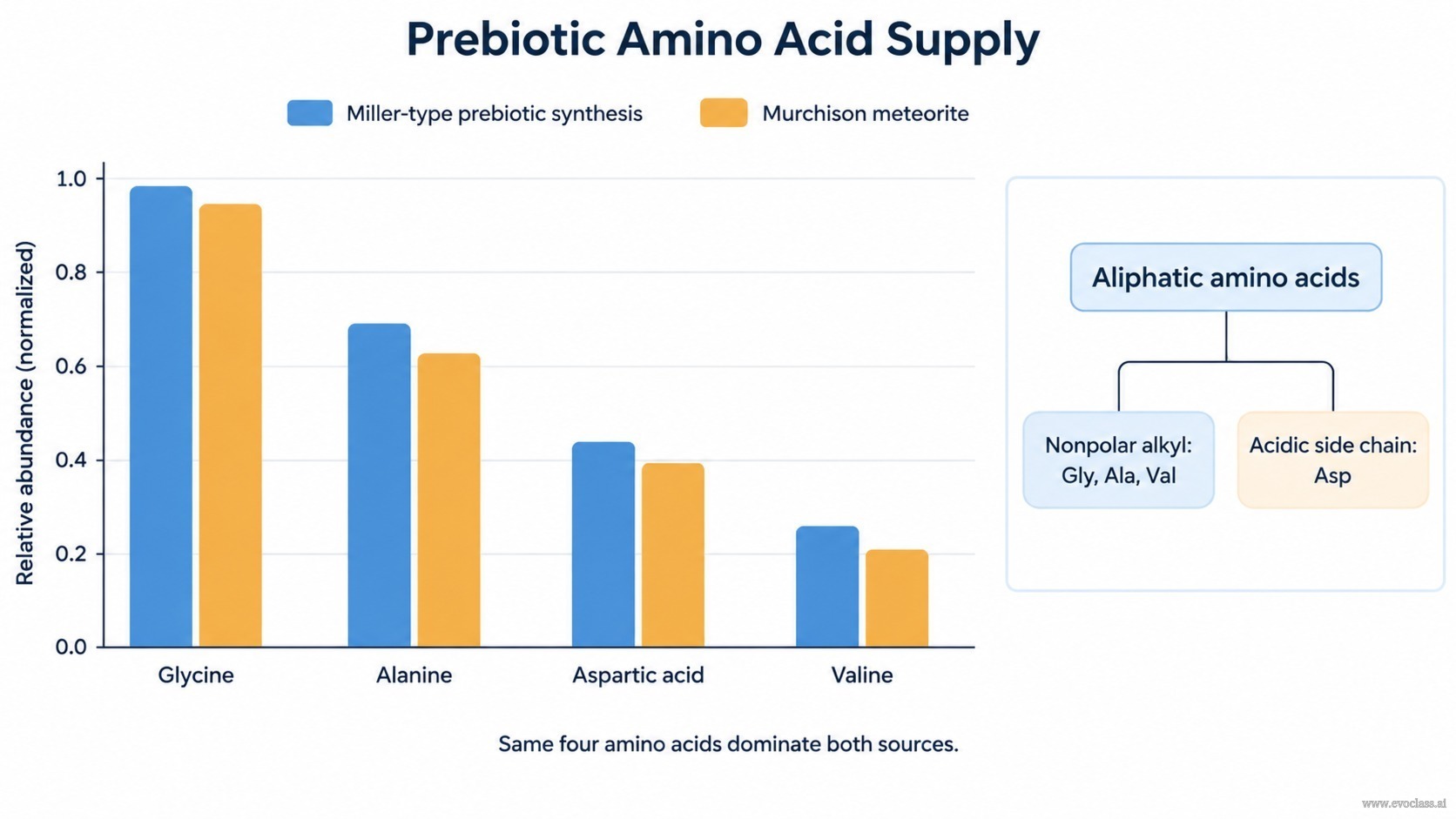
The primordial amino acid inventory was not a random subset of the amino acids that modern biology uses. Two independent lines of evidence converge on the same short list: glycine, alanine, aspartic acid and valine dominate both simulated prebiotic chemistry and the amino acid content of carbonaceous chondrites such as Murchison. Because these molecules are small, structurally simple and can be formed without enzymes, they are the most plausible substrates for the first translation apparatus.
The Aliphatic Family Tree
The aliphatic amino acid family tree organizes the amino acids relevant to early translation by side-chain chemistry and prebiotic availability, not by the order in which codons were later assigned. Glycine carries nothing larger than a hydrogen; alanine and valine carry short nonpolar alkyl chains; aspartic acid carries a short, acidic carboxyl-bearing chain. All four sit at the simple end of the structural spectrum, and none of them needs a dedicated biosynthetic pathway to appear in a prebiotic mixture.
Two Independent Lines of Evidence
- Miller-type prebiotic synthesis. Spark-discharge experiments on reduced gas mixtures yield glycine and alanine in the greatest amounts, with aspartic acid and valine following, a ranking that reflects how readily each molecule assembles from simple precursors.
- Murchison meteorite. Extracts from this carbonaceous chondrite contain the same dominant amino acids, which indicates that these molecules were also produced abiotically beyond Earth and that exogenous delivery could have supplemented the terrestrial inventory.
The convergence is what carries the argument: when a laboratory synthesis and a meteorite sample, two entirely different physical settings, select the same four amino acids, the pattern is far more likely to reflect abiotic chemistry than coincidence or contamination.
Why Abundance Matters: A Substrate-Limited Start
The first translation apparatus would have been substrate-limited. An amino acid produced or delivered in high amounts is encountered far more often, so it has a higher chance of being recruited by early adapter and messenger strands than a rare molecule that depends on a long, enzyme-catalysed pathway. Abundance is therefore a proxy for availability, and availability is a precondition for recruitment.
What the Evidence Constrains — and What It Does Not Determine
Environmental supply constrains the candidate pool, but it does not determine the order of codon assignments. The correspondence between the abundance order glycine > alanine > aspartic acid > valine and the first GC-frame codon assignments is suggestive, yet the mapping also reflects RNA–amino acid affinities, codon–anticodon chemistry, and later expansion or reassignment of the code. Abundance narrows who could enter early; it does not by itself fix the entry order.
Prebiotic Amino Acid SupplyPaired bars compare the relative yields of glycine, alanine, aspartic acid and valine from Miller-type prebiotic synthesis with their relative abundance in Murchison meteorite extracts, while the inset family tree groups the same molecules by side-chain chemistry. Both evidence lines select the same four small, aliphatic or simple amino acids, which makes them the strongest candidates for the substrate-limited first translation apparatus; the pattern constrains the early candidate pool without fixing the later order of codon assignment.