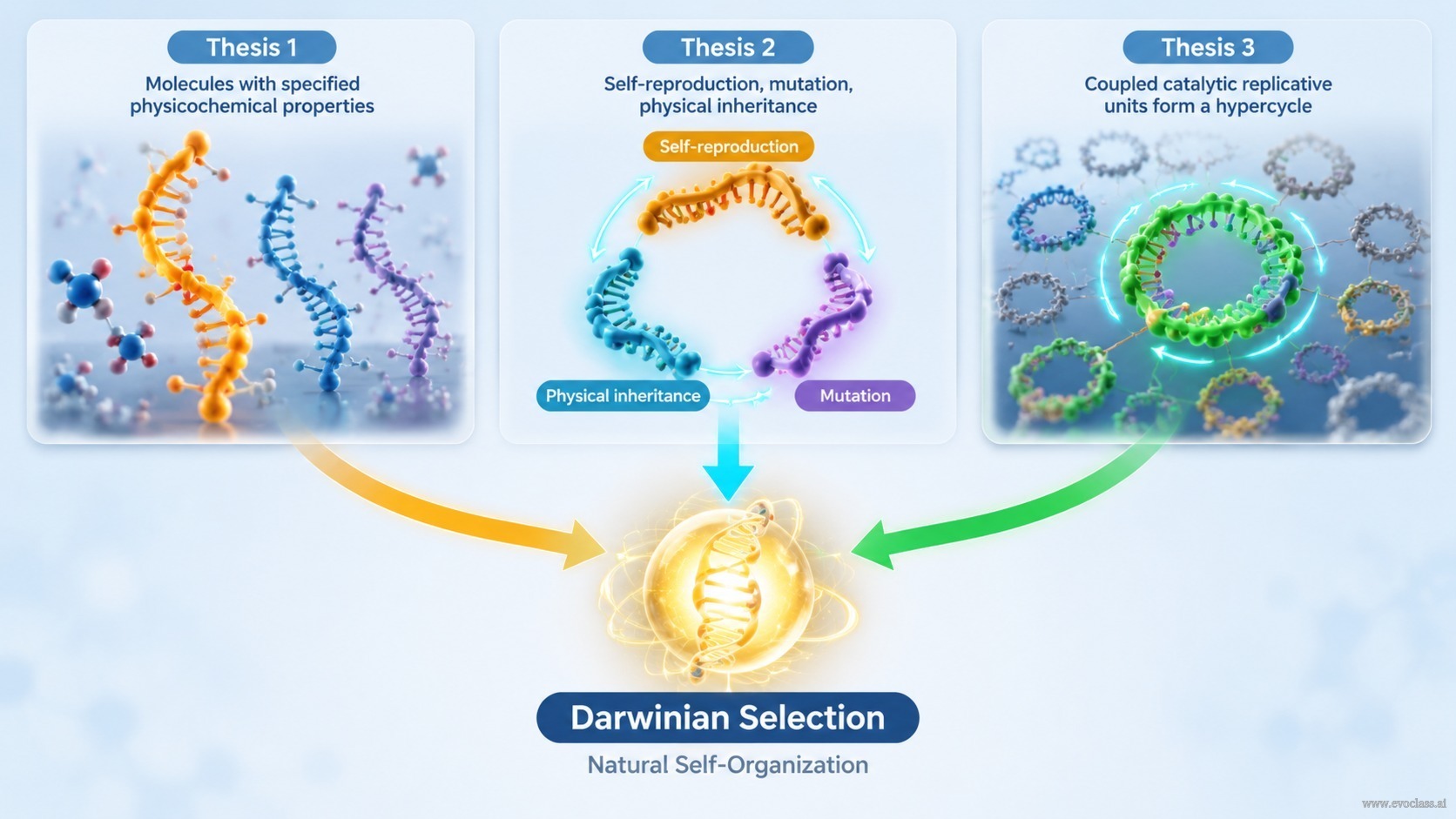
Hypercycle theory advances three central theses that together specify how molecular replication can be integrated with Darwinian selection. The theses move from the molecular preconditions of selection, to the requirements for Darwinian dynamics, to the higher-order organization that links self-replicating units.
Thesis 1 — A Specified Molecular Basis
Selection and evolution are not global attributes of any arbitrary form of matter. They are consequences of peculiar, specifiable physicochemical properties. Under this thesis, a system can be said to undergo selection only when its component molecules possess concrete kinetic, thermodynamic, and structural features that permit differential replication. Appeals to matter or self-organization in the abstract are insufficient; the mechanism must be identified.
Thesis 2 — Requirements for Darwinian Selection
Darwinian selection requires three molecularly instantiated capacities: self-reproduction, mutation, and a physical basis for inheritance. Self-reproduction supplies lineage continuity; mutation supplies variation; and a physical inheritance mechanism ensures that altered molecular structures are transmitted to descendants. Without all three, a process may change in time but does not constitute Darwinian selection.
Thesis 3 — Hypercyclic Organization
Hypercycle theory proposes a self-organizing, catalytic and functional integration of self-replicative units. This higher-order organization is what connects molecular replication to Darwinian selection and to natural self-organization. An isolated replicator is constrained by finite copying fidelity and an error threshold; hypercyclic organization offers a way for several replicative entities to be retained and coupled, so that the collective can maintain and evolve more information than a single unit.
Interdependence and Constraints
The three theses are interdependent. Thesis 2 specifies the molecular requirements for selection, while Thesis 3 addresses how these units can be organized beyond isolated replicators. Copying fidelity and error thresholds act as constraints that link the theses: they determine how much information a single replicative unit can maintain and therefore motivate integration. Each thesis must be given a concrete molecular or physicochemical mechanism; the mere invocation of self-organization or matter does not satisfy the theory.
Three Central Theses of Hypercycle Theory
The visual summarizes the three central theses: a specified molecular basis for selection, the molecular requirements of Darwinian selection (self-reproduction, mutation, physical inheritance), and hypercyclic organization of self-replicative units. Arrows show that all three converge on Darwinian selection and natural self-organization.