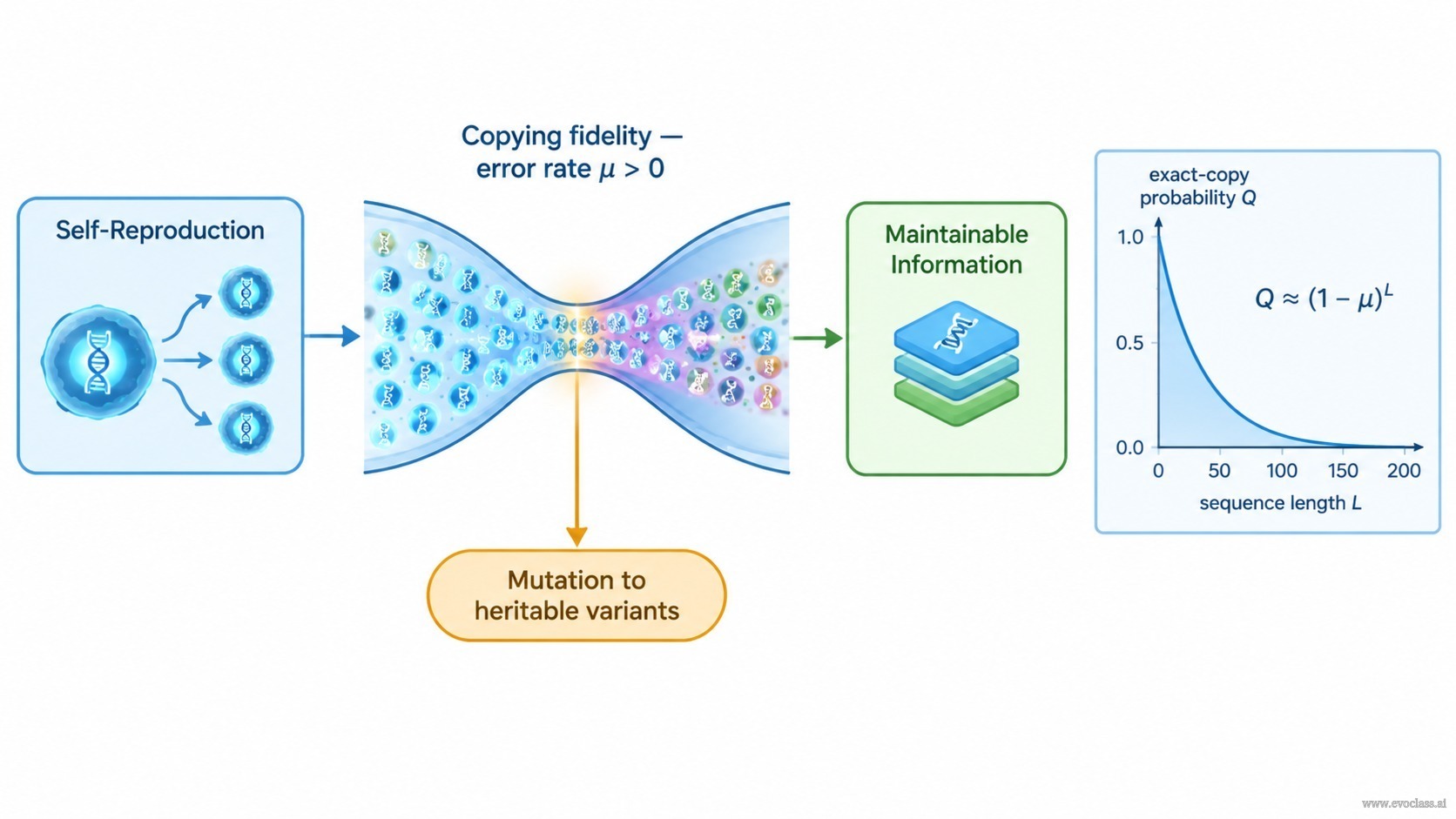
In hypercycle theory, self-reproduction means that a molecular unit directs the synthesis of new copies that carry its own sequence information. Because the chemistry of copying is not exact, mutation is not an external accident imposed on replication — it is built into the copying mechanism itself. The consequence is a hard ceiling on how much sequence information a single replicative unit can reliably maintain before error accumulation erodes inheritance.
Self-reproduction: a unit that copies its own sequence
A self-replicative template acts as an instruction for its own duplication: the unit's sequence is read and used to assemble a new molecule carrying the same information. This is what makes heredity possible at the molecular level, and it is the starting point of the hypercycle argument.
Mutation is intrinsic, not accidental
Every copying event carries a nonzero probability of inserting the wrong monomer. Those errors are not noise layered on top of an otherwise perfect process — they are heritable variants generated by the process itself. Mutation therefore supplies the raw material for selection automatically, whenever replication occurs.
Fidelity is finite — and length makes it harsher
With a per-base error rate μ, the probability that a single copying event is error-free is approximately
The single-unit constraint: an error threshold
The same arithmetic limits any one replicator. If the functional sequence is favoured by selection with advantage σ over its error copies, the longest information a single unit can maintain is of order
The central trade-off
Fidelity and variation pull in opposite directions. Raising fidelity preserves the functional sequence but starves the system of heritable variation; lowering fidelity supplies variation but pushes the replicator toward the error threshold and the loss of function. Nothing in the copying chemistry removes this tension — organization at a higher level must accommodate it.
Copying-Fidelity Bottleneck
Self-reproduction feeds a copying step whose finite fidelity compresses the information a single replicator can keep. As sequence length L grows, the fraction of error-free copies falls exponentially, and the errors produced by the copying step re-enter the system as heritable mutants; the narrowing channel marks the constraint that ultimately motivates integrating several replicative units.