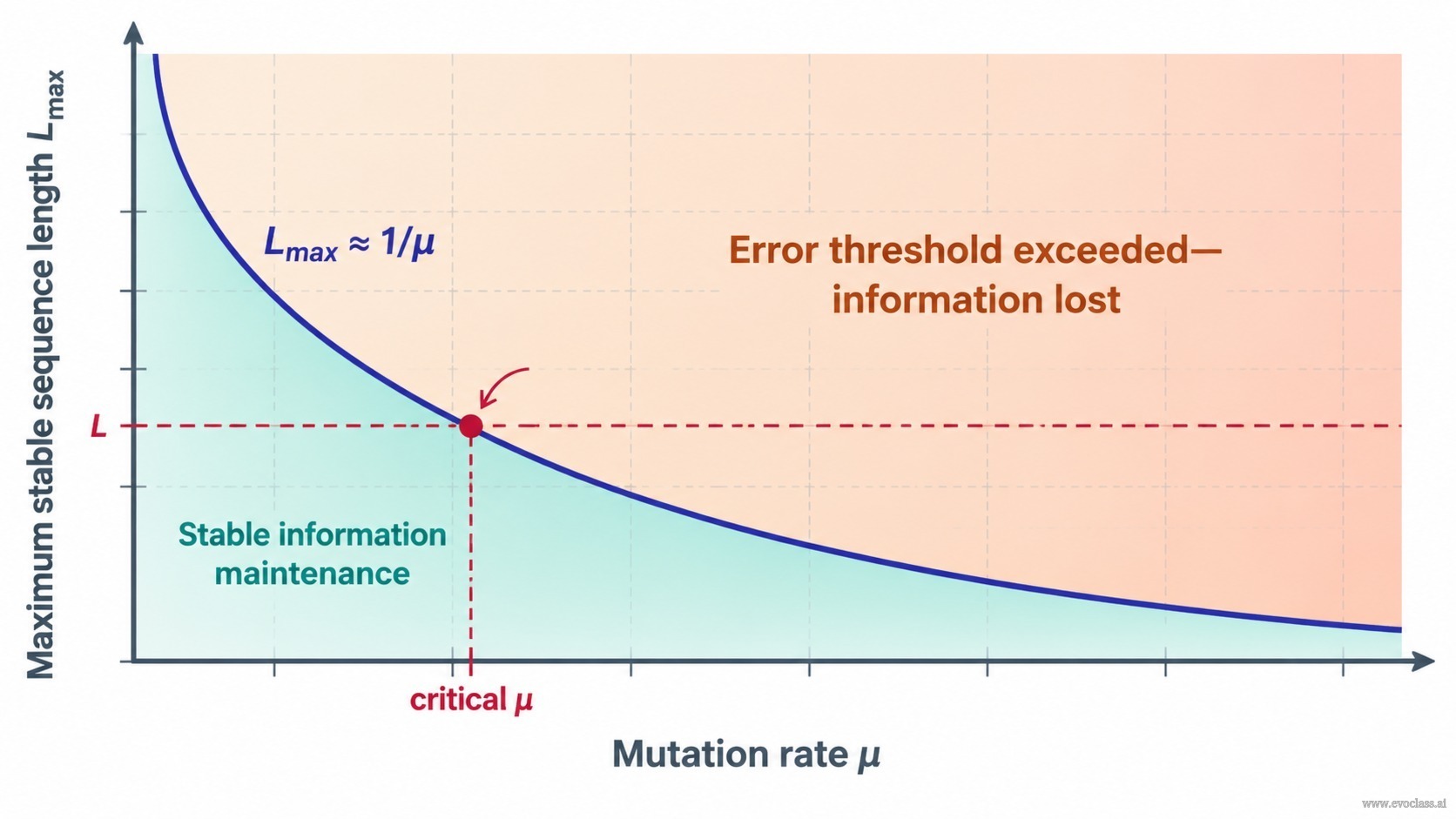
For a single self-replicating unit—such as an RNA molecule or a simple genome—finite copying fidelity imposes a fundamental limit on the amount of hereditary information that can be maintained. This limit is the error threshold: the maximum per-base mutation rate μ at which the functional sequence can be stably inherited. The threshold is determined jointly by replication fidelity and sequence length L. In the idealized single-unit picture, stability requires μ
Below the threshold, selection can maintain the functional sequence despite recurrent mutation, and the population is described by a quasispecies distribution centered on the master sequence. Above the threshold, mutations accumulate faster than selection can remove them, the original information is lost, and the population enters a mutation-dominated regime known as error catastrophe. This is a constraint on a single replicative unit, not a property of a hypercyclic network; it establishes the informational bottleneck that larger molecular organization must overcome.
Key Implications
- Joint dependence: The threshold depends on both replication fidelity and sequence length; longer sequences require lower per-base mutation rates.
- Informational limit: For a given fidelity, the maximum maintainable length is Lₘₐₓ ≈ 1/μ.
- Selection–mutation balance: Below threshold, selection maintains the functional sequence; above, error catastrophe ensues.
- Motivation for integration: Because a single unit cannot maintain enough information for complex functions, integrating multiple self-replicative entities (e.g., in a hypercycle) becomes necessary.
Error Threshold Boundary
Plot of maximum stable sequence length Lₘₐₓ versus per-base mutation rate μ. The hyperbolic boundary Lₘₐₓ ≈ 1/μ separates the region of stable information maintenance (below) from the error catastrophe regime (above). A horizontal line at a given L intersects the curve at the critical μ.