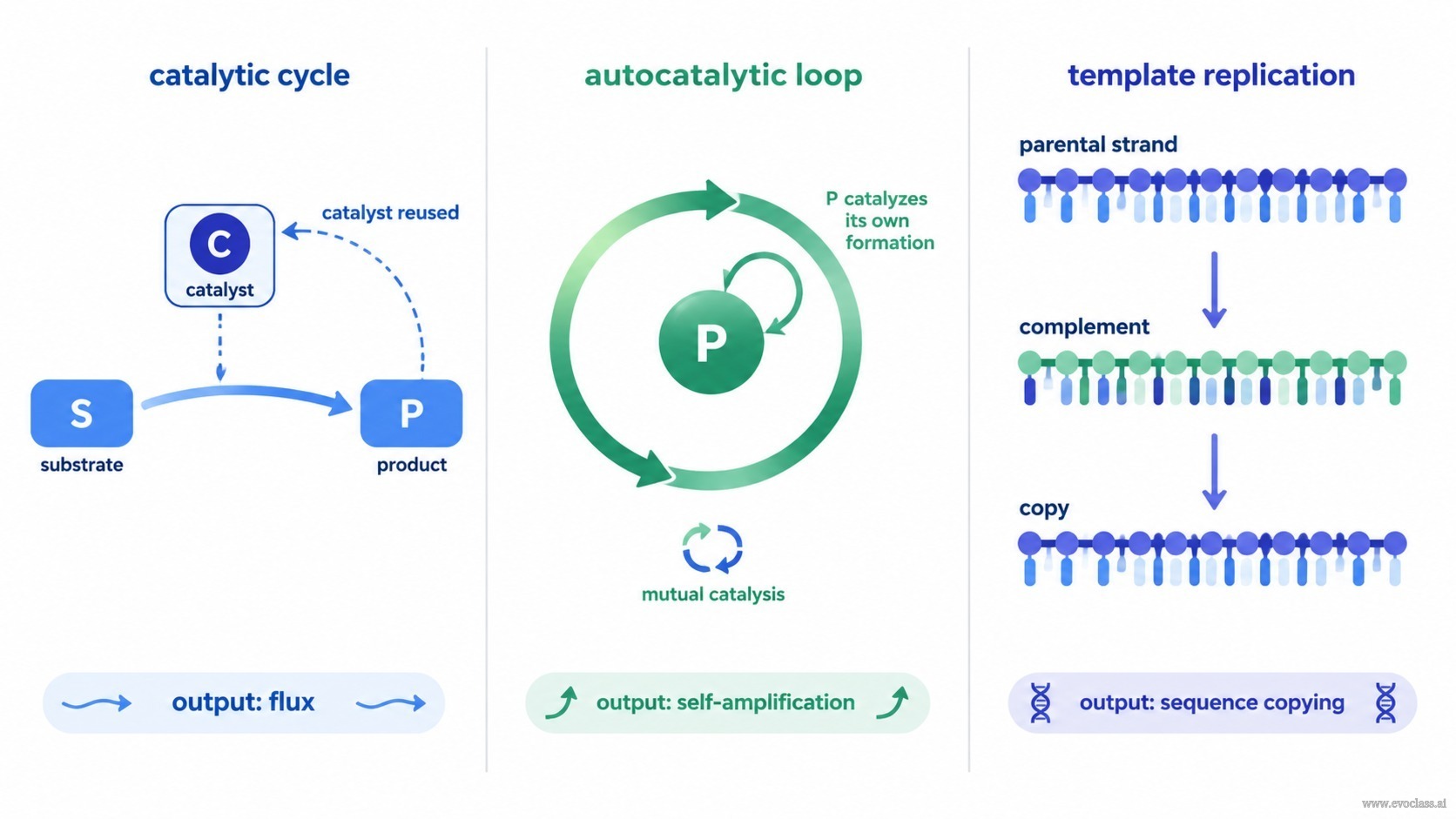
Hypercycle theory separates three molecular modes that are frequently conflated but do very different work: simple catalytic cycles, which generate flux; autocatalytic units, which generate self-amplification; and self-replicative templates, which generate heritable sequence copies. A hypercycle needs all three behaviours at once, and confusing them produces claims the chemistry cannot support — for example, treating a catalyst that merely accelerates a reaction as if it were already reproducing itself.
1. Simple catalytic cycles: coupled flux without self-amplification
A catalytic cycle uses one or more catalysts to convert substrates into products. What matters is what the cycle does not output: the catalyst itself. The catalyst is reused but is not reproduced as a required product of the cycle, so it must be supplied from outside or regenerated by some other process. Such cycles readily establish steady-state fluxes and coupled reaction networks, but they are not intrinsically self-amplifying: if the catalyst is diluted or degraded, its concentration falls unless the cycle is continuously fed. Enzyme turnover, and a ribozyme that promotes a substrate conversion without being regenerated by that reaction, are both examples of this mode.
2. Autocatalytic units: positive feedback on the unit itself
An autocatalytic unit produces a product that catalyzes its own formation, so the defining feature is positive feedback on the production of the unit itself. This yields self-amplification and can support exponential growth while precursors last. Autocatalysis may be direct, where a molecule catalyzes its own synthesis, or collective, where a set of molecules mutually catalyze one another. Crucially, autocatalysis alone does not guarantee faithful sequence copying: a unit can amplify without transmitting a defined sequence, so self-amplification is not the same as heredity.
3. Self-replicative templates: copying sequence information
A self-replicative template directs the synthesis of a complementary strand by using itself as a template. Because the immediate product is a complement rather than an identical copy, regenerating the original sequence normally requires a second round in which the complementary strand serves as the template. Template replication is therefore mechanistically distinct from catalytic cycling: template-directed polymerization copies sequence information, a catalytic cycle transforms substrates, and an autocatalytic loop amplifies products. Only the template mode carries information whose length is limited by copying fidelity and the error threshold.
Why the distinction matters for the hypercycle
These three modes are the building blocks of hypercyclic organisation. Catalytic cycles provide functional coupling between components; autocatalytic units provide growth; templates provide heritable information that must remain below the error threshold. A primitive translation apparatus cannot be assembled from a single short self-replicative unit alone — it requires the integration of coupling, growth and information, which is precisely why the hypercycle is proposed as a unit of natural self-organization.
Boundary caution
In real molecular systems these categories overlap: a template may also possess catalytic activity, and an autocatalytic set may include template-directed steps. The distinction is analytical — a way of assigning which contribution a given step makes — not a claim about mutually exclusive natural kinds.
Catalytic Cycles
Three panels compare the modes distinguished in hypercycle theory by their defining output. Left: a simple catalytic cycle converts substrate S into product P while the catalyst C is reused rather than reproduced, so the output is steady flux. Centre: an autocatalytic loop in which product P catalyzes its own formation, so the output is more of the unit itself (self-amplification), whether by direct self-catalysis or collective mutual catalysis. Right: a parental strand directs synthesis of a complementary strand, and the complement then directs synthesis of a copy of the original, so the output is copied sequence information.