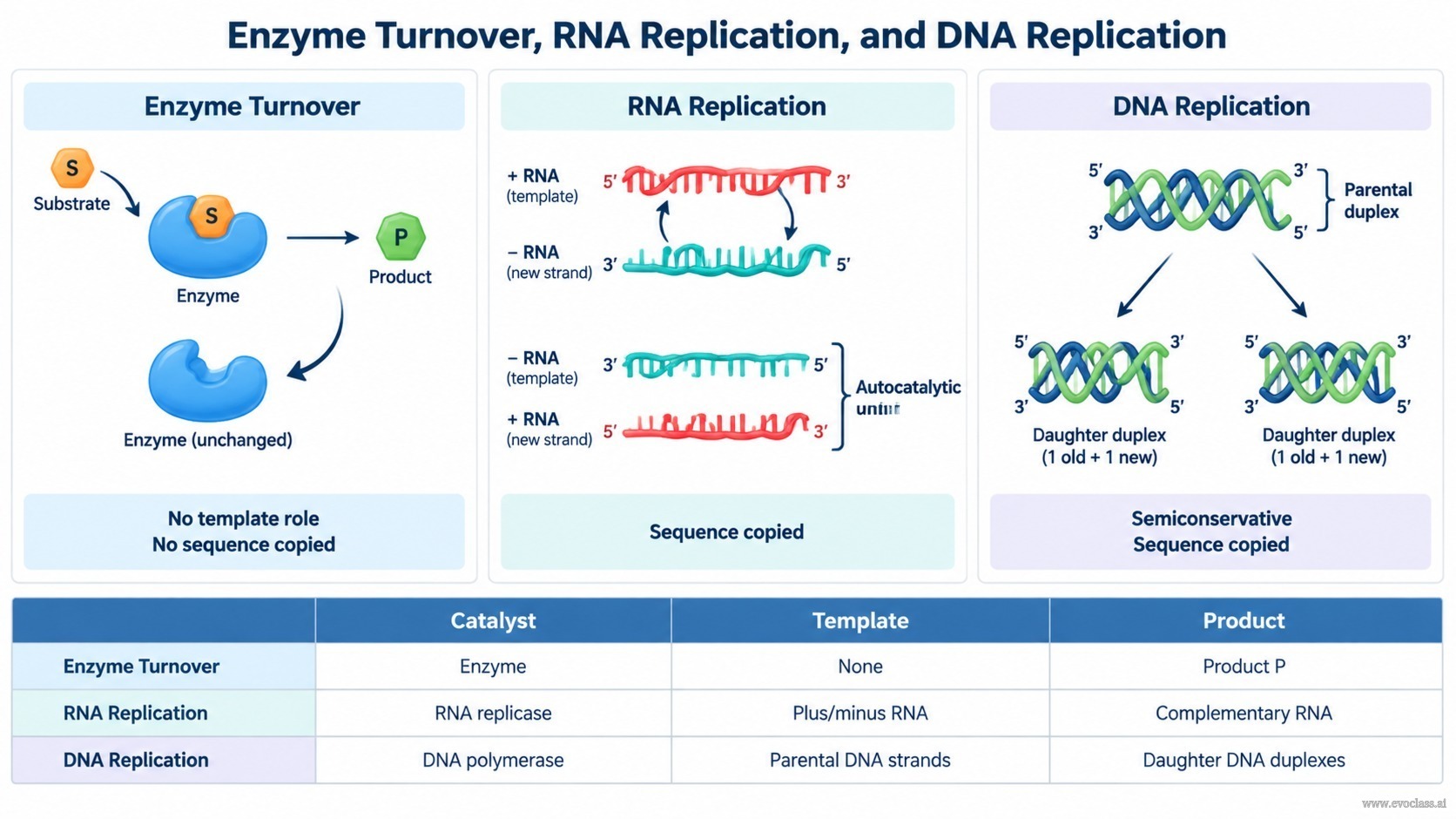
An enzyme turnover cycle, a template-directed RNA replication cycle, and semiconservative DNA replication are three molecular patterns that hypercycle theory must not conflate. The decisive contrast is whether a process merely converts substrate or also copies sequence information. Only template replication creates a heritable unit subject to mutation, selection, and error-threshold constraints that shape hypercyclic organization.
Three roles to keep separate: catalyst, template, product
Enzyme turnover. An enzyme accelerates the conversion of substrate into product, is released unchanged, and is neither consumed nor replicated. The enzyme has no template role. It amplifies product without copying the catalyst's own molecular information. In hypercycle terms, catalysis alone cannot serve as a Darwinian unit because it carries no heritable sequence.
RNA replication. RNA replication is template-directed synthesis: an RNA strand directs formation of a complementary RNA strand. In a plus/minus replication cycle, the complement can template regeneration of the original strand, so the complementary pair can act as an autocatalytic unit, even though an individual RNA strand is a template rather than a turnover catalyst. The copied sequence is the heritable information.
DNA replication. DNA replication is semiconservative template replication: the duplex separates, and each parental strand serves as a template for a new complementary strand. Each daughter duplex contains one old strand and one new strand. The duplication is semiconservative because neither daughter is made entirely of new material; each retains one parental strand.
Comparison table
| Process | Catalyst | Template | Product | Cycle mode | Sequence copied? |
|---|---|---|---|---|---|
| Enzyme turnover | Enzyme (released unchanged) | None | Converted substrate | Simple catalytic cycle | No |
| RNA replication | Replication apparatus; copied RNA strand is not a turnover catalyst | RNA strand (plus or minus) | Complementary RNA strand | Plus/minus template cycle; pair can be autocatalytic | Yes |
| DNA replication | Replication machinery | Each parental DNA strand | New complementary DNA strand | Semiconservative duplex replication | Yes |
Why this matters for hypercycles
Catalysis alone cannot be a Darwinian unit because it carries no heritable sequence. Autocatalytic and template-replicative systems provide the self-replication and mutability required by error-threshold and hypercycle arguments. A hypercycle integrates self-replicative entities; therefore the distinction between turnover and replication is foundational. The comparison separates three roles: catalyst, template, and product. Enzyme turnover amplifies product without copying the catalyst; RNA replication amplifies sequence through a complementary intermediate; DNA replication duplicates a duplex semiconservatively.
Enzyme Turnover
Enzyme turnover converts substrate to product without copying the catalyst; RNA replication copies sequence through a complementary plus/minus pair that can act autocatalytically; DNA replication is semiconservative, with each daughter duplex retaining one parental strand and one new strand.