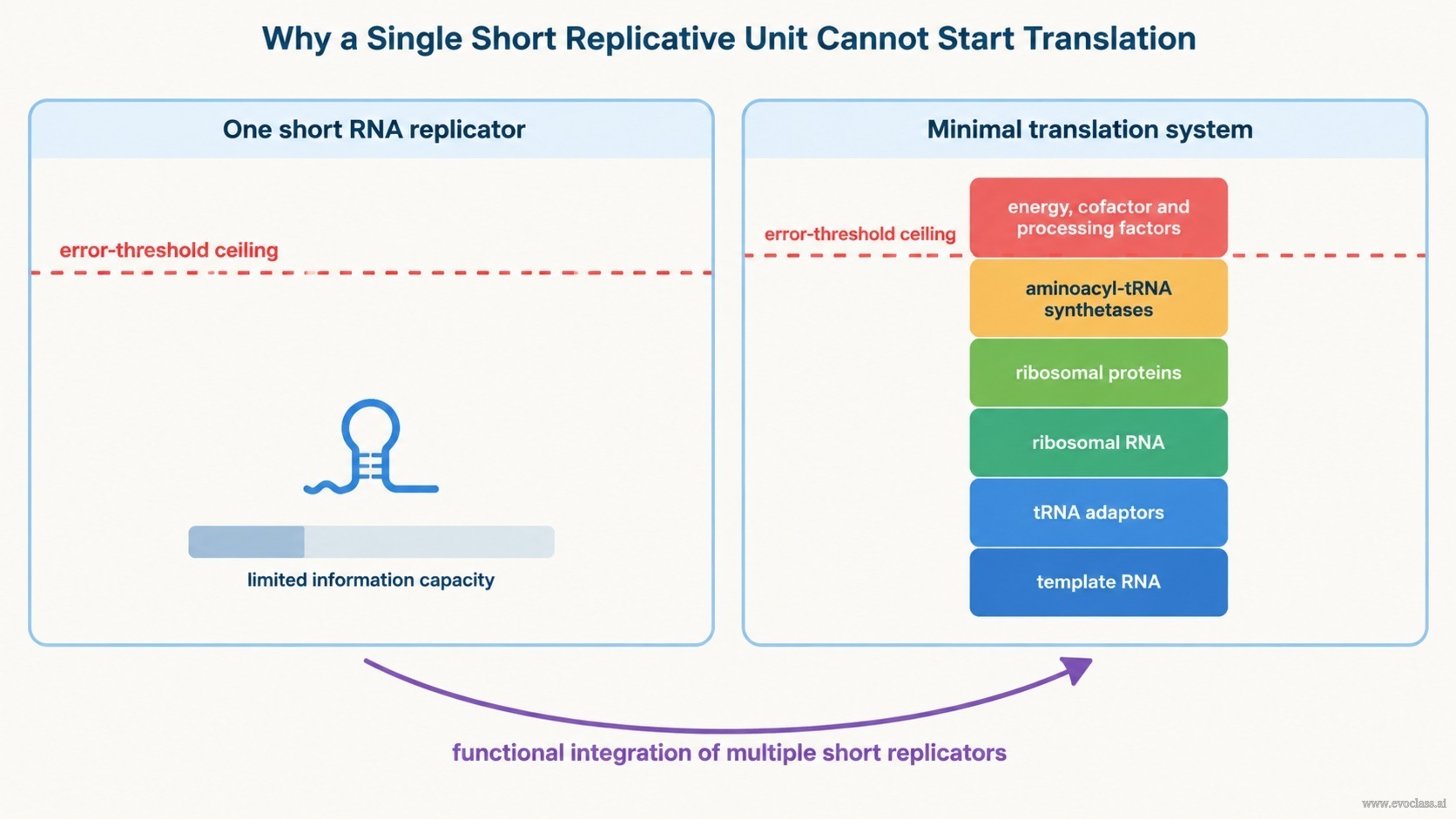
An origin of translation is not a single-molecule event. A primitive translation apparatus is a distributed, multi-component function: it requires template RNA, tRNA adaptors, ribosomal RNA, ribosomal proteins, aminoacyl-tRNA synthetases, and auxiliary energy, cofactor and processing factors. Each component must itself be encoded by heritable information, and together their information demand is far larger than any one short replicator can carry.
The Information-Capacity Ceiling
- Every component costs information: tRNAs, rRNAs, ribosomal proteins and synthetases are distinct molecules, so each one adds a sequence that replication must maintain.
- The error threshold: at a per-base mutation rate μ, a replicator of length L survives only while μ·L stays below a critical value. Longer sequences accumulate errors faster and suffer mutational decay.
- Capacity mismatch: the coding length needed for even a minimal translation system exceeds what one short replicator can hold below the error threshold. A single unit that tried to encode everything would be pushed past the ceiling and lose its own information.
Prerequisites Are Not Sufficient
Reproducible RNA molecules as large as tRNA and a supply of sufficiently common amino acids are necessary prerequisites, but they do not solve the coordination, assembly and coding problem: which adaptor carries which amino acid, how adaptors dock on a template, and how the catalytic core is assembled. A single short replicator cannot co-emerge with translation, because it cannot simultaneously hold its own replication information and the whole distributed apparatus.
Why a Single Short Replicative Unit Cannot Start Translation
Two-panel comparison. Left: one short RNA replicator sits below the error-threshold ceiling, so the information it can maintain is limited by mutation. Right: the stacked components of a minimal translation system — template RNA, tRNA adaptors, rRNA, ribosomal proteins, aminoacyl-tRNA synthetases, and auxiliary factors — push total information demand above that same ceiling. The bridge arrow shows that only functional integration of multiple short replicators lets the system carry more information than any single unit could.