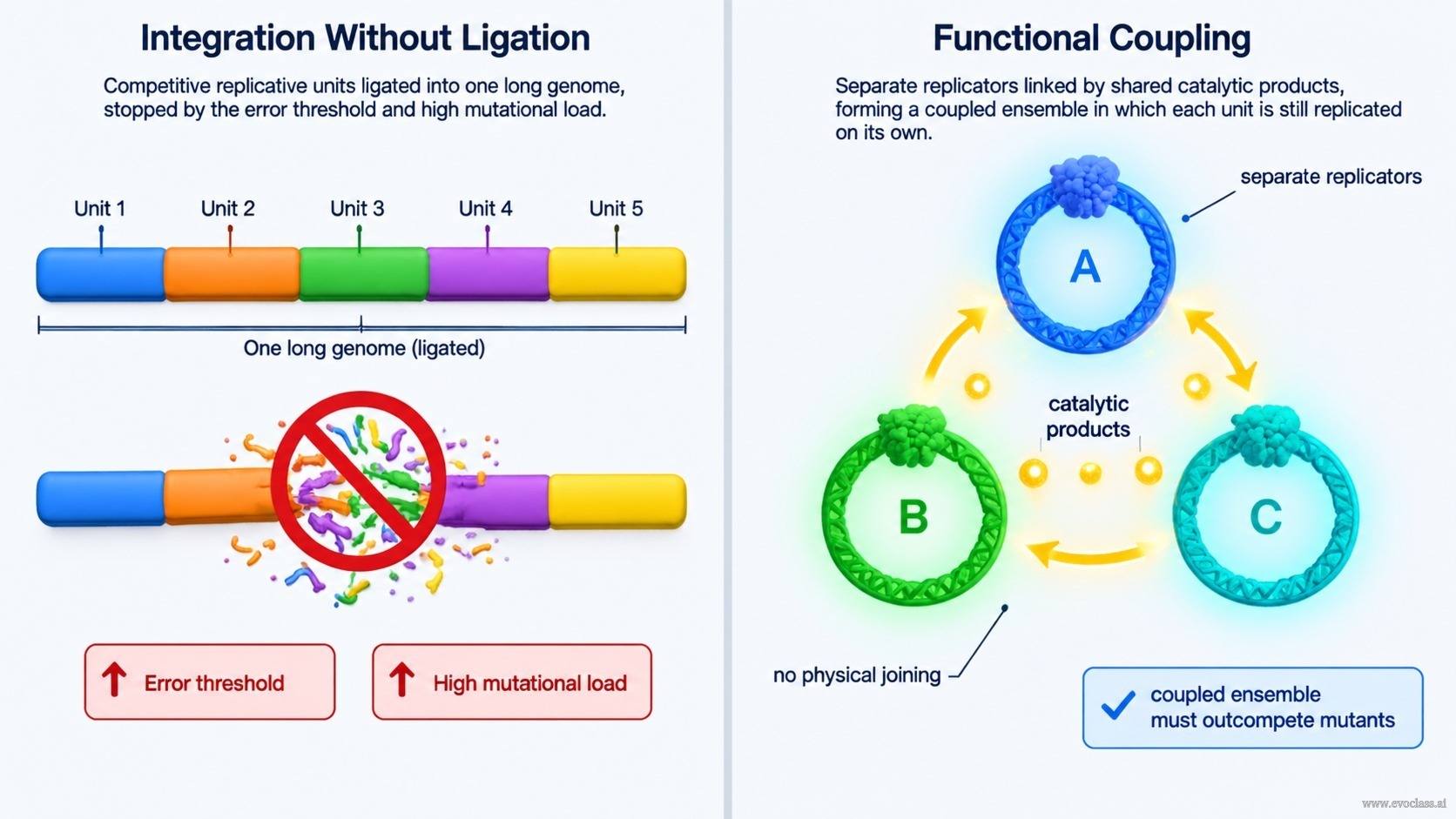
Every earlier constraint on copying fidelity now becomes a constraint on integration. Because a single self-replicative unit can stably maintain only a limited amount of information, joining competitive molecules into one long fused replicative unit is not an available route. Ligation increases the sequence length, the mutational load rises with that length, and the resulting unit is pushed past the error threshold; the threshold relation for vₘₐₓ makes such a long unit unsustainable. Integration, if it is to occur at all, must therefore be achieved without covalent fusion.
Why Ligation Fails
Ligating several replicators into one molecule produces a longer sequence that must be copied accurately at every position. The longer the sequence, the larger the mutational load carried per replication, and once the length exceeds what the copying fidelity can support, the unit falls outside the region of stable information maintenance. This is the same barrier that limits any single self-replicative unit, now applied to a fused genome: the threshold relation for vₘₐₓ rules out the very long unit that ligation would create.
Functional Coupling: Integration Without Fusion
The alternative is to leave the units separate and join them functionally rather than covalently. Each replicative unit remains individually replicable, but the catalytic products they produce act on one another, so that the replication of each is enhanced by the presence of the others. Integration therefore takes the form of a catalytic network or cycle, not a single fused genome:
- No ligation required — the sequences stay short, so they remain within the range of stable information maintenance.
- Shared catalytic products — the products of one unit serve as catalysts for the replication of another, creating mutual dependence.
- Non-covalent integration — the link is catalytic and dynamic, not a new chemical bond between the sequences.
A Catalytic Cycle as the Simplest Example
Consider two replicators, A and B. The catalytic product of A enhances the replication of B, and the catalytic product of B enhances the replication of A. A and B are never ligated into one genome, yet their shared catalytic products couple them into an integrated functional unit. Because each unit is still copied on its own, the cycle does not inherit the length penalty that a fused A–B genome would carry.
The Coupled Ensemble as the Unit of Selection
Once units are coupled in this way, selection no longer tests a single long sequence. It tests the whole coupled ensemble. This creates an additional requirement: the integrated system must remain competitive with respect to its own mutants. If mutant sub-units arise that abandon the cooperation and replicate faster on their own, they will spread and the coupled arrangement will lose its specific information. Functional integration therefore persists only when the ensemble as a whole outcompetes its mutants — and that competitiveness is exactly what allows the coupled system to evolve further.
Integration Without Ligation
Left: competitive replicative units ligated into one long genome, which is stopped by the error threshold and the threshold relation for vₘₐₓ because its mutational load is too high. Right: the same units kept separate but linked by shared catalytic products, forming a coupled ensemble in which each unit is still replicated on its own. The comparison shows that integration can be catalytic rather than covalent.