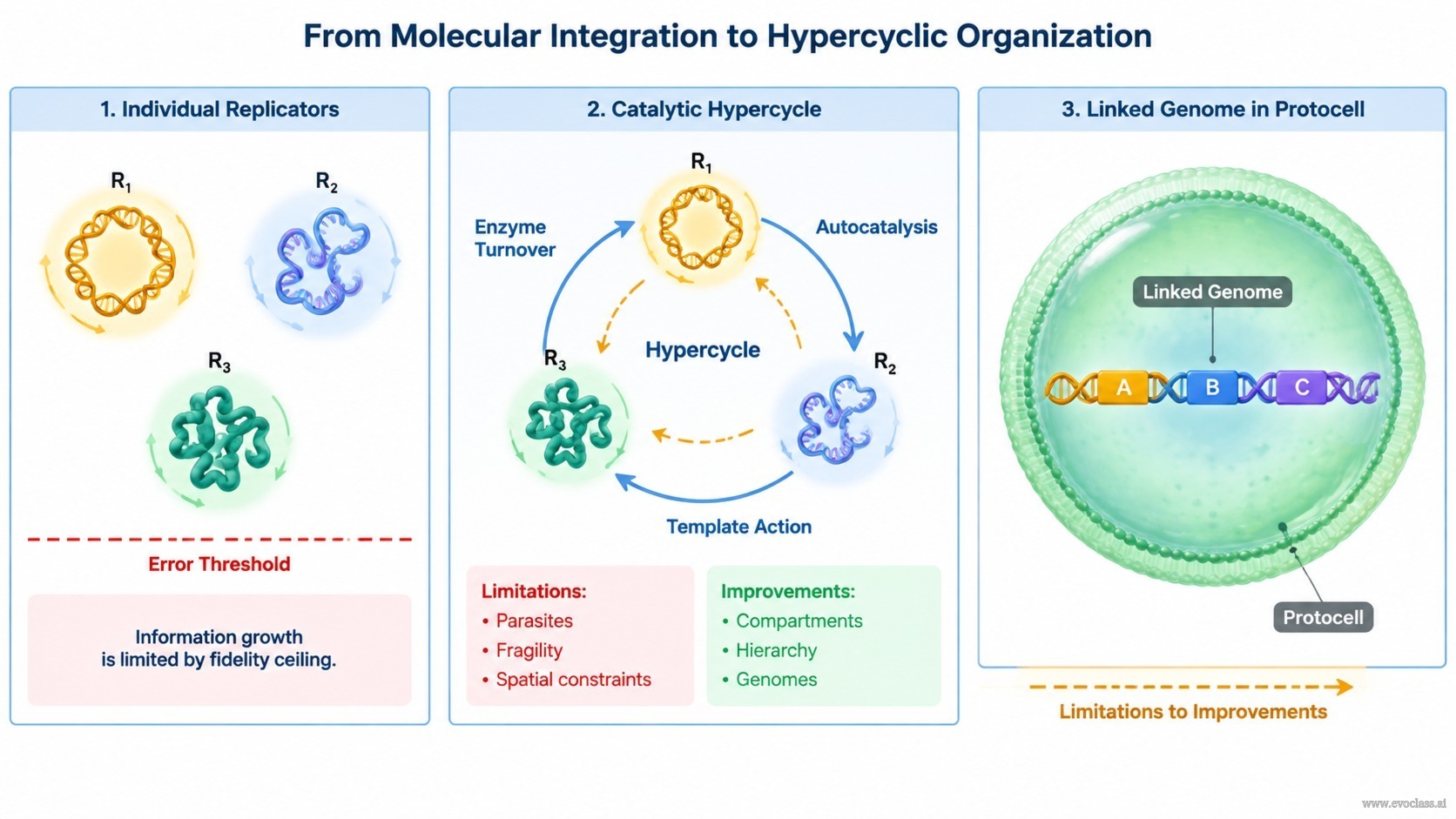
The slide captures a decisive transition in early molecular evolution: when one self-replicative unit can no longer carry enough information, selection can favor integration of several self-replicative entities. The reason is the error threshold. A replicator's copying fidelity sets an upper limit on the length of a sequence that can be maintained against mutational decay. Beyond that limit, producing more information in a single unit becomes self-defeating, because most copies are erroneous and the master sequence is lost.
Hypercyclic organization solves this constraint by coupling multiple self-replicative units into a closed, cooperative catalytic network. In this network, each unit supports the replication of others through catalytic cycles, autocatalysis, template action, and enzyme turnover. The collective, rather than any single molecule, becomes the unit of selection. Functional integration therefore does not require the genes to be physically ligated at first; it requires only that their catalytic products feed back into the replication of network members.
Why Functional Coupling Comes First
Before genomes exist as linked structures, selection can act on a set of replicators that cooperate catalytically. A hypercycle converts independent competitors into a cooperative network that can maintain more collective information than any member alone. This may also provide a route toward early translation-related functions, because several RNA-like units can contribute different catalytic or coding roles without any one unit exceeding its fidelity limit.
From Functional to Structural Integration
As genomes evolve, functional coupling can be replaced by complete structural integration of genes. Even the most primitive known cells have genomes that are structural units. Structural linkage makes the cooperative set a single heritable entity, reduces dependence on diffusible catalytic coupling, and can protect cooperating genes from being lost or exploited separately.
The Mutant-Spectrum Rationale
A central question is why use hypercyclic organization of many single mutant genes rather than one steadily growing genome. For a set of 100 genes, the number of k-error mutants is
Limitations and Improvements
Hypercyclic organization is not a final solution. It can be indirect, dynamically fragile, vulnerable to parasitic or selfish replicators, and dependent on spatial or compartmental constraints. Improvements include compartmentalization, hierarchical hypercycles, and eventual structural genome formation. These changes stabilize cooperation and reduce reliance on diffusible catalytic coupling.
Takeaway: The hypercycle is an intermediate principle of natural self-organization: it links self-replicative units through catalytic cooperation so that a collective can maintain information beyond the limit of any single replicator, and it prepares the way for structurally integrated genomes.
From Molecular Integration to Hypercyclic Organization
Stage 1 shows individual self-replicative units constrained by a fidelity ceiling; Stage 2 shows catalytic cycles, autocatalysis, template action, and enzyme turnover forming a closed hypercyclic network; Stage 3 shows functional coupling replaced by a structurally linked genome in a protocell, with a dashed amber arrow marking limitations and stabilizing improvements.