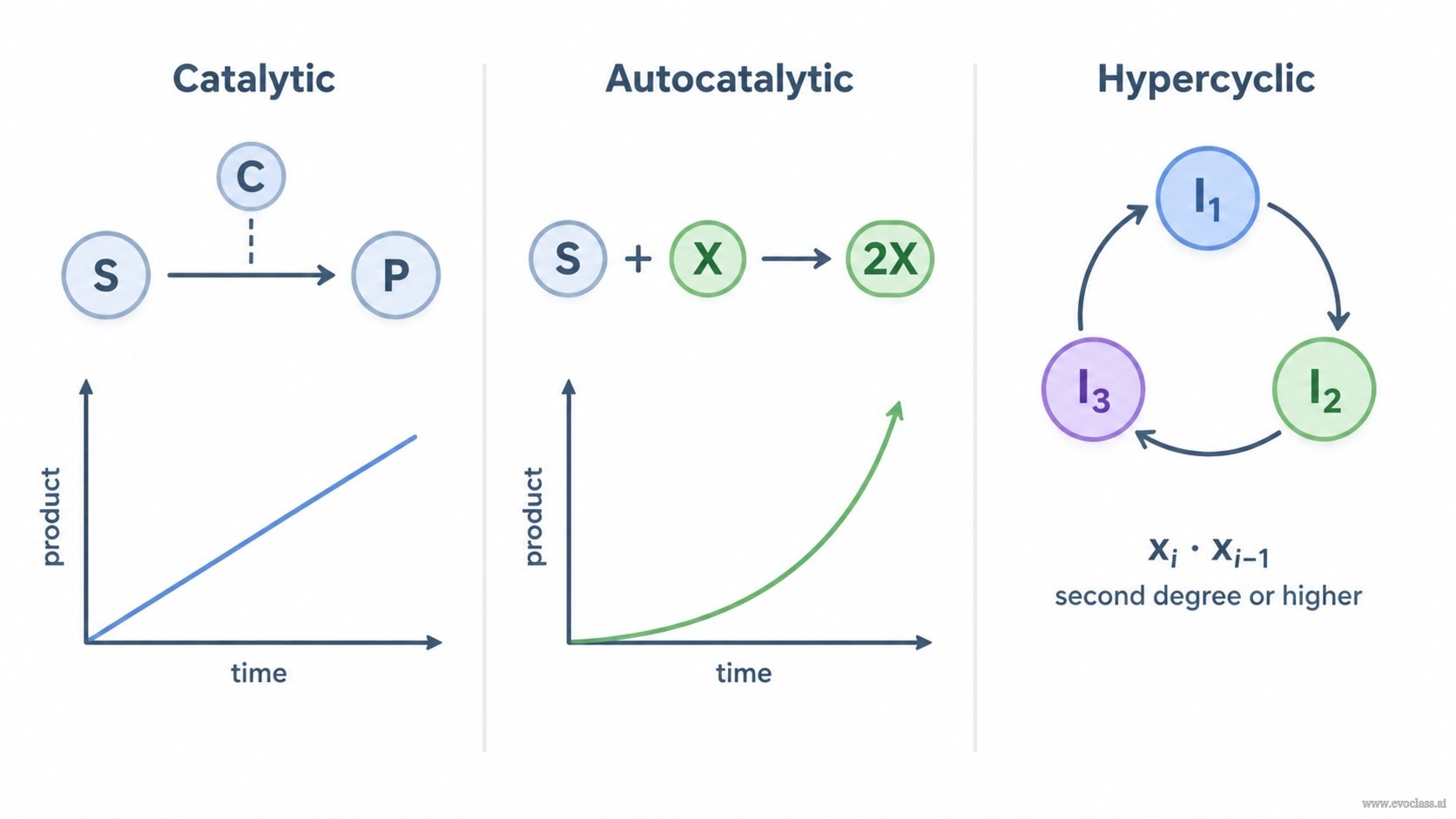
Growth modes in replicating molecular systems are separated by two things at once: their kinetic order and the network topology that links the reacting species. With the same substrate supply and the same rate constants, three regimes appear - plain catalysis (linear), autocatalysis (exponential) and hypercyclic growth (second- or higher-degree, cooperative).
1 · Plain catalytic growth: the product does not help itself
A catalyst C mediates S → P. When [C] is held constant - a buffered enzyme, a steady supply, or a mineral surface - the rate d[P]/dt ≈ k[C][S] stays constant as long as S is not depleted, so the product accumulates linearly with time. Nothing in the scheme makes P catalyse its own formation: the growth term contains no factor of [P], and the reaction is not coupled to any wider network.
2 · Autocatalytic growth: first-order self-amplification
In S + X → 2X the template X is regenerated as product, so X catalyses its own formation. With substrate buffered, d[X]/dt = k[S][X] and the solution is exponential,
3 · Hypercyclic growth: a closed catalytic loop
Hypercyclic growth appears when self-replicative units I1, I2, ...,
Two criteria that identify a hypercycle
- Network criterion. A hypercycle is not a mixture of independent autocatalysts. Its catalytic links must close into a cycle, so growth and selection act on the coupled loop as a single unit.
- Degree criterion. Catalytic hypercycles are systems of second or higher degree, because their reproduction terms contain products of at least two concentration variables, such as xixi-1. Higher-order terms can arise from complex formation, translation-coupled replication, or saturating kinetics.
Consequence for selection
Hypercyclic growth is cooperative and nonlinear. It cannot be reduced to independent exponential competitors, because the fate of each member is tied to its cyclic predecessor: removing, slowing, or exploiting one unit changes the growth of the whole loop. That is precisely why the hypercycle foreshadows the later questions of integration, stability and parasitic challenge.
Catalytic
The three regimes of molecular growth compared on one canvas. Plain catalysis with a constant catalyst C gives a straight product-versus-time line, autocatalysis (S + X → 2X) gives an exponential curve, and a hypercycle closes its catalytic links into a loop so that each unit is catalysed by its cyclic predecessor, producing second-degree growth terms of the form xᵢ·xᵢ₋ 1.