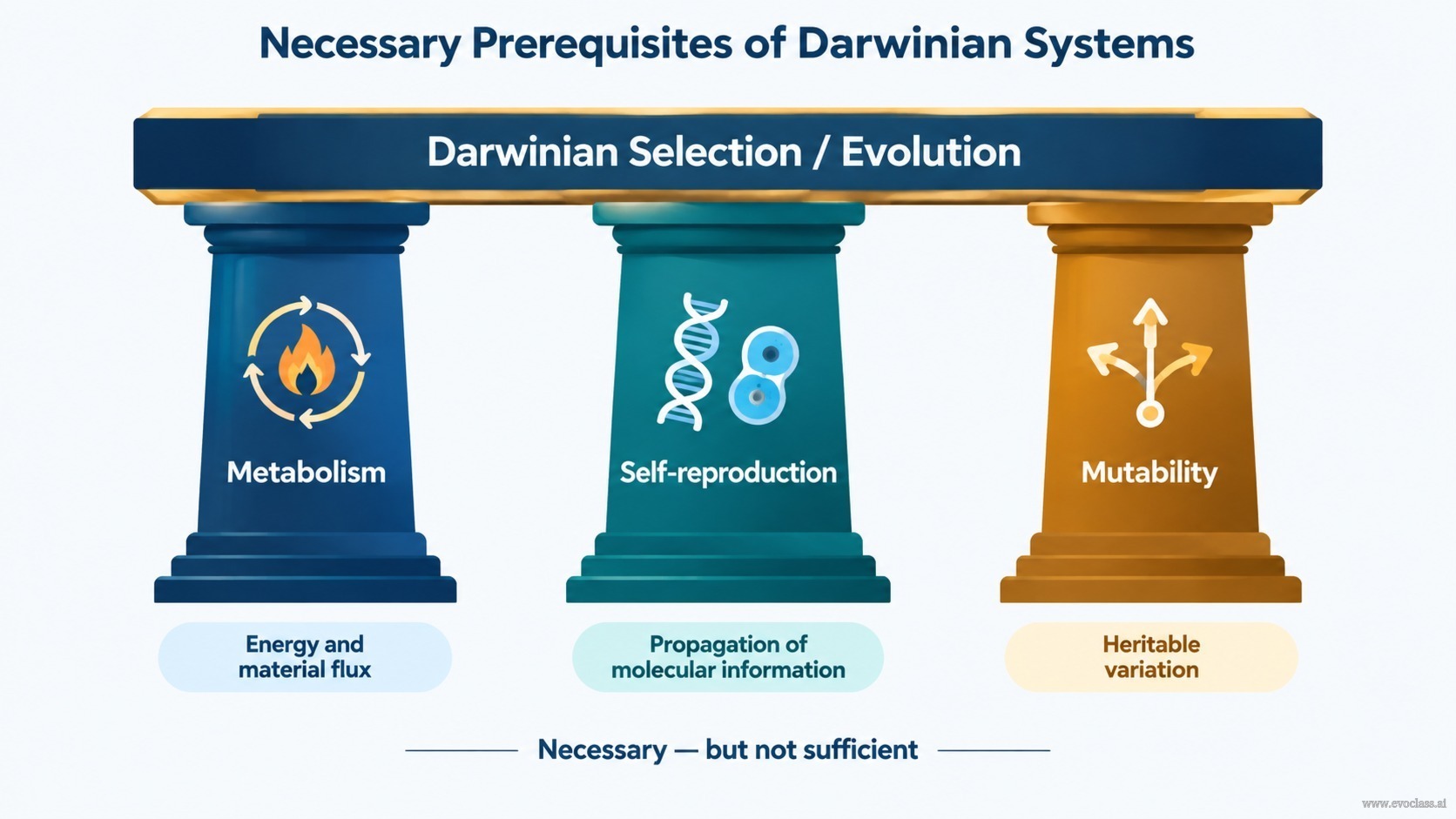
Is Darwinian selection a global attribute of matter? It is not. Selection and evolution arise only in systems that possess a specific set of molecular properties, and this slide specifies the three that are necessary: metabolism, self-reproduction, and mutability. The framing question for the unit is exacting: “What is the molecular basis of selection and evolution? Obviously, such a behavior is not a global attribute of any arbitrary form of matter but rather is the consequence of peculiar properties which have to be specified.”
Core Concepts
- Metabolism: supplies the energy and material flux required for replication and keeps the system far from thermodynamic equilibrium. A replicator that only dissipates energy into equilibrium cannot sustain a lineage.
- Self-reproduction: enables the propagation of molecular information and secures lineage continuity, so that a molecular organisation can outlast the individual molecule that embodies it.
- Mutability: generates heritable variation. Without variants that differ in replication rate or fidelity, selection has no substrate on which to act.
Why These Properties, and Not Others
The three prerequisites are not a convenient checklist; each covers a logically distinct requirement. Metabolism answers the question of where the free energy and building blocks come from. Self-reproduction answers the question of how information persists across generations. Mutability answers the question of where the differences that selection sorts come from. A population that lacks any one of these cannot exhibit differential reproduction: no drive, no memory, or no variety.
Necessary, Not Sufficient
It is important to read the claim precisely. The prerequisites are necessary: remove one and Darwinian behaviour disappears. They are not sufficient: a system that satisfies all three may still fail to produce a stable, integrated evolving entity. Higher-order organisation — for example the cyclic catalytic couplings studied later in this lesson — is what addresses integration, coexistence, and long-term stability. This is why the three prerequisites are a starting condition, not a finished theory of evolution.
Necessary Prerequisites of Darwinian Systems
Metabolism, self-reproduction, and mutability stand as the three pillars that support Darwinian selection and evolution. Metabolism supplies the energy and material flux that keep the system away from equilibrium, self-reproduction propagates molecular information, and mutability generates heritable variation; together they establish the minimal physicochemical conditions for differential reproduction. The footnote reminds the reader that these conditions are necessary but not sufficient.