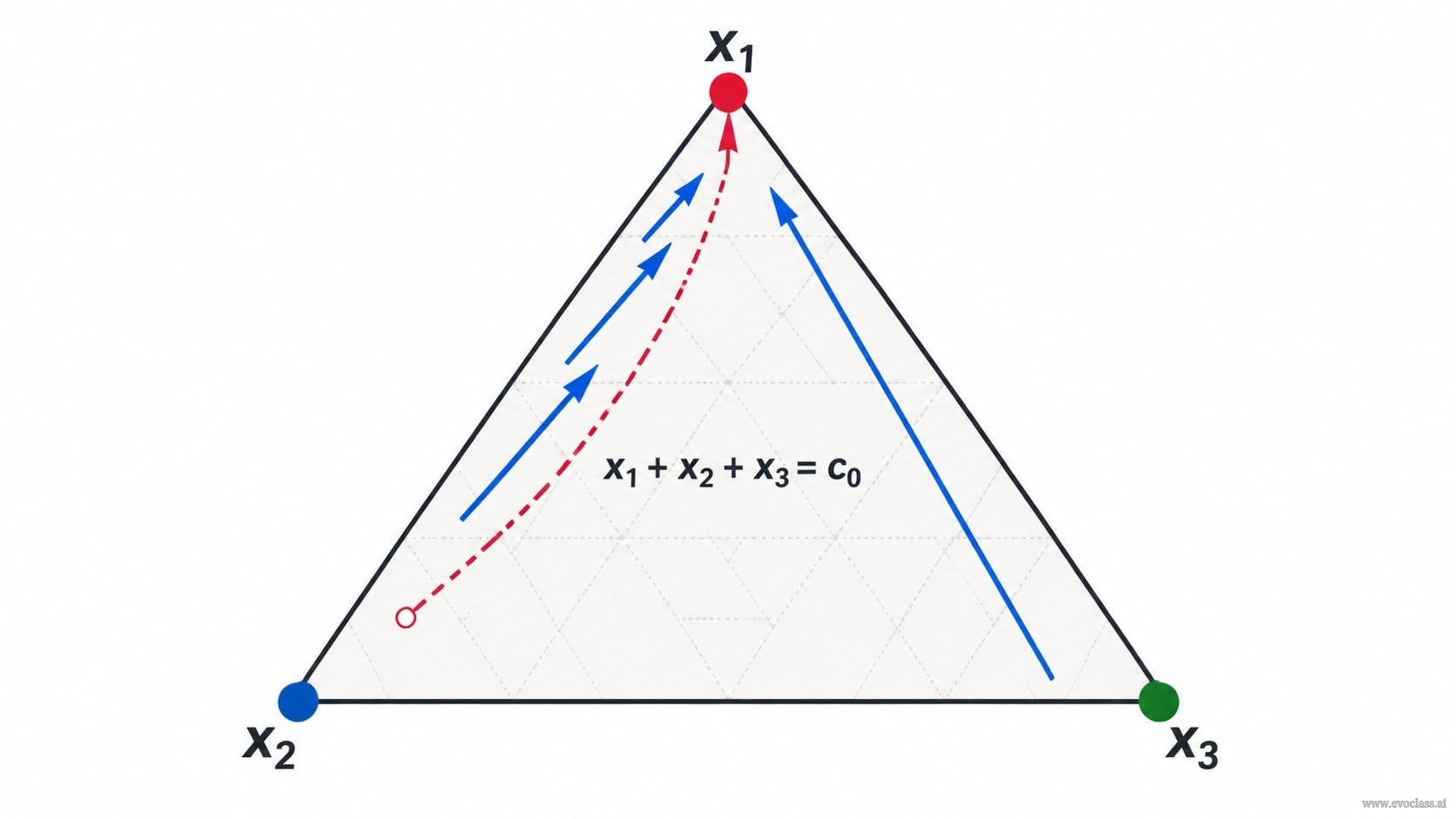
Under constant organization, the total concentration of molecular species is held fixed: ∑i. This constraint removes one degree of freedom, so the state space is the concentration simplex. Selection equations then describe how the normalized composition / ∑k evolves, not how total population size grows.
In normalized flux form, the selection equation is:
· ( / ∑k)
Here, is the total flux (or productivity) under the constraint. Selection acts as redistribution within the fixed total: species with higher selective value or excess productivity increase their share, while lower-value species are diluted without changing c0.
Because ∑i, only n − 1 relative concentrations are independent. In the deterministic mutation-free limit, simplex boundaries are invariant: if initially, it remains zero. Thus fixed points often lie at vertices or lower-dimensional faces.
An affine transformation of the x-coordinate system can separate total scale from relative frequencies, yielding transformed variables and simplified equations for compositional dynamics. The derivation proceeds as follows:
“How to carry out this new subdivision is suggested by the structure of the differential equations (6). It corresponds actually to an affine transformation of the x-coordinate system, well known from the theory of linear differential equations. One obtains a new set of equations for the transformed population variables yi which reads:”
For example, with two species and , we have . On the line segment , if species 1 has a larger selective value than species 2, the flow moves toward , . The total concentration remains 1, illustrating selection as composition change under constant organization.
Concentration Simplex Diagram
The simplex of possible compositions under constant organization. Vertices represent pure species (x 1, x 2, x 3). The interior represents mixtures. Arrows show selection flow toward the vertex with the highest selective value, while the total concentration remains fixed at c 0.
QUESTION 1
What does the constraint ∑i represent in the selection equations under constant organization?
A system containing only a single species.
A fixed total concentration of all species.
A rule that every species must grow equally fast.
A total population that grows without bound.
✅ Correct!
Yes. Constant organization holds the total concentration fixed, so the system evolves on a simplex of constant total.
❌ Incorrect
Constant organization fixes the sum of concentrations; it does not imply unlimited growth, a single species, or equal growth rates.
QUESTION 2
In the normalized flux form · ( / ∑k), what does / ∑k represent?
The intrinsic growth rate of species i.
The relative share of species i.
The total flux of the whole system.
The absolute concentration of species i.
✅ Correct!
Correct. This ratio is the relative abundance, or selective share, of species i.
❌ Incorrect
It is a normalized quantity, not an absolute concentration or a rate; it measures the fraction of the total held by species i.
QUESTION 3
Why does an affine transformation of the x-coordinate system simplify the selection equations?
It adds more independent variables.
It sets every selective value equal.
It removes the constraint on total concentration.
It separates total scale from relative frequencies.
✅ Correct!
Right. The affine transformation decouples the overall scale from the compositional dynamics, yielding simpler equations for the transformed variables .
❌ Incorrect
The transformation does not remove the constraint or equalize selective values; it changes coordinates to separate scale from composition.
QUESTION 4
Under constant organization, if species 1 has a larger selective value than species 2 in a two-species system with , what happens to the composition over time?
rises toward 1 and falls toward 0.
and both rise together.
falls toward 0 and rises toward 1.
The composition stays fixed at all times.
✅ Correct!
Correct. Selection favors the species with higher selective value, so its share grows while the other is diluted, keeping the total at 1.
❌ Incorrect
The total is fixed, so one species cannot increase without the other decreasing. The fitter species gains share over time.
QUESTION 5
In the deterministic mutation-free limit, what is true about the simplex boundaries?
The total concentration drifts over time.
An absent species can appear later.
All species eventually vanish together.
If initially, it stays zero.
✅ Correct!
Yes. Without mutation, a species that is absent cannot appear, so the faces of the simplex are invariant.
❌ Incorrect
Mutation would be needed for a zero concentration to become positive; in the mutation-free limit the boundaries are invariant.
Case Study: Three-Species Competition under Constant Organization
Read the scenario below and answer the questions.
A prebiotic reaction network contains three molecular species with concentrations , , and . The system is held under constant organization with , so . The selection dynamics follow the normalized flux form Φᵢ = · (xᵢ / ). Species 1 has the highest selective value, species 2 an intermediate value, and species 3 the lowest. Assume no mutations and deterministic dynamics.
Q
1. Describe qualitatively the trajectory of the composition on the concentration simplex from an initial interior point.
Answer: The composition will move toward the vertex corresponding to species 1, because it has the highest selective value. Over time, increases toward 1, while and decrease toward 0. The total concentration remains fixed at . If there are no internal fixed points, the trajectory ends at the vertex (1,0,0).
Q
2. Explain how an affine transformation of the x-coordinate system could be used to analyze this system.
Answer: The affine transformation separates the total scale from the relative frequencies. It defines new variables yᵢ that remove the constraint's effect on the equations, yielding a simplified system that describes compositional dynamics directly. This transformation is well known from linear differential equations and helps to reveal the invariant simplex structure and the flow toward stable vertices or faces.
How to carry out this new subdivision is suggested by the structure of the differential equations (6). It corresponds actually to an affine transformation of the x-coordinate system, well known from the theory of linear differential equations. One obtains a new set of equations for the transformed population variables which reads: